Appointed Head of Legislative Research Office in April, Focused on Legislative Impact Analysis
No Tae-woo and Kim Dae-jung's 'Integrated Politics' Saved the Nation
If Conservatives and Progressives Unite, Problems Will Be Solved
"When looking into the legislative process of the National Assembly, doesn't it seem like a car running without important parts? It should not be just about political clashes. To trust the laws made by the National Assembly, legislative impact analysis is essential."
Park Sang-cheol, Director of the National Assembly Legislative Research Office, recently said this in an interview with Asia Economy. Since his appointment in April this year, Director Park has been putting all his efforts into introducing a legislative impact analysis system for bills proposed by members of the National Assembly.
Legislative impact analysis is being promoted to reduce so-called 'legislative risks' by analyzing the social impacts of bills being enacted or amended. In the case of government legislation, after legislative notice, regulatory review and review by the Ministry of Government Legislation include impact analysis to minimize side effects, but for member-initiated legislation, a bill can be proposed with the signatures of more than 10 co-sponsors, leading to many criticisms of excessive and poor legislation.
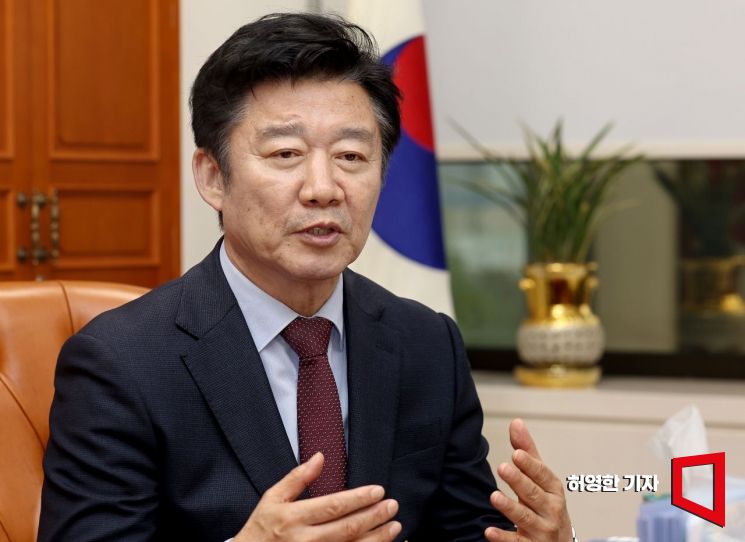 Sangcheol Park, Director of the National Assembly Legislative Research Office. Photo by Younghan Heo younghan@
For example, the National Assembly's amendment to the Road Traffic Act strengthening the statutory penalties for drunk driving (known as the ‘Yoon Chang-ho Act’) was ruled unconstitutional by the Constitutional Court because it did not specify certain temporal criteria for repeated drunk driving offenses and did not subdivide the statutory penalties. Such legislative risks have led to 'blind bill proposals' since the 17th National Assembly, as the legislative activities of members have become a major evaluation index. In fact, in the 21st National Assembly, member-initiated legislation has exceeded 90% of all bills. Because of this, related laws are being enacted one after another. In the ruling party, Representative Yoon Jae-ok, along with Lee Jong-bae, Jeong Kyung-hee, and Hong Seok-jun of the People Power Party, have taken the lead in proposing bills, and in the opposition party, Kim Tae-nyeon and Shin Jeong-hoon of the Democratic Party of Korea have also submitted bills.
Since his appointment, Director Park has conducted legislative impact analyses on everyday life-related bills such as inter-floor noise (Building Act) and MyData (Medical Service Act). He argued that legislative impact analysis enables value-neutral legislative analysis. Director Park explained, "In the case of a bill proposed to reduce inter-floor noise, if the construction company discloses building materials to the buyers, it would be good for the general public but could be a regulation for construction companies. When we understand what impact such regulation would have, it actually strengthens the bill's passage."
The legislative impact analysis related to ‘MyData’ is similar. In the case of an amendment allowing the transfer of medical records such as medication information and test results from the previous hospital when changing hospitals, hospitals may oppose it as they are directly regulated, but Director Park argued that a reasonable balance can be found through scientific legislative impact analysis.
He is a constitutional scholar who graduated from Sungkyunkwan University Law School and earned a master's and doctorate in law from the same graduate school. While serving as a professor at Kyonggi University Graduate School of Political Studies, he has accumulated political expertise by observing the Korean political scene for a long time, serving as a member of the Presidential Advisory Policy Planning Committee, head of the Constitutional Amendment TF team, member of the Political Affairs Division of the Presidential Transition Committee, and member of the National Assembly Innovation Advisory Committee.
Director Park also cited the current situation of a divided National Assembly, where the ruling party is in the minority and the opposition party is dominant, leading to a vicious cycle of the opposition party unilaterally passing bills and the president exercising veto power, as another reason why legislative impact analysis is necessary. He said, "In the legislative process, it should not be that only political conflicts arise and only stakeholders and interest groups come forward, reflecting only their intentions in the bills. After all the effort to make a bill, the president exercises veto power and the Constitutional Court is repeatedly asked to adjudicate disputes. To create laws that can gain the trust of the people, legislative impact analysis is definitely helpful."
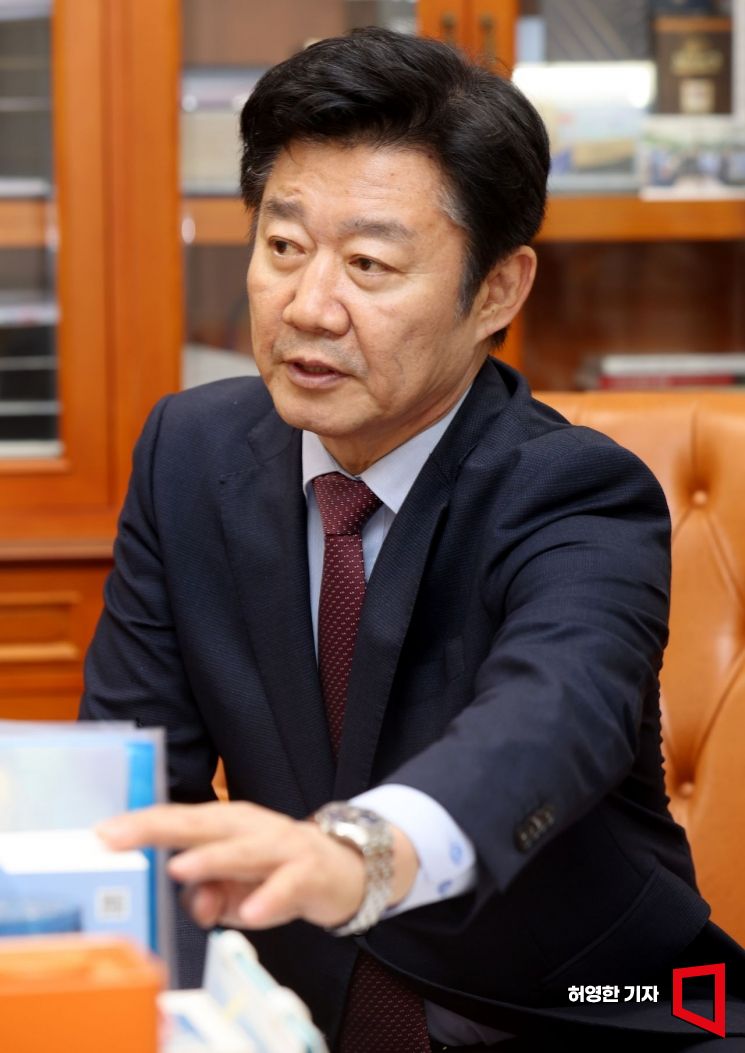 Sangcheol Park, Director of the National Assembly Legislative Research Office. Photo by Younghan Heo younghan@
Earlier, Speaker Kim Jin-pyo emphasized this point in his opening speech at the regular session of the National Assembly on the 1st, saying, "As the government increasingly relies on member-initiated legislation by skipping the complex legislative process, excessive conflicts arise between the ruling and opposition parties and among standing committees during the legislative process." He added, "Legislative impact analysis involving experts from the Legislative Research Office and the Budget Office, along with professional committee review reports, should become the driving force for promoting good legislation."
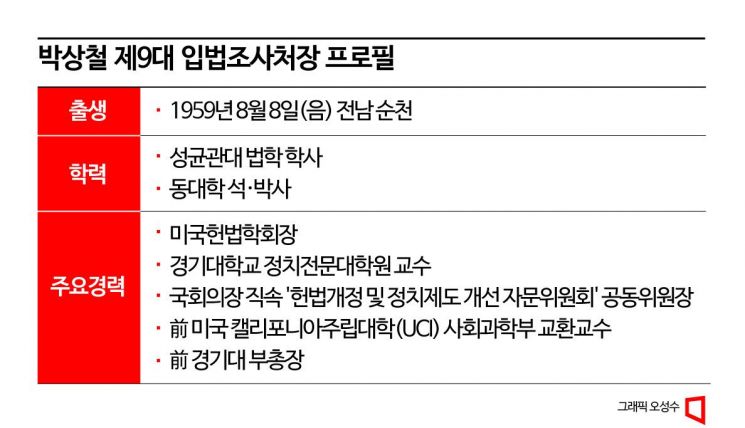
Director Park referred to himself as a 'political integrationist.' He also expressed his ambition to create a foundation for integration between conservatives and progressives, and between the ruling and opposition parties, through the Legislative Research Office. He said, "Among past presidents, former President Roh Tae-woo from the conservative side and former President Kim Dae-jung from the progressive side accomplished the most work." He explained, "The reason they could accomplish the most was that they realized 'politics of integration.' Former President Roh valued communication with the opposition so much that he was known for the 'three-party merger,' and former President Kim formed a coalition government through the DJP Alliance." He especially introduced that the simultaneous admission of North and South Korea to the UN in 1991, achieved during the conservative Roh administration, was the result of communication with the opposition party.
He emphasized, "When conservatives and progressives integrate, they really accomplish a lot. There is also the expression 'coalition politics,' but those who have done politics only within their own factions have practically achieved nothing in retrospect. When they put their heads together, problems get solved." He added, "This is why the National Assembly may not be more efficient than the executive branch, but it can be productive."
© The Asia Business Daily(www.asiae.co.kr). All rights reserved.



















