95% of Factories in 'Natural Conservation Zones' Are Individually Located, Not in Industrial Complexes
Increasing Wastewater Treatment Burden Despite Han River Basin Protection Purpose
There are growing concerns that factory location regulations in the ‘Natural Conservation Zone’?established to protect the water quality, green spaces, and natural environment of the Han River watershed, the main water source for the Seoul metropolitan area?are instead exacerbating small-scale indiscriminate development.
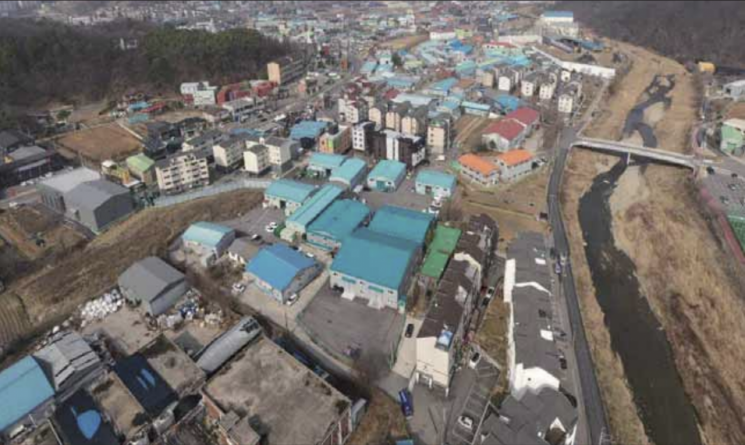 A panoramic view of the area around Gwangju-si, Gyeonggi-do, where small-scale factories are densely located. [Photo by Hangang Saram Forum]
According to major local governments and industry sources in the metropolitan area on the 5th, the proportion of small-scale individual factories within the Natural Conservation Zone of the Han River watershed exceeds 95% in key local governments.
Han River Watershed Under Regulation, Proliferation of Small-Scale Factories
The ‘Natural Conservation Zone’ is an area designated under the Capital Region Readjustment Planning Act as requiring protection of the water quality, green spaces, and natural environment of the Han River watershed. Currently, the entire areas of Icheon, Yeoju, and Gwangju cities in Gyeonggi Province, as well as Yangpyeong and Gapyeong counties, and parts of Yongin, Namyangju, and Anseong cities are designated as Natural Conservation Zones.
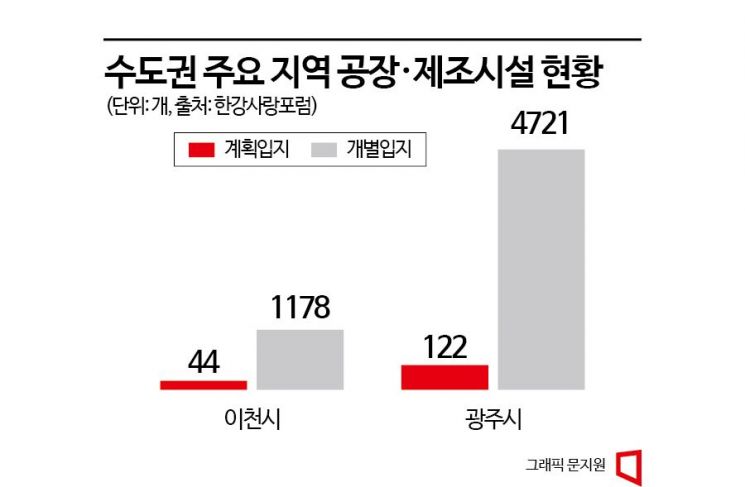
A notable characteristic of these areas is the high proportion of small-scale individual factories rather than industrial complexes. As of the end of July, Icheon city has a total of 1,222 factories. Among them, only 44 are planned factories located in industrial complexes or industrial zones. The remaining 1,178 factories, accounting for 96.4%, are individually located factories.
Similarly, Gwangju city, which is entirely designated as a Natural Conservation Zone, shows a similar situation. Out of a total of 4,847 factories and manufacturing businesses, only 126 (2.2%) are located within industrial zones. The remaining 97.8% are factories individually scattered throughout the city.
The problem, according to local governments, is that the amount of wastewater discharged per unit area from these small-scale factories is higher than that from factories within industrial complexes. A representative from Icheon city explained, "The daily biological oxygen demand (BOD) load of 40 wastewater discharge facilities with a capacity of 50㎥ each was analyzed to be up to four times higher than that of a single 2,000㎥ facility," adding, "This means that the proliferation of small-scale factories negatively impacts water quality."
Excessive Regulations Actually Fuel Indiscriminate Development
The reason for the proliferation of small-scale factories in the Natural Conservation Zone is the strict regulations under the Capital Region Readjustment Planning Act. This act is known as the ‘law above laws.’ It stipulates that it takes precedence over provincial, city, and county plans under the National Land Planning and Utilization Act, as well as other land use or development plans under different laws.
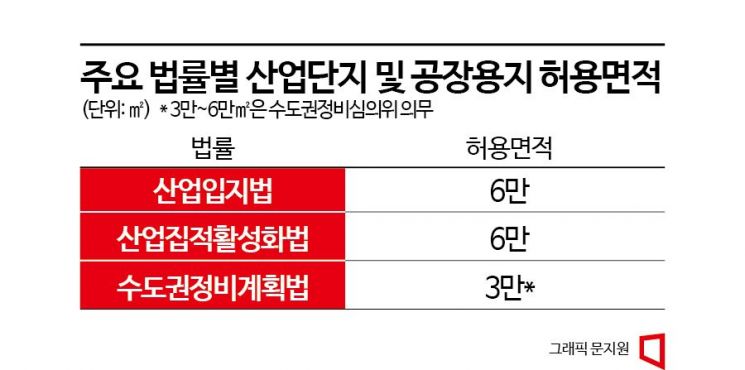
Current laws such as the Industrial Cluster Activation and Factory Establishment Act (SanJipBeop) and the Industrial Location Act (SanIpBeop) allow free establishment of factory sites and industrial complexes up to 60,000㎡. However, the Capital Region Readjustment Planning Act mandates that the Capital Region Readjustment Committee must review any factory site or industrial complex development exceeding 30,000㎡. To avoid this regulation, companies build factories only up to 30,000㎡, resulting in a proliferation of small-scale factories scattered throughout urban areas.
Restrictions on related activities in the Natural Conservation Zone are also strict. In industrial zones, urban-type factories of small and medium enterprises can only be newly established or expanded up to 3,000㎡. In other areas, new establishment or expansion is limited to ▲ up to 1,000㎡ for advanced and local neighborhood factories ▲ and up to 2,000㎡ for urban-type factories.
No Compensation System for Residents... "Regulations Must Be Relaxed"
Related local governments criticize that the regulations under the Capital Region Readjustment Planning Act have failed to achieve the core goal of protecting the water quality of the Han River watershed and instead have deepened regional disparities within the metropolitan area.
An official from a local government pointed out, "The Natural Conservation Zone imposes strict activity restrictions that infringe on property rights, but there is no compensation for residents," adding, "This is unfair compared to the Greenbelt (Development Restriction Zone), which has separate compensation regulations for restrictions."
For this reason, the ‘Han River Love Forum,’ a recent gathering of local governments and regional organizations in the Natural Conservation Zone, has petitioned the Prime Minister’s Office to ease regulations on industrial complexes and factory sites in the Natural Conservation Zone to prevent the proliferation of small-scale factories and promote balanced development in the metropolitan area.
© The Asia Business Daily(www.asiae.co.kr). All rights reserved.



















