Jeonbuk Province Faces Immediate Budget Shortage for This Year
Namwon City to Completely Reassess Next Year's Projects
The government’s decision to cut the local allocation tax by a record 8.5 trillion won in next year’s budget has put local governments on high alert regarding their financial management.
As of the 4th, all local governments except Seoul and Gyeonggi Province are simultaneously undergoing expenditure restructuring in anticipation of reduced revenue next year. Seoul and Gyeonggi Province are financially independent and do not receive local allocation tax from the government. The urgency among local governments stems from the fact that the cut in the local allocation tax is larger than expected. Nara Salim Research Institute, a private think tank specializing in budget analysis, projected in July that the local allocation tax in next year’s budget would be 7.1 trillion won. Son Jongpil, senior research fellow at Nara Salim Research Institute, said, “Considering budgets that are difficult to cut, such as welfare, local governments will be in a situation where they cannot undertake any new projects.”
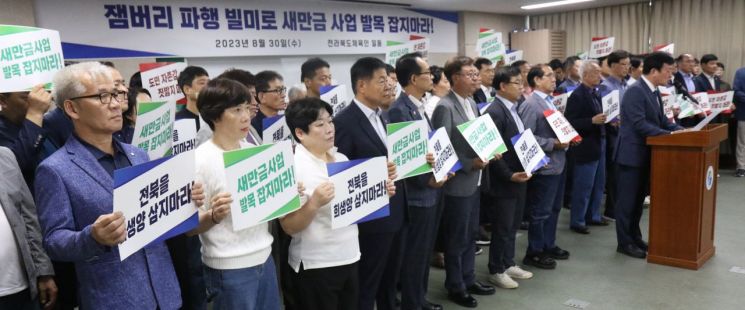 Jeong Gang-seon, President of the Jeonbuk Sports Council, and other sports officials from Jeonbuk held a press conference at the Jeonbuk Sports Council Hall on the 30th of last month, urging, "Do not use the Jamboree disruption as a pretext to hinder the Saemangeum project." Photo by Yonhap News
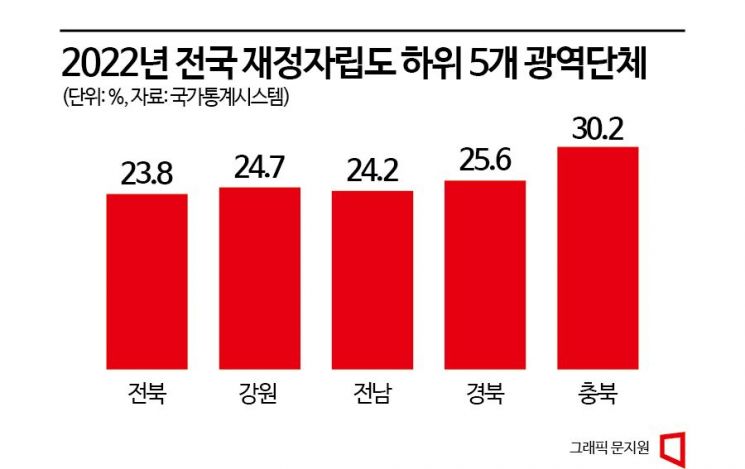
The most urgent case is Jeonbuk Province, which has the lowest financial independence rate among metropolitan governments at 23.8%. Jeonbuk Province expects a total revenue decrease of 205 billion won next year, including 190 billion won from local allocation tax and 115 billion won from local taxes. Previously, the local allocation tax reduction was expected to be about 130 billion won. The amount has decreased more than anticipated.
Jeonbuk Province is urgently concerned about costs to be used this year. It was scheduled to receive 1.332 trillion won in local allocation tax this year, but about 420 billion won has not yet been disbursed. This is about 200 billion won less than in previous years.
Jeonbuk Province is considering a blanket 10% cut in administrative operating expenses. A Jeonbuk Province official said, “Administrative operating expenses mainly include office management costs and travel expenses for public officials. Due to the nature of government offices, the largest office management cost is printer paper, and we are considering a 10% cut in this expense.”
Due to severe financial pressure, Jeonbuk Province is also considering withholding statutory transfers to cities, counties, and education offices. It is also considering lowering the provincial share of city and county subsidy projects to below 30%. A Jeonbuk Province official said, “Currently, the province lacks funds to provide statutory transfers. Both local allocation tax and local taxes are decreasing, so cutting statutory transfers is inevitable.”
Jeju Province is expected to see a reduction of about 200 billion won in local allocation tax. Jeju requested 2.18 trillion won in national funds for next year but only 1.85 trillion won was reflected. Among these, the maritime transport support project requested 10 billion won but received none. The Jeju public sewage treatment facility modernization project requested 41 billion won but only 16.3 billion won was approved.
Sejong City faces deeper concerns than other metropolitan governments because its financial special privileges will end this year. As a single-tier local government combining metropolitan and basic functions, Sejong has received an average of 20.9 billion won annually in financial special privileges. Therefore, it is demanding an amendment to the Sejong City Act to extend these privileges until 2030 and receive an additional approximately 80 billion won annually.
Basic local governments are in an even more serious situation. Namwon City, which has one of the lowest financial independence rates nationwide, plans to completely reassess major financial investment projects and annual recurring events from scratch. Projects will be evaluated, with “excellent” projects maintained and “insufficient” ones cut. In effect, there will be no “increases.” Namwon City selected key budget projects for next year, including ▲Namwon Drone Culture Experience Center construction (total project cost 25 billion won), ▲Ceramics Exhibition Hall construction (15 billion won), ▲National Jirisan Mountain Climbing School construction (8 billion won), and ▲Namwon-Sunchang metropolitan solid waste incineration facility installation (78.3 billion won), but reportedly did not receive any allocation for these. A Namwon City official said, “We will minimize new projects and only increase budgets for ongoing projects that must meet deadlines.”
Yeom Bongseop, chairman of the Namwon City Council Budget and Accounts Special Committee, said, “The government increased the budget by 2.8%, but considering inflation, it is effectively frozen. On top of that, local governments are facing an unprecedented reduction in local allocation tax.” He added, “The situation is urgent, so we plan to fully reassess existing projects with sufficient public consensus.”
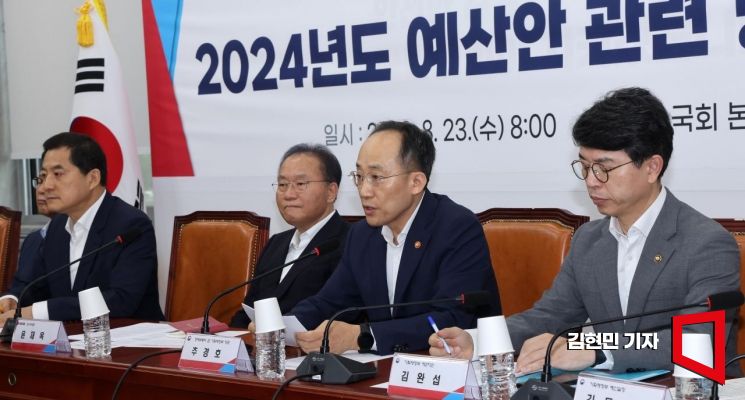 Deputy Prime Minister and Minister of Economy and Finance Choo Kyung-ho is speaking at the ruling party and government meeting on the 2024 budget bill held at the National Assembly on the 23rd of last month. Photo by Hyunmin Kim kimhyun81@
Local government budget officers expressed concern not only about next year’s budget but also about immediate cash shortages. One local government official said, “The government instructed early this year to proactively execute the budget to stimulate the economy. Given this situation and the reduction in next year’s local allocation tax, there is no budgetary leeway at all. We are considering issuing local bonds next year.”
On the other hand, Gyeonggi Province, a non-recipient of local allocation tax, chose a different path from the central government. It decided to pursue expansionary fiscal policy to boost the economy. Gyeonggi Province announced a supplementary budget on the 25th of last month. The supplementary budget is 33.95 trillion won, 140 billion won more than the original budget of 33.81 trillion won. Governor Kim Dongyeon said, “Now is the time for the budget to play an active role.”
Experts advise that the significant cut in local allocation tax could shake local decentralization and that alternatives must be prepared. Senior Research Fellow Son said, “Local financial difficulties inevitably have a negative impact on local decentralization. It is time to improve the local fiscal adjustment system, just as the Lee Myung-bak administration introduced local consumption tax and local income tax while implementing tax cuts.”
© The Asia Business Daily(www.asiae.co.kr). All rights reserved.



















