Foreign Media Including CNN Report
Concerns Raised Over Domestic Worker Labor Exploitation
As the government finalizes a plan to pilot the introduction of foreign workers to assist with household chores and childcare as part of its low birthrate countermeasures, foreign media are also showing considerable interest.
On the 1st (local time), the US CNN network introduced the Korean government's pilot project for foreign domestic workers, reporting that "South Korea, which needs more babies and workers, hopes that foreign domestic helpers will help solve this issue."
CNN reported, "As early as December this year, about 100 foreign domestic helpers will start working in Seoul," explaining that "the increase in highly educated women reluctant to interrupt their careers, rising living costs, and the burden of childcare and housework are factors contributing to the decline in marriage and childbirth in Korea."
It then cited a government report published this week, stating, "More than half of adults aged 19 to 34 in Korea responded that they do not feel the need to have children after marriage, and only 36.4% of respondents held a positive view of marriage."
In 2022, South Korea's total fertility rate fell to a record low of 0.78, the lowest in the world. In particular, Seoul's total fertility rate is 0.59. The total fertility rate refers to the average number of children a woman is expected to have in her lifetime. The replacement fertility rate, which is the level needed to maintain the current population, is 2.1.
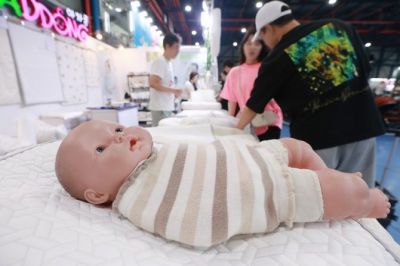 Visitors are examining childcare products at the 2023 KOBE Baby Fair & Early Childhood Education Exhibition held at SETEC in Gangnam-gu, Seoul. [Image source=Yonhap News]
Foreign media pointed out that although the Korean government has introduced measures such as cash subsidies to address the ultra-low birthrate issue, young people still hesitate to have children, and there are socio-structural problems behind this.
CNN reported, "As labor shortages caused by the low birthrate became apparent, the Korean government proposed increasing the maximum weekly working hours from the current 52 hours to up to 69 hours, but the plan was scrapped due to opposition from the younger generation."
The US Wall Street Journal (WSJ) also analyzed in an article titled "Even with cash payments to parents, the world's lowest birthrate is falling further," published on the 31st of last month, that "the Korean government has poured about 280 trillion won into solving the low birthrate issue since 2006, but this has had no effect on the younger generation."
Additionally, foreign media pointed out that there are concerns and controversies regarding the treatment of foreign domestic helpers, including potential side effects such as labor exploitation.
CNN reported, "In places like Singapore, many live-in domestic helpers suffer inhumane treatment and abuse without even receiving minimum wage due to fears of being fired and forcibly deported back to their home countries."
© The Asia Business Daily(www.asiae.co.kr). All rights reserved.

















