The Korean Dementia Association Holds 'Special Symposium'
'DMT' Lecanemab and Donanemab Development in Final Stages
Effective but Concerns Over Side Effects Like ARIA
Debate on Companion Diagnostics Including PET, CSF, and Blood Tests
Eisai Predicts Lecanemab Launch in South Korea in Late Next Year
Ezai and Biogen's 'lecanemab' (product name Leqembi) recently received formal approval from the U.S. Food and Drug Administration (FDA), and Eli Lilly's 'donanemab' announced successful clinical results, bringing the dream of conquering Alzheimer's dementia through disease-modifying therapies (DMTs) closer to reality. As Korea Ezai has applied for domestic approval of lecanemab, the introduction of DMTs in Korea is highly likely soon. Against this backdrop, a forum was held to discuss the advantages and disadvantages of these therapies and the infrastructure needed for their actual implementation.
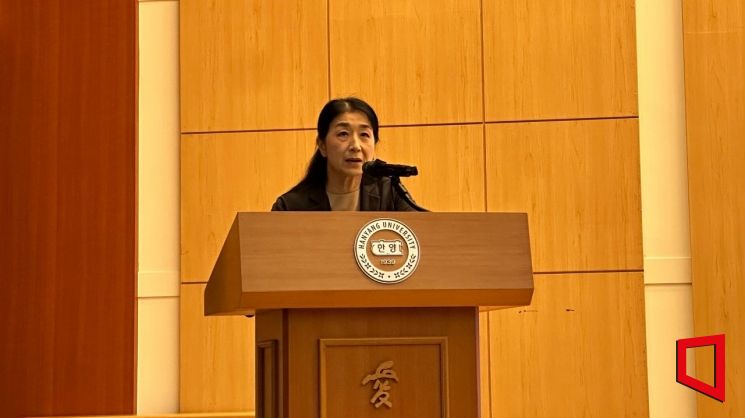 On the morning of the 2nd, at Hanyang University in Seongdong-gu, Seoul, Professor Choi Seong-hye of the Department of Neurology at Inha University College of Medicine is giving a lecture at the '2023 Korean Dementia Association Special Symposium.'
 [Photo by Lee Chun-hee]
On the morning of the 2nd, Professor Choi Seong-hye of the Department of Neurology at Inha University College of Medicine delivered a lecture titled "Clinical Effect Analysis of Lecanemab and Donanemab" at the '2023 Korean Dementia Association Special Symposium' held at Hanyang University in Seongdong-gu, Seoul. She introduced the clinical trial results of these drugs, noting that they showed quite meaningful effects. Addressing concerns that the drugs might not have definite effects, she explained, "(The clinical result figures) are averages; not all patients improved by the same amount." She added, "In the moderate-to-low tau experimental group of donanemab, 47% showed no disease progression, indicating that a significant number of patients experienced meaningful improvement." She emphasized, "As we move toward precision medicine, further research is needed to determine who responds well and who does not."
Experts attending the event also voiced concerns about side effects, including deaths during donanemab's clinical trials, stressing the need for preparedness. Currently, dementia antibody therapies raise significant concerns about side effects related to amyloid-related imaging abnormalities (ARIA), such as cerebral edema and microbleeds. These antibody therapies remove amyloid beta (Aβ) protein deposits in blood vessels, a known cause of dementia, but this process can cause bleeding in cerebral blood vessels.
Professor Han Seol-hee of Konkuk University’s Department of Neurology remarked, "Some have described it as a 'Russian roulette,'" cautioning, "We should not view this too optimistically; the worst-case scenarios could hinder progress." Professor Kim Hee-jin of Hanyang University’s Department of Neurology added, "Most ARIA cases disappear after 3 to 4 months," but noted, "It is necessary to check for the presence of apolipoprotein E (ApoE) ε4 and to monitor carefully during dose escalation in treatment. I believe Korea needs its own guidelines."
'Medications You Need to Know to Use' DMT... Which Diagnostic Method: PET, Cerebrospinal Fluid, or Blood?
The symposium also discussed what preparations are necessary for the introduction of DMTs. These drugs use biomarkers such as the degree of accumulation of Aβ or phosphorylated tau (pTau), and the presence of ApoE ε4, which are important for selecting clinical candidates and analyzing efficacy. In other words, an infrastructure that allows continuous, low-cost monitoring of dementia-related biomarkers is essential for effective drug use. There were differing opinions on which diagnostic method should be primarily used.
Traditionally, amyloid positron emission tomography (PET) has been the main diagnostic tool for measuring these biomarkers and diagnosing dementia. Professor Lee Chan-nyeong of Korea University College of Medicine’s Department of Neurology stated, "Lecanemab, donanemab, and gantenerumab (Roche) all used amyloid PET for monitoring in clinical trials," emphasizing, "Amyloid PET has very high accuracy, with sensitivity and specificity of 85.7% and 100%, respectively, based on autopsy analyses." He also noted, "While PET might be difficult to access abroad, Korea has 43 PET centers in Seoul alone," highlighting "better accessibility compared to other countries." However, amyloid PET has drawbacks: since Aβ accumulates significantly from the early stages of disease, it is difficult to assess disease progression through PET, and the high cost of imaging has been criticized. Professor Lee also pointed out, "It is better not to use PET unnecessarily in asymptomatic cases, when assessing dementia severity, or when Alzheimer's dementia is already confirmed."
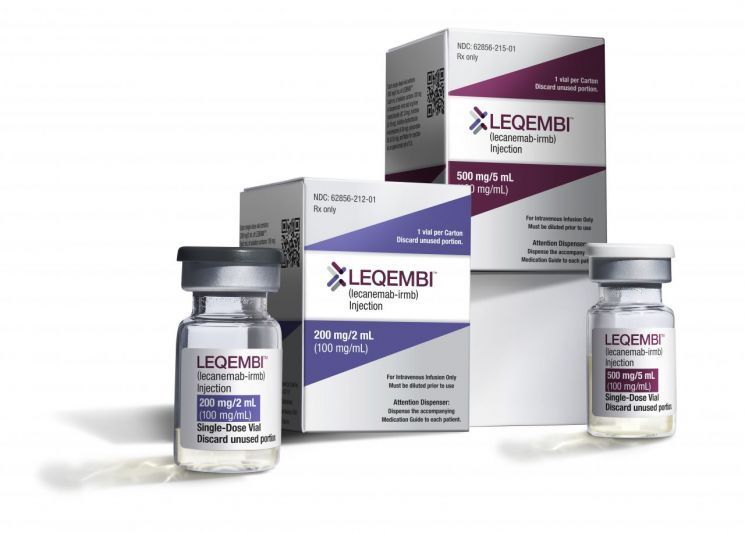 Eisai and Biogen's Alzheimer's dementia treatment 'Leqembi (generic name: lecanemab)' [Image source=AP Yonhap News]
Recently, cerebrospinal fluid (CSF) analysis and blood diagnostics have gained attention. These methods can assess various biomarkers simultaneously, but CSF extraction requires lumbar puncture, which is invasive and burdensome for both medical staff and patients, while blood diagnostics still face concerns about accuracy.
Professor Park Seon-ah of Ajou University School of Medicine’s Department of Medical Life Sciences emphasized, "CSF is a 'cost-effective test,'" explaining, "One sample can measure multiple biomarkers, and the cost is about one-seventh that of PET." She added, "Past obstacles such as lack of evidence for additional benefits or analytical issues are now being overcome with the advent of DMTs and the recent introduction of automated analysis systems in Korea, which will soon be available." In July, the Ministry of Food and Drug Safety approved Korea Roche Diagnostics' CSF analysis test 'Elexis,' which can detect Aβ and pTau181 through CSF.
Regarding blood diagnostics, which have recently been approved and commercialized by companies such as PeopleBio and QuantaMatrix in Korea, Professor Go Seong-ho of Hanyang University College of Medicine’s Department of Neurology stated, "Imaging like PET is accurate but expensive and difficult to perform frequently; CSF is invasive and has a high refusal rate among elderly patients, with only about 10-15% acceptance." He emphasized, "Blood tests can measure biomarkers such as Aβ and pTau, making them useful for preliminary screening and early evaluation of treatment effects."
"Treatment Continuation Should Be Determined Through Interim Diagnosis"... Ezai Expects Lecanemab Launch Next Year
In the subsequent discussion, intense debates took place regarding the current status and necessity of DMT introduction in Korea. Professor Yang Dong-won, president of the Korean Dementia Association and professor of neurology at Catholic University College of Medicine, said, "Not everyone needs it, but some do," emphasizing, "Doctors should provide the best treatment, and although there are side effects, patients who can benefit should use it. As the association president, I believe it should be introduced."
Professor Choi Seong-hye highlighted donanemab’s clinical trial design as a cost-effective alternative. In phase 3 trials, donanemab switched patients who showed Aβ clearance at interim analysis from the treatment group to the placebo group. Professor Choi said, "After one year of observation, these patients showed improvements comparable to those who continued treatment," suggesting, "Instead of lifelong indefinite treatment with expensive drugs, it might be better to limit treatment to a maximum of 18 months until Aβ clearance is achieved or to stop treatment if pTau levels rise."
 On the morning of the 2nd, at Hanyang University in Seongdong-gu, Seoul, the '2023 Korean Dementia Association Special Symposium' was held, where Youngin Eom, Executive Director of Medical Affairs at Korea Lilly, Minyoung Kim, Director of Medical Affairs at Korea Eisai, Dongwon Yang, Chairman of the Korean Dementia Association, Eunjeong Jeon, Director of Elderly Health at the Ministry of Health and Welfare, Sunghye Choi, Professor of Neurology at Inha University College of Medicine, and Jiwon Seo, Deputy Director of the Central Dementia Center (from left), were conducting a discussion.
 Photo by Chunhee Lee
Meanwhile, Kim Min-young, director of medical affairs at Korea Ezai, stated, "We have completed the domestic approval application for lecanemab, and according to the Ministry of Food and Drug Safety’s biologics license application (BLA) timeline, approval is expected within 1 to 1.5 years," adding, "Domestic launch is anticipated in the second half of 2024." On the other hand, donanemab has not undergone clinical trials in Korea, so even if it receives FDA approval, domestic approval is expected to take considerable time. Um Young-in, executive director of medical affairs at Korea Lilly, explained, "We are making every effort to expedite domestic introduction. We plan to register additional clinical trials involving Korean participants as early as this year and have started discussions with the Ministry of Food and Drug Safety for approval."
© The Asia Business Daily(www.asiae.co.kr). All rights reserved.



















