Bills Proposed by Ruling and Opposition Parties, Common Ground and Differences Coexist
Possibility of 'Veto' on Nobong Act and Broadcasting Act
Disagreements Over Election System, Number of Lawmakers, and Semi-Linked Proportional Representation
The final regular session of the 21st National Assembly, which will last for 100 days, began on the 1st. At the end of last month, the ruling and opposition parties held a two-day workshop to strategize for the regular session and selected key legislative bills, including the '7 Major Legislative Tasks.'
Both parties are expected to promptly legislate on socially shocking incidents such as the flood damage caused by the summer monsoon season and the suicide of a teacher at Seoul Seoi Elementary School. However, there are also many bills expected to cause conflicts, such as the ruling party's 'Five Laws to Normalize Construction Sites' and the opposition's bills related to local currency.
Direct referral bills like the Yellow Envelope Act and the Broadcasting Act, which were postponed through negotiations in last month's extraordinary session, are being pushed forward, and the 'veto standoff' is likely to be revived. There are also disagreements over the electoral district reform, which both parties have gathered opinions on through party meetings, making coordination difficult.
Both Parties United on 'Flood Damage Measures' and 'Protection of Teachers' Rights'... Disagreements on Some Bills
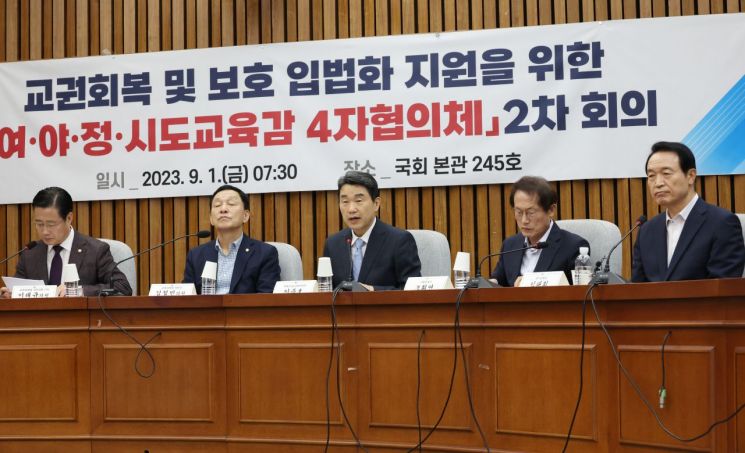
According to political circles on the 4th, both parties have formed a consensus to pass bills protecting teachers' rights and preventing flood damage during this regular session.
The bill to protect teachers' rights has passed through three subcommittee hearings and is awaiting a plenary session. The Education Committee originally planned to hold a plenary session on this day but postponed it considering the 'Day of Public Education Suspension.' Earlier, Kim Cheol-min, chairman of the National Assembly Education Committee and a member of the Democratic Party, said at a four-party consultative meeting with the ruling and opposition parties, the government, and metropolitan and provincial education superintendents on the 1st, "Although the procedures in the Legislation and Judiciary Committee and the plenary session remain, there is sufficient consensus between the ruling and opposition parties on establishing teachers' rights, so I believe we will see results soon." The Special Act on the Status and Protection of Teachers, which prohibits school principals from infringing on or concealing teachers' activities and adds malicious complaints to acts infringing on educational activities, has passed the subcommittee stage. Additionally, amendments to the Elementary and Secondary Education Act, which clarify that proper student guidance is not considered abuse under the Child Welfare Act, as well as amendments to the Framework Act on Education and the Early Childhood Education Act, have passed the subcommittee and moved to the plenary session.
Furthermore, the amendment to the Building Act, agreed upon by the ruling and opposition parties' flood recovery task force, was included in the ruling party's key legislative agenda. On the 18th of last month, the task force concluded its activities, agreeing on an amendment to the Building Act that restricts and supplements the construction of underground housing. Yoon Jae-ok, floor leader of the People Power Party, stated at a floor strategy meeting on the 1st, "We included major bills such as the Building Act, which both parties promised to resolve before the public after experiencing a major accident, in the key legislative agenda."
On the other hand, there are bills that both parties have expressed intent to push but are already causing conflicts. The opposition criticizes the ruling party's 'Five Laws to Normalize Construction Sites,' which include the Labor Union Act, the Framework Act on the Construction Industry, and the Fair Hiring Procedure Act, set as key legislative bills for the regular session, as measures to suppress labor unions. These bills were proposed by the ruling party as alternatives to eradicate construction violence and prevent substandard construction. The Democratic Party's Euljiro Committee criticized at a National Assembly press conference on the 7th of last month, "No expert attributes the cause of substandard construction to the previous government or labor unions, yet the ruling party is distorting the essence," adding, "These five laws are a trick to divert attention from construction companies and government authorities, including the Ministry of Land, Infrastructure and Transport, who have been under scrutiny for substandard construction ahead of the general election."
The Democratic Party's 'Livelihood Economic Recovery Package,' announced as one of the seven major legislative tasks, includes the Local Love Gift Certificate Act, which is expected to face opposition from the ruling party. The bill mandates support from the national and local governments to revitalize local love gift certificates. The government and ruling party are negative about the local love gift certificates promoted by the Democratic Party. The government recently cut the entire budget for local love gift certificates in the 2024 budget proposal submitted to the National Assembly. Last year, the government also cut the entire budget for local currency, but the National Assembly allocated 352.5 billion won for this year during budget review. This is the smallest amount secured for local currency budgets in the past four years.
Will the '3rd and 4th Veto' Be Exercised?
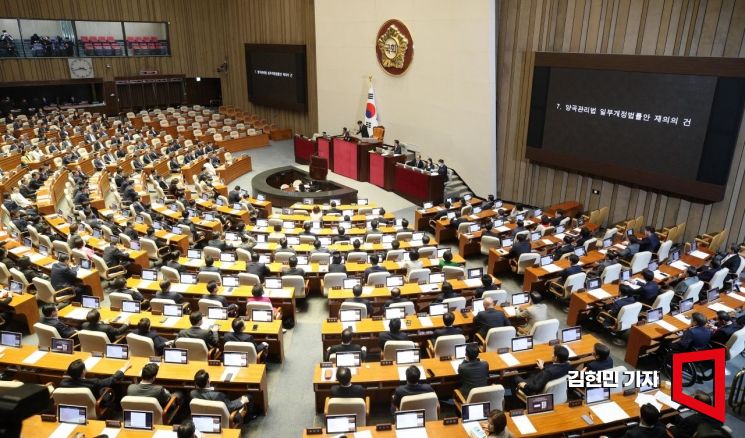 On the 13th, the revised Grain Management Act was presented at the 4th plenary session of the 405th National Assembly (extraordinary session) held at the National Assembly in Yeouido, Seoul. The amended Grain Management Act, which was returned to the National Assembly after President Yoon Seok-yeol exercised his veto power, was ultimately rejected with 290 members present, 177 in favor, 112 against, and 1 abstention. Photo by Hyunmin Kim kimhyun81@
As the Yellow Envelope Act and Broadcasting Act, directly referred to the plenary session under opposition leadership, move into the regular session, there are forecasts that President Yoon Suk-yeol will continue to exercise his veto (reconsideration request) power. Previously, President Yoon exercised veto power on the Grain Management Act in April and the Nursing Act in May.
As the Democratic Party secured a non-session period at the end of last month in preparation for the prosecution's possible arrest warrant request against leader Lee Jae-myung, these two bills moved into the regular session. Song Ki-heon, deputy floor leader of the Democratic Party, told reporters at the National Assembly on the 21st of last month, "We plan to process the Yellow Envelope Act and Broadcasting Act as quickly as possible during the regular session."
The problem is that the government and ruling party have already hinted at exercising veto power on these bills. Yoon Jae-ok, floor leader of the People Power Party, said at the May supreme council meeting, "If the Yellow Envelope Act passes the plenary session, our party will request President Yoon to exercise his reconsideration request power." A ruling party official said, "(The Broadcasting Act) is nonsense. If the Democratic Party passes it alone, we will request a veto."
In addition, the Democratic Party's re-promotion of the Grain Act and the ruling party's unilateral passage of the Itaewon Disaster Special Act in the Public Administration and Security Committee are also expected to lead to vetoes. Lee Yang-su, deputy floor leader of the People Power Party, raised his voice at the floor strategy meeting on the 1st, saying, "The Democratic Party is again predicting legislative rampage by re-promoting the Grain Management Act in this regular session. Moreover, they committed the outrage of forcibly passing the Itaewon Disaster Special Act yesterday (the 31st of last month)." He added, "Forcibly passing this bill is nothing but a political purpose to frame the ruling party as ignoring the unilateral government operation disaster by inducing the president's reconsideration request."
Ruling Party: "Reduce Total Seats and Abolish Semi-Linked Proportional Representation" vs Opposition: "Expand Proportional Representation and Oppose Parallel System as Regression"
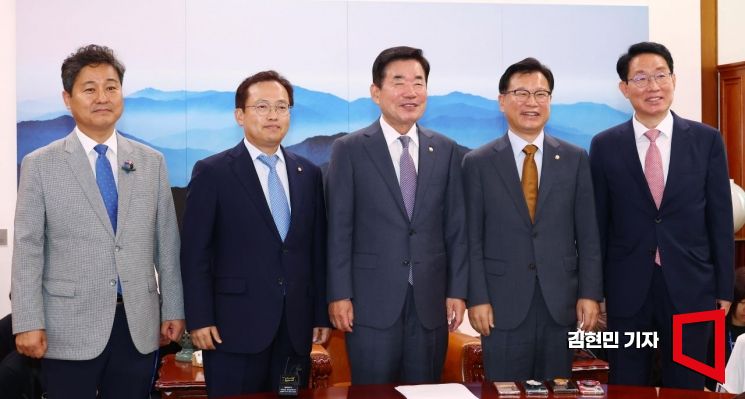 At the inauguration ceremony of the 'Ruling and Opposition 2+2 Election System Reform Consultative Group' held on the 3rd at the Speaker's Office in the National Assembly, Speaker Kim Jin-pyo is taking a commemorative photo with the attendees. From the left, Kim Young-bae, opposition party secretary of the Political Reform Special Committee and Democratic Party lawmaker; Song Ki-heon, Democratic Party floor leader deputy; Speaker Kim Jin-pyo; Lee Yang-su, People Power Party floor leader deputy; and Kim Sang-hoon, ruling party secretary of the Political Reform Special Committee and People Power Party lawmaker. Photo by Kim Hyun-min kimhyun81@
In discussions on electoral district reform, the ruling and opposition parties remain at odds. On the 1st, both parties held separate party meetings to gather opinions from members after the report from the Special Committee on Political Reform.
The People Power Party advocates for a nationwide parallel proportional representation system and demands the abolition of the semi-linked proportional representation system introduced in the 21st general election. After the party meeting, Floor Leader Yoon told reporters, "Our party has advocated for a nationwide parallel proportional representation system from the beginning of negotiations," adding, "Our party strongly opposed the introduction of the semi-linked proportional representation system, and there is no significant disagreement within the party regarding the parallel proportional representation system." Regarding the 'reduction of 30 seats' consistently advocated by leader Kim Ki-hyun, he said, "We will continue to strive for reduction during negotiations."
On the other hand, the Democratic Party's party meeting converged on operating proportional representation by three regions?capital area, central, and southern regions?alongside the semi-linked system and increasing the number of proportional seats. They clearly opposed the ruling party's advocated 'parallel proportional representation.' Kim Han-gyu, the Democratic Party's floor spokesperson, told reporters after the meeting, "Many members believe that the parallel system would basically result in regression." Regarding the increase in proportional representatives, he explained, "Although the degree varies, everyone agreed that the number of proportional representatives should increase."
Although there are differences between the ruling and opposition parties, there is room for adjustment in future negotiations within the Special Committee on Political Reform and floor negotiations. Kim, the floor spokesperson, said, "Compared to the early stages of negotiations, it seems both parties have obtained members' consent on the broad direction of single-member districts and regional proportional representation, so major obstacles have been somewhat resolved," adding, "We are making progress."
© The Asia Business Daily(www.asiae.co.kr). All rights reserved.



















