Eurozone CPI at 5.3% in August... Same as Previous Month
Betting on Further Hikes Instead of Freeze
The European Central Bank (ECB) is facing increasing dilemmas between inflation and the economy. Raising interest rates to curb inflation risks worsening an already struggling economy, while keeping rates steady raises concerns about entrenched inflation, intensifying the ECB's predicament. Although the market sees a deepening downward trend in the European economy, expectations are growing that the ECB will prioritize inflation control and maintain a tightening stance.
On the 31st (local time), Eurostat, the statistical office of the European Union (EU), announced that the Eurozone's consumer price index (CPI) for August rose by 5.3% year-on-year on a preliminary basis. This matches the previous month's rate (5.3%) and is higher than market expectations, which anticipated a decrease to 5.1%. The Eurozone inflation rate has been declining since peaking at 10.7% in October last year, but since March it has hovered at more than twice the target rate (2%), showing signs of a slowdown stalling.
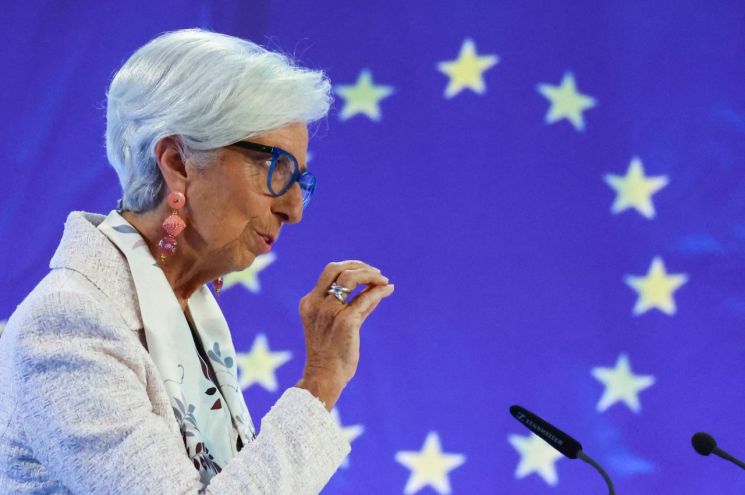
Initially, the market expected the ECB to hold rates steady rather than raise them further at the September monetary policy meeting. ECB President Christine Lagarde also left the door open for either decision during a press conference after the July meeting, stating, "We are open-minded about decisions at subsequent meetings," and "We could raise or hold rates. Future rate decisions depend on incoming economic data," thus leaving the possibility of a hold.
However, the inflation data released that day did not provide any certainty to the ECB, which had left the possibility of a hold open. Due to ambiguous inflation figures, the market is now leaning toward the ECB continuing rate hikes rather than holding steady. Piet Christiansen, chief strategist at Danske Bank, said, "Overall, a disinflation process is underway, but it is not sufficient for the ECB to be confident about price stability," and predicted, "The ECB will raise rates in September." The August CPI is the last inflation indicator before the monetary policy meeting on the 14th of next month, making it a decisive variable for the ECB's policy direction.
Inflation concerns remain unresolved in major Eurozone countries, including Germany, the largest economy in the Eurozone, as well as France and Spain. Germany's CPI released that day recorded 6.4%, higher than the Eurozone average. France's inflation rose by 0.6 percentage points from the previous month to 5.7%, and Spain's rate increased by 0.3 percentage points to 2.4%. Although Spain's inflation is relatively low among Eurozone countries, its rate of increase has recently accelerated.
The core inflation rate, considered a variable in the ECB's interest rate moves, was 5.3%, slightly down from 5.5% the previous month. Price pressures eased across all sectors except services (energy and food), leading to a reduction in core inflationary pressures. One foreign media outlet noted, "The slight decline in core inflation is a positive sign, but the risk of entrenched inflation remains, and with deepening recession concerns, the ECB's dilemma will continue."
The Eurozone economy, which seemed to rebound in the second quarter, is showing signs of worsening weakness. The economies of Eurozone countries, including Germany, which is heavily dependent on China and has been hit hard by its economic crisis, are deteriorating. The Eurozone composite Purchasing Managers' Index (PMI) recorded 47.0, significantly below the previous month's 48.6 and the market expectation of 48.5. This marks five consecutive months of decline since April's 54.1. The market expects that after a temporary rebound in the second quarter, the economy will continue to slow in the third quarter. Considering the PMI for July and August, there is speculation that the third quarter could see negative economic growth. The ECB has projected this year's GDP growth rate at 0.9%, which is more optimistic than economists' forecasts.
The ECB has raised interest rates nine consecutive times since July last year. At the July monetary policy meeting, it raised the benchmark interest rate to 4.25%. The current benchmark rate of 4.25% is the highest level since the euro was introduced in 2001.
© The Asia Business Daily(www.asiae.co.kr). All rights reserved.

















