Gangnam Daechi·Gaepo 3 Billion Won, Jongno Surpasses 2 Billion Won Again
Various Factors Including Regulation Easing and Rising Jeonse Prices at Play
Recently, the rise in housing prices in popular areas of Seoul has become prominent. In particular, newly built apartments less than 10 years old are leading this trend.
Seoul Housing Prices Rising... 61% Recovery of Last Year's Decline
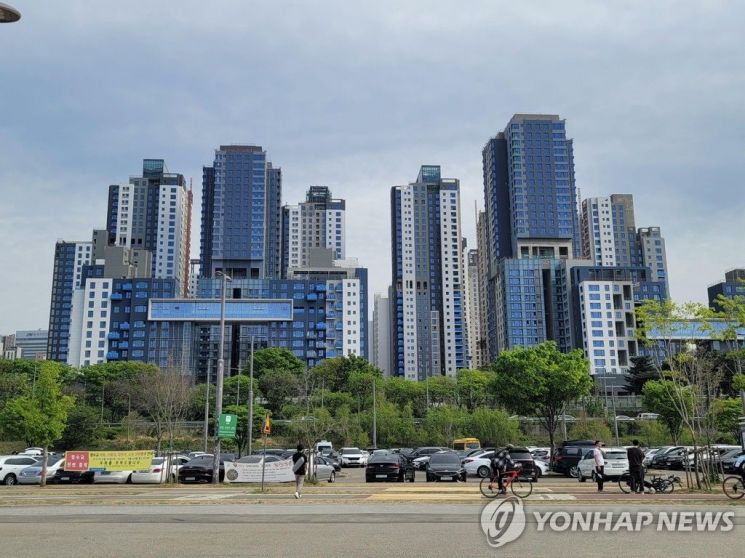 The 'Raemian One Bailey' apartment in Banpo-dong, Seocho-gu, Seoul, where move-in began on the 31st. [Image source=Yonhap News]
On the 31st, an 84㎡ apartment in 'Raemian One Bailey' in Banpo-dong, Seocho-gu, Seoul, which began occupancy, was sold for 4.59 billion KRW in July. This is the first time since last year's housing price decline that an 84㎡ apartment has surpassed 4 billion KRW. At 135 million KRW per 3.3㎡, it jumped nearly 700 million KRW from the previous highest price of 3.92 billion KRW recorded in May.
In July, an 84㎡ apartment in 'Gyeonghuigung Xi 3rd Complex' in Pyeong-dong, Jongno-gu, Seoul, was traded for 2.045 billion KRW. This is close to the highest price of 2.3 billion KRW set in April last year. Also, based on actual transaction prices, 84㎡ apartments in Banpo-dong, Seocho-gu, exceeded 4 billion KRW again, and in Daechi and Gaepo-dong, Gangnam-gu, prices surpassed 3 billion KRW. In Jongno and Dongjak-gu, as well as in the 'Mayongseong' area (Mapo, Yongsan, and Seongdong-gu), prices broke through 2 billion KRW again.
The rise in housing prices has been led by newly built apartments less than 10 years old. An 84㎡ apartment in 'Raemian Daechi Palace 1st Complex' in Daechi-dong, Gangnam-gu, which was occupied in 2015, was recently sold for 3.2 billion KRW. The price, which had dropped to 2.82 billion KRW in February, has risen close to the highest price of 3.3 billion KRW.
An 84㎡ apartment in 'Acro River Heim' in Heukseok-dong, Dongjak-gu, occupied in 2019, was sold for 1.82 billion KRW in April but traded for 2.25 billion KRW in June.
As housing prices rise in the Gangnam area of Seoul, non-Gangnam areas are also breaking through the 'housing price hurdles' formed in 2021-22 one after another. According to the Korea Real Estate Board, the actual transaction price index for apartments in the southeastern region of Seoul, including the three Gangnam districts (Gangnam, Seocho, and Songpa-gu), rose 14% from the end of last year during January to June this year. This is the second-highest increase since statistics began in 2006, following 2009, and it recovered 61% of last year's decline (-22.9%) in just half a year. During the same period, the northeastern region of Seoul, including Nowon, Dobong, and Gangbuk-gu, rose 8.1%.
Along with Real Estate Regulation Easing, 'Housing Price Bottom Theory,' and Hot Subscription Fever... 'Rising Jeonse Prices and Supply Shortage Anxiety'
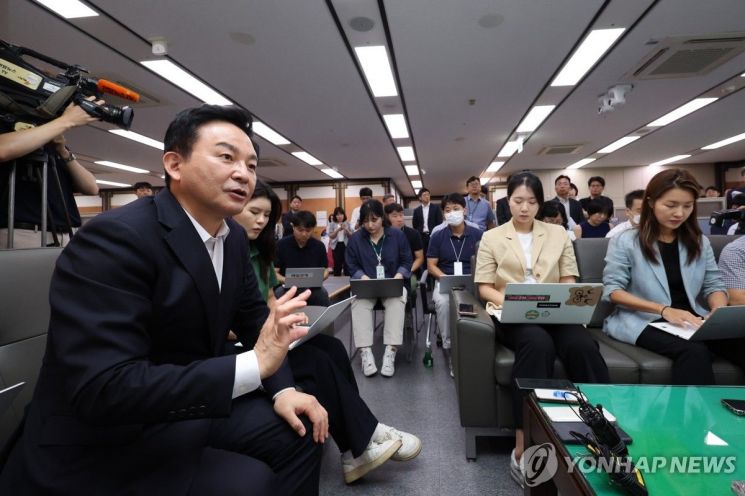 Won Hee-ryong, Minister of Land, Infrastructure and Transport, is speaking at a press briefing held at the Government Complex Sejong on the 28th. [Image source=Yonhap News]
The causes cited include the easing of real estate regulations, the spread of the 'housing price bottom theory,' and the hot fever for subscription. According to Real Estate R114, the competition rate for apartment subscriptions in Seoul this year was 77.6 to 1, a sevenfold increase from last year's 10.9 to 1. In particular, 'Lotte Castle East Pole' in Jayang-dong, Gwangjin-gu, with a maximum 84㎡ price of 1.4 billion KRW, attracted 40,000 applicants in the first priority subscription last month, recording a competition rate of 98 to 1.
Rising Jeonse prices are also pushing up housing prices. According to the Real Estate Board, Seoul apartment Jeonse prices have risen for 15 consecutive weeks.
Anxiety about housing supply shortages has also stimulated housing prices. According to Zigbang, the number of apartments scheduled for occupancy in Seoul next year is 11,105 units, a 63% decrease from this year's 30,312 units. Additionally, according to the Ministry of Land, Infrastructure and Transport, the number of apartment construction starts in Seoul from January to July this year was 9,944 units, a 68% decrease from a year earlier.
The government is also monitoring the market situation. On the 28th, Won Hee-ryong, Minister of Land, Infrastructure and Transport, stated, "Loan regulations remain in place, and since income increases have not accompanied, there has not been a large wave of speculative buying," adding, "If psychological factors and market supply and demand are stably maintained, housing prices are manageable."
© The Asia Business Daily(www.asiae.co.kr). All rights reserved.


















