"Destruction of Democracy under Yoon Suk-yeol Government"
11-Day Hunger Strike during Seongnam Mayoralty
Hunger Strikes for Democratization by YS, DJ, and Others
Lee Jae-myung, leader of the Democratic Party of Korea, began an indefinite hunger strike on the 31st, criticizing the Yoon Seok-yeol administration for undermining democracy. This is his second hunger strike, following a ten-day hunger strike in 2016 when he was the mayor of Seongnam, demanding the government withdraw its local finance reform. Marking his first anniversary in office, Lee is suffering from judicial risks due to the prosecution's all-out investigations into the Daejang-dong incident and Ssangbangwool's North Korea remittance case, making this hunger strike interpreted as a political gambit ahead of next year's general election.
In his opening remarks at a meeting held at the National Assembly in Yeouido, Seoul, on the 31st, Lee stated, "With the resolve of 'death before dishonor,' I will stop the destruction of democracy," and "As a last resort, I am starting an indefinite hunger strike from today." He emphasized, "The Yoon Seok-yeol regime has destroyed the constitutional order and democracy and declared war on the people," adding, "Today will be the first day to judge the ruthless regime and restore democracy."
He also demanded ▲ an apology from President Yoon Seok-yeol for destroying people's livelihoods and democracy ▲ the government's clear opposition to Japan's Fukushima Daiichi nuclear power plant contaminated water discharge into the ocean and filing a case with the International Tribunal for the Law of the Sea ▲ and a comprehensive government reform and cabinet reshuffle.
11-day hunger strike as Seongnam mayor... stopped upon recommendation by Kim Jong-in, emergency committee chairman
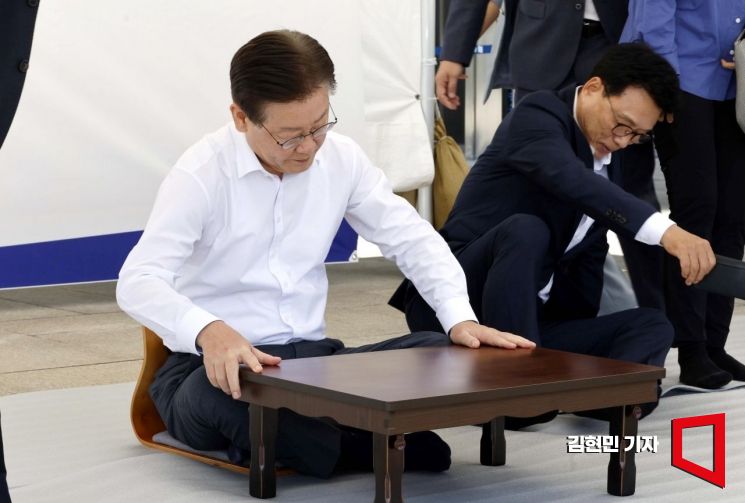 Lee Jae-myung, leader of the Democratic Party of Korea, is on a hunger strike in front of the National Assembly main building on the 31st. At a press conference marking his first anniversary in office, Lee declared, "I will start a national uprising against the incompetent and violent regime," and began an indefinite hunger strike. Photo by Kim Hyun-min kimhyun81@
Previously, Lee conducted an 11-day hunger strike from June 7 to 17, 2016, at Gwanghwamun Square in Seoul while serving as the mayor of Seongnam. He entered an indefinite hunger strike demanding the withdrawal of the government's local finance reform until a "fundamental measure" was presented. At that time, Kim Jong-in, the emergency committee chairman of the Democratic Party, visited the site at Gwanghwamun and persuaded him to stop. Lee was later hospitalized at Bundang Seoul National University Hospital, receiving treatment including intravenous fluids.
In the same year, in October, Lee criticized Lee Jung-hyun, then leader of the Saenuri Party (predecessor of the People Power Party), who entered an indefinite hunger strike demanding the resignation of National Assembly Speaker Chung Sye-kyun in protest against the opposition parties' motion to dismiss Minister of Agriculture, Food and Rural Affairs Kim Jae-soo. At that time, Lee posted on his social media under the title "The difference between Lee Jung-hyun's hunger strike and Lee Jae-myung's hunger strike," stating, "Hunger strikes are the last means of resistance for the weak," and "The mayor of Seongnam's hunger strike against the president's suppression of local autonomy is resistance, but the ruling party leader's hunger strike just because things don't go his way is not resistance but a tantrum or threat."
In fact, in the political arena, hunger strikes have mostly been undertaken by opposition party leaders rather than ruling party leaders. Due to the nature of power, political acts like hunger strikes were mostly by opposition leaders who lacked power. From the 1980s to the 1990s, when hunger strikes became prominent in politics, they were desperate struggles risking lives for democratization.
From YS's resistance against Chun Doo-hwan's dictatorship to hunger strikes opposing Fukushima
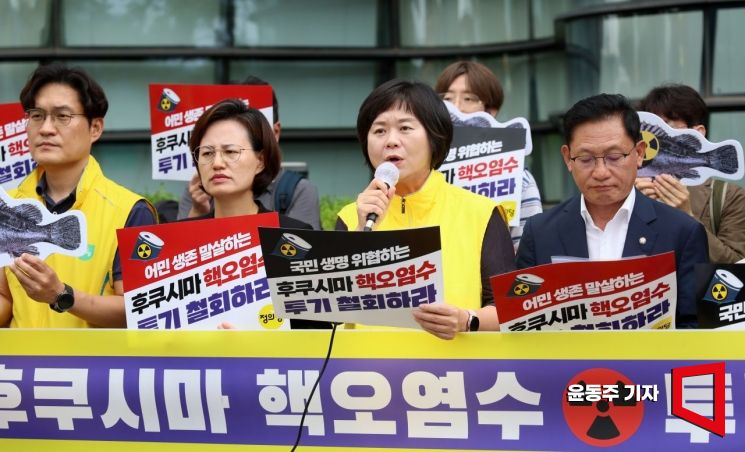 Lee Jung-mi, leader of the Justice Party, holds a press conference on the 26th in front of the Japanese Embassy in Jongno-gu, Seoul, announcing the start of a hunger strike to stop the dumping of contaminated water from Fukushima. Photo by Yoon Dong-joo doso7@
Former President Kim Young-sam, during his time as leader of the New Democratic Party in 1983, protested against Chun Doo-hwan's dictatorship by fasting. Under house arrest due to the Special Measures Law for political reform, he demanded the release and reinstatement of students, religious figures, and intellectuals, and the cancellation of media consolidation. He stopped his 23-day hunger strike saying, "I stop to die standing and fighting rather than sitting and dying."
In 1990, former President Kim Dae-jung, then chairman of the Peace Democratic Party, fasted for 13 days demanding an end to political surveillance and full implementation of local autonomy. His demands were partially realized with the 1991 local council elections and fully achieved with the 1995 local government head elections.
In the 2000s, hunger strikes were increasingly used to demonstrate political clarity or to oppose specific policies. In the early 2000s, former Democratic Labor Party lawmaker Kang Ki-gap fasted for 29 days opposing the rice negotiation ratification bill, and in 2007, former Democratic Labor Party leader Moon Sung-hyun fasted for 26 days opposing the Korea-US Free Trade Agreement (FTA). In 2011, Justice Party lawmakers Roh Hoe-chan and Sim Sang-jung fasted for 30 days demanding the withdrawal of layoffs at Hanjin Heavy Industries, marking the longest hunger strike by politicians in South Korean history.
In December 2018, then Bareunmirae Party leader Sohn Hak-kyu and Justice Party leader Lee Jeong-mi began a hunger strike demanding the introduction of a mixed-member proportional representation system. They ended their strike after nine days when the five ruling and opposition parties agreed to actively consider concrete measures for its implementation. In November 2019, former Liberty Korea Party leader Hwang Kyo-ahn began a hunger strike demanding the withdrawal of the decision to terminate the Korea-Japan General Security of Military Information Agreement (GSOMIA). After eight days of protest in front of the Blue House, Hwang collapsed and was hospitalized; he ended the hunger strike following advice from family, doctors, and his party.
Former President Moon Jae-in also fasted for ten days in August 2014 at Gwanghwamun Square when he was a standing adviser to the New Politics Alliance for Democracy, the predecessor of the Democratic Party of Korea. He joined the hunger strike in solidarity with Kim Young-oh, known as 'Yumin's father,' a bereaved family member of the Sewol ferry disaster, who was demanding the passage of the Sewol Special Act.
Recently, Lee Jeong-mi resumed a hunger strike in July to block the discharge of contaminated water from the Fukushima nuclear power plant, stopping after 20 days. Democratic Party lawmaker Woo Won-shik also fasted for 15 days opposing the contaminated water discharge but stopped upon Lee Jae-myung's persuasion.
© The Asia Business Daily(www.asiae.co.kr). All rights reserved.
!["The Woman Who Threw Herself into the Water Clutching a Stolen Dior Bag"...A Grotesque Success Story That Shakes the Korean Psyche [Slate]](https://cwcontent.asiae.co.kr/asiaresize/183/2026021902243444107_1771435474.jpg)

















