Institute for Basic Science publishes paper in Nature Metabolism on the 1st
"Astrocytes in the brain's lateral hypothalamus regulate activation of lipid metabolism"
"MAOB enzyme as an effective target for obesity treatment"
Successful animal experiments in developing new obesity treatment drugs
Domestic researchers have finally discovered a way to "lose weight while eating to your heart's content." This brings good news to the one billion obese patients worldwide.

The research team led by Director Changjoon Lee of the Cognitive and Sociality Research Center at the Institute for Basic Science (IBS) announced on the 1st that they found the principle of fat metabolism regulation in star-shaped non-neuronal cells called "astrocytes" in the brain. Furthermore, in animal experiments where they administered the newly developed drug "KDS2010," they succeeded in weight loss without controlling food intake.
Hunger and energy balance in the body are controlled by the lateral hypothalamus of the brain. Although lateral hypothalamic neurons are known to connect to adipose tissue and be involved in fat metabolism, the exact mechanism of fat metabolism regulation had not been elucidated.
The research team discovered a cluster of neurons called GABRA5 in the lateral hypothalamus that specifically express receptors for the inhibitory neurotransmitter gamma-aminobutyric acid (GABA). They then confirmed that the periodic firing of GABRA5 neurons was significantly reduced in obese mouse models. Using chemogenetic methods to inhibit the activity of GABRA5 neurons resulted in decreased thermogenesis (energy expenditure) in adipose tissue, leading to fat accumulation and weight gain. Conversely, activation of GABRA5 neurons in the lateral hypothalamus led to weight loss. Thus, GABRA5 neurons act as a weight control switch.
The team found that astrocytes in the lateral hypothalamus regulate the activity of GABRA5 neurons. Reactive astrocytes, which increase in number and size, express the enzyme monoamine oxidase B (MAO-B) and produce large amounts of tonic GABA, thereby inhibiting surrounding GABRA5 neurons. Suppressing MAO-B gene expression in reactive astrocytes reduced GABA secretion, activated GABRA5 neurons, and promoted thermogenesis in adipose tissue, resulting in weight loss without controlling food intake. This experiment demonstrated that the MAO-B enzyme in reactive astrocytes is an effective target for obesity treatment.
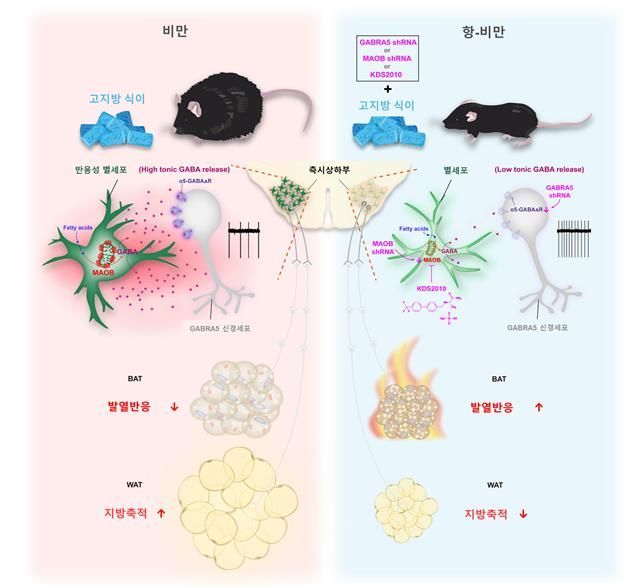 Schematic Diagram of Astrocyte Regulation of Fat Metabolism
(Left) In the lateral hypothalamus of obese mice fed a long-term high-fat diet, reactive astrocytes express the MAO-B enzyme, leading to excessive production of persistent GABA. GABA reduces the activity of GABRA5 neurons, suppressing fat metabolism (decreasing thermogenesis in brown adipose tissue and increasing white fat accumulation), resulting in weight gain.
(Right) Inhibition of astrocytic MAO-B or the GABRA5 gene, or administration of the MAO-B inhibitor KDS2010, reduces GABA secretion, activates GABRA5 neurons, and promotes fat metabolism (enhancing thermogenesis in brown fat and reducing white fat accumulation), leading to weight loss.
Image source: Provided by IBS
Moreover, the selective and reversible MAO-B inhibitor "KDS2010," which was licensed to Neurobiogen in 2019 and is currently in Phase 1 clinical trials with Phase 2 planned for 2024, was administered to obese mouse models. This also significantly reduced fat accumulation and body weight without affecting food intake.
Dr. Sun Sa Mun, the first author and postdoctoral researcher, explained, "Existing hypothalamus-targeted obesity treatments have mainly focused on neuronal mechanisms related to appetite control. To overcome this, we focused on non-neuronal astrocytes and revealed that reactive astrocytes are a cause of obesity."
The results of this study were published online in the international journal Nature Metabolism (IF=20.8), a sister journal of Nature, on the same day.
© The Asia Business Daily(www.asiae.co.kr). All rights reserved.


















