Preparing for the UAM Era... Development of Solutions and Simulators
Enabling Quality Evaluation and Analysis of Air-Ground Network Communication Services
SK Telecom has embarked on developing aerial network technology to prepare for the Urban Air Mobility (UAM) era.
On the 31st, SKT announced that it has developed an integrated solution and simulator for predicting and analyzing the communication quality of aerial networks for UAM.
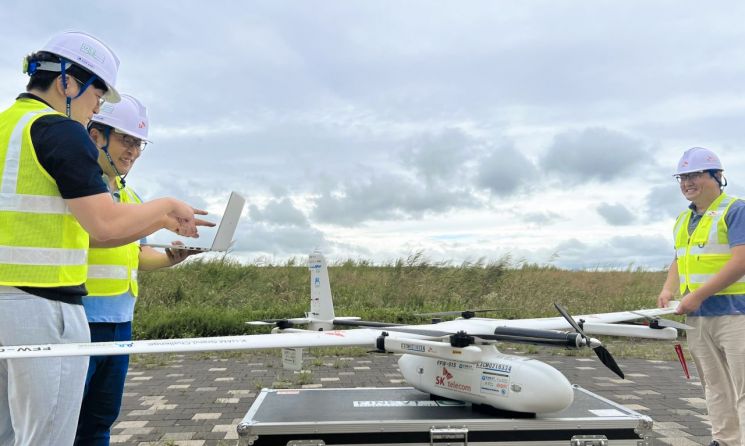
The newly developed integrated solution displays aerial network quality data measured via drones in real time using analysis tools, and visualizes the measurement results through maps, graphs, and charts.
It also applies scenarios where UAM passengers use smart devices such as phone calls and video streaming, enabling a more accurate evaluation of the communication service quality of the aerial network.
The aerial network communication quality prediction simulator developed by SKT can perform integrated analysis of various factors affecting communication quality, such as flight path and altitude settings, and antenna height. It can also be used to calculate aerial network investment costs and derive optimal design plans by considering realistic constraints like base station installation environments and terrestrial network interference.
To improve the simulator’s performance, SKT plans to develop an AI-based optimal design model that recommends base station and antenna settings, aiming to enhance aerial network quality and reduce analysis time.
SKT presented its vision for aerial networks for UAM at MWC 2023 in March. Since last year, it has been continuously conducting communication quality checks at pilot aerial network testbeds established in Goheung and Yangpyeong.
Ryu Jeong-hwan, Vice President and Head of SKT’s Infrastructure Strategy Technology CT, stated, "Developing communication for mobile aerial networks for UAM services requires technological development across all fields including frequency, transmission methods, and equipment. We will do our best not only in 5G but also in developing core technologies for the future evolution of 6G to ensure UAM becomes a reliable means of transportation for customers."
© The Asia Business Daily(www.asiae.co.kr). All rights reserved.
![From Bar Hostess to Organ Seller to High Society... The Grotesque Con of a "Human Counterfeit" [Slate]](https://cwcontent.asiae.co.kr/asiaresize/183/2026021902243444107_1771435474.jpg)
















