'AI Technology Status and International Norms Seminar'
"Global AI Market 500 Trillion by 2027... Semiconductor Level"
"Development of Massive AI Ecosystem... Response to Google and Others Entering Korea"
"Global AI Market 500 Trillion by 2027... Semiconductor Level"
"Development of Massive AI Ecosystem... Response to Google and Others Entering Korea"
The artificial intelligence (AI) market is projected to grow to a scale of 500 trillion won in four years, becoming as important as the semiconductor market, according to an analysis. It was pointed out that South Korea needs to develop its own super-large AI ecosystem to compete with overseas companies such as Google.
The Federation of Korean Industries (FKI) announced on the 31st that it held a seminar on "Current Status of AI Technology and Trends in International Norms" at the FKI building in Yeouido, Yeongdeungpo-gu, Seoul. About 60 people attended the seminar, including Bae Sang-geun, an FKI expert, and Lee Kwang-yong, Director of Policy Strategy at Naver.
In his opening remarks, Executive Director Bae said, "The global AI market size is expected to grow to about 500 trillion won by 2027, which is comparable to the global semiconductor market," adding, "For South Korea to gain an advantage in AI competition, government-level support measures such as expanding related investments, securing infrastructure, and attracting talent are necessary."
Director Lee gave a presentation titled "The Current Status of South Korea in the Global Super-large AI Hegemony Competition." Super-large generative AI is AI that learns from vast amounts of data based on large-scale language models and can be utilized in production activities.
Lee said, "We are now in an era of AI competition where countries worldwide are developing their own super-large AI competitiveness," and added, "South Korea is a country that possesses its own super-large AI, but it is facing a crisis as Google has declared its intention to expand in the Korean market." He further stated, "Developing a domestic super-large AI ecosystem in South Korea will be an opportunity for new growth engines."
Super-large generative AI from global companies disclosed so far include the U.S. OpenAI's 'GPT-3', Google's 'LaMDA', China's Huawei 'Pan-Gu', South Korea's Naver 'HyperCLOVA', and LG's 'ExaWON'.
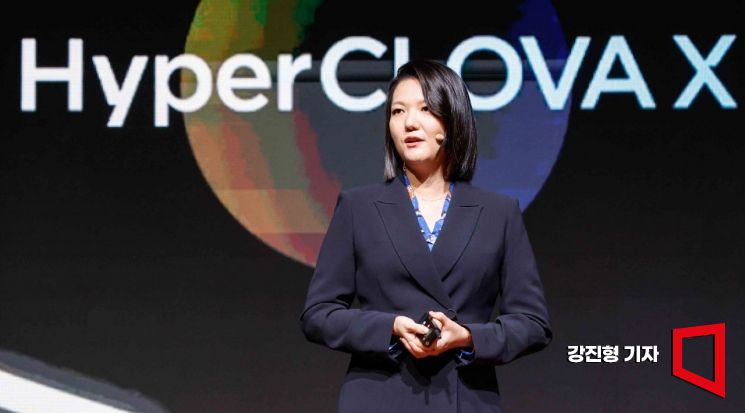 Choi Soo-yeon, CEO of Naver, is unveiling the large language model 'Hyper ClovaX' for the super-large artificial intelligence (AI) service at the 'Team Naver Conference Dan23' held on the 24th at the Grand InterContinental Seoul Parnas in Gangnam-gu, Seoul. Photo by Kang Jin-hyung aymsdream@
Discussions were also held regarding AI regulation. The United Nations (UN) recently announced plans to establish a specialized AI regulatory body at the level of the International Atomic Energy Agency (IAEA). The Organisation for Economic Co-operation and Development (OECD) released the 'OECD AI Recommendation'. The United States, China, and the European Union (EU) are also actively seeking to regulate AI.
Experts agreed that South Korea needs to take the lead in discussions on AI norms.
Choi Seok-young, an advisor at the law firm Kwangjang, suggested during the panel discussion that a public-private cooperation system like the U.S. AI National Security Commission (NSCAI) should be established. NSCAI is an independent federal agency that collects extensive information from academia, industry, and nonprofit organizations to provide recommendations to the government on strengthening national AI competitiveness.
Lee Jong-yong, senior researcher at the Electronics and Telecommunications Research Institute (ETRI), emphasized the need to link AI strategy with digital international norm policies to ensure policy consistency. He cited the United Kingdom as an exemplary case. Lee said, "The UK established a dedicated AI organization within the government to avoid overlapping functions and presented national AI strategies, digital strategies, and international norm strategies on a ten-year basis."
Kim Bong-man, head of the FKI International Headquarters, said, "Major countries such as the U.S., which focuses on fostering the AI industry, and the EU, which emphasizes control and management, are leading discussions on AI norms," adding, "South Korea also needs to actively participate in AI norm discussions to avoid falling behind in the international community."
© The Asia Business Daily(www.asiae.co.kr). All rights reserved.
![From Hostess to Organ Seller to High Society... The Grotesque Scam of a "Human Counterfeit" Shaking the Korean Psyche [Slate]](https://cwcontent.asiae.co.kr/asiaresize/183/2026021902243444107_1771435474.jpg)
















