Stagnation in Private Loan Growth Amid High-Intensity Tightening
Eurozone M3 Money Supply Down 0.4% Year-on-Year in July
The money supply in the Eurozone has decreased for the first time in 13 years. Analysts attribute this to the European Central Bank's (ECB) aggressive tightening, which has stalled loan growth primarily in the private sector, causing liquidity in the market to shrink.
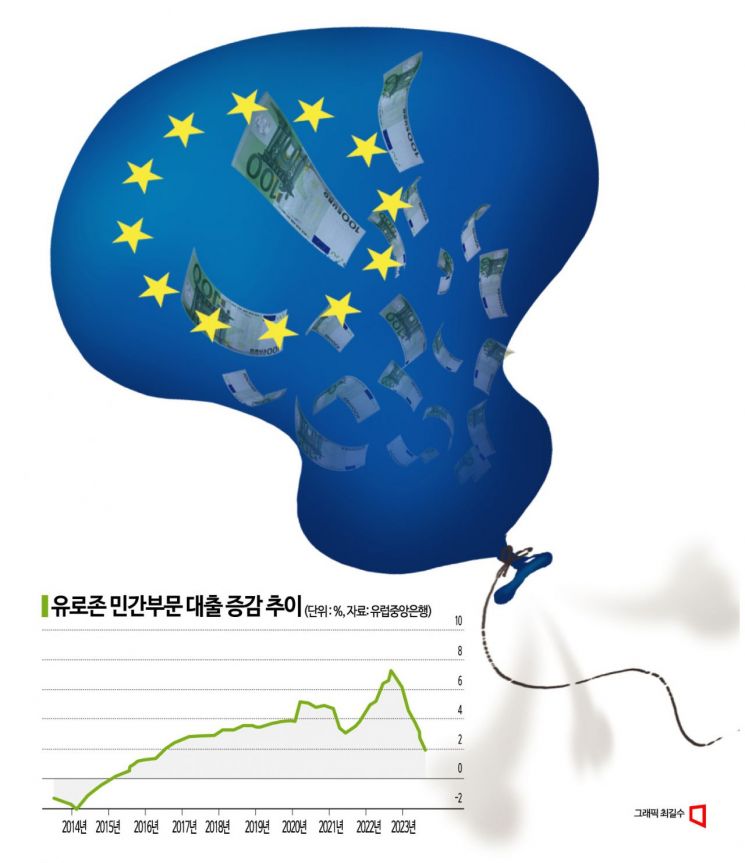
On the 28th (local time), the ECB announced that the Eurozone's total money supply (M3) in July fell by 0.4% compared to the same period last year. This marks a slowdown from the 0.6% increase in the previous month and is the first decline in Eurozone M3 since 2010. M3 is one of the liquidity indicators that includes deposits, loans, cash in circulation, and financial products. It shows how much liquidity is circulating in the market.
The slowdown in private sector loan growth and a decrease in deposits are cited as the causes of the Eurozone's money supply decline for the first time in 13 years. Private sector loans increased by only 1.6% on an annualized basis last month, the lowest growth rate since 2016. Government loans also fell by 2.7% in the same month, marking the largest decline in 16 years since 2007.
Deposits are also rapidly decreasing. Household and corporate deposits fell by 10.5% in July. Total deposits, including those held by households, corporations, government, and financial institutions, also declined by 1.6%.
Bert Colijn, an economist at the Dutch ING Group, diagnosed, "The growth rate of bank loans continues to decline sharply," adding, "Corporate sector loans are significantly decreasing, and mortgage loans are also continuing to slow down." He further stated, "Current economic activity has already entered a recession phase," and predicted, "(Tightening) monetary policy will contribute to creating vulnerable economic conditions for the next few quarters."
The contraction of the Eurozone's money supply is the result of the ECB's aggressive tightening over the past year. While the ECB has continued raising interest rates to curb inflation, the Eurozone economy recorded growth rates of 0.1% in Q1 and 0.3% in Q2 this year. There is growing anticipation that the third quarter will see negative growth. Most notably, Germany, the largest economy in the Eurozone, has fallen into a technical recession. Germany's economic growth rate was -0.4% in Q4 last year, -0.1% in Q1 this year, marking two consecutive quarters of contraction, and recorded 0% growth in Q2.
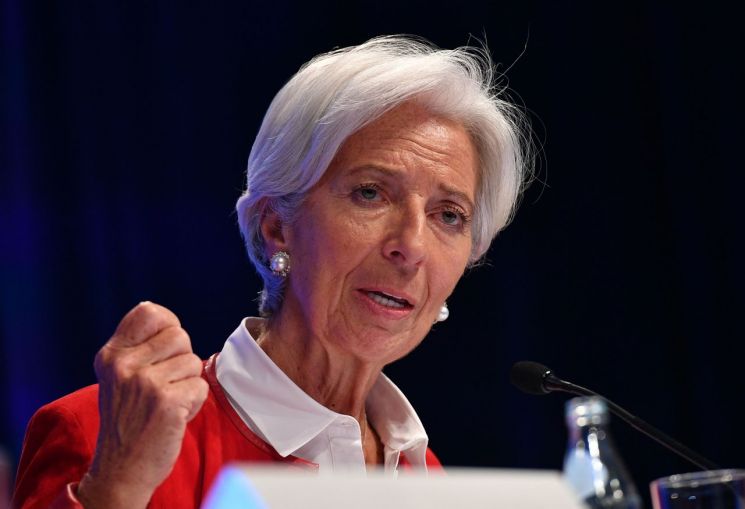
In the market, attention is focused on the ECB's interest rate decision on the 14th of next month, as the Eurozone money supply is one of the key indicators the ECB watches to assess the impact of its tightening monetary policy. The Eurozone inflation data for August, to be released on the 31st, is also a major variable that will influence the direction of ECB monetary policy. Christine Lagarde, President of the ECB, said in an interview with Bloomberg during the Jackson Hole meeting held from the 24th to 26th, "Due to broad structural changes, it is becoming more difficult to understand the economy," and added, "The ECB's decisions will be cautious and firmly data-driven."
Experts predict that the ECB is likely to keep the benchmark interest rate unchanged next month. According to a recent survey of 70 economists conducted by a foreign media outlet, more than half of the respondents, 37 (53%), expected the ECB to hold the benchmark rate at 3.75% at the upcoming monetary policy meeting. Fr?d?ric Du Crozet, Chief Macroeconomic Researcher at Pictet Asset Management, emphasized, "The situation seems to be worsening as credit (loans) growth, especially for households, is collapsing," and added, "The ECB may soon stop raising rates. It must stop."
© The Asia Business Daily(www.asiae.co.kr). All rights reserved.











![The Special Connection Between the Statue of Martyr Lee Jun in Jangchungdan Park and Mayor Oh Sehoon ③ [Current Affairs Show]](https://cwcontent.asiae.co.kr/asiaresize/319/2026012110001599450_1768957215.jpg)