SNS Posts of 'Jaetbitbada' Spread
Government Says "Timing Does Not Match"
The government has denied claims that the color of the nearby sea changed immediately after contaminated water from Japan's Fukushima Daiichi Nuclear Power Plant was discharged into the ocean, stating there is "no causal relationship."
On the 28th, Park Gu-yeon, the First Deputy Minister of the Office for Government Policy Coordination, said at a daily briefing on the Fukushima contaminated water discharge held at the Government Complex Seoul, "Photos claiming that the color of the seawater near the Fukushima nuclear power plant changed immediately after the start of the contaminated water discharge are spreading on the internet."
He added, "After inquiring with Tokyo Electric Power Company (TEPCO) about the related matter, it was confirmed that the photo was taken around 1:05 PM, while the actual contaminated water began flowing into the sea at 1:13 PM," and dismissed the claim by saying, "The assertion that the phenomenon in the photo was caused by the discharge is temporally inconsistent."
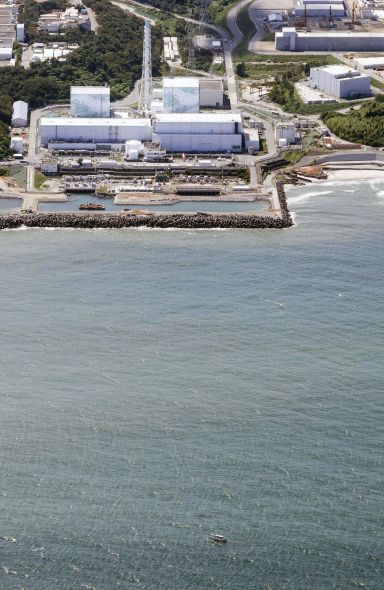 The Fukushima Daiichi Nuclear Power Plant, where the discharge of contaminated water (referred to as "treated water" by the Japanese government) into the ocean began on the afternoon of the 24th. [Image source=Yonhap News]
Previously, posts rapidly spread on online communities and social networking services (SNS) claiming that the color of the seawater in front of the Fukushima nuclear power plant changed from blue to an ashen color after the contaminated water discharge. Some netizens also posted photos showing the seawater turned ashen, explaining that the photos were taken from the air one hour after the discharge began.
In response, Deputy Minister Park explained, "The parts of the sea that appear black in the photo correspond to the location of the reef zone, and the color can change depending on the amount of light," adding, "The phenomenon in the photo is a completely natural occurrence and is not related to the contaminated water discharge."
Japan: "No Tritium Detected in First Seawater Test After Contaminated Water Discharge"
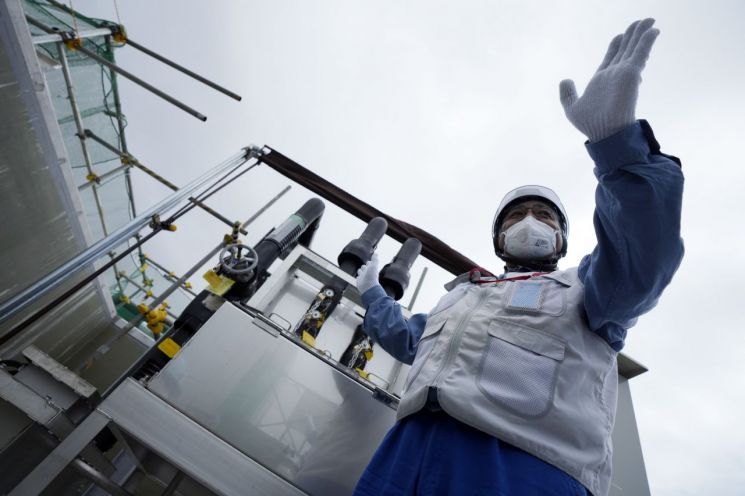 A Tokyo Electric Power Company official explained to reporters the machine used to collect samples of diluted contaminated water (referred to as "treated water" by the Japanese government) at the Fukushima Daiichi Nuclear Power Plant in Futaba, Fukushima Prefecture, Japan, on the 27th.
 [Image source=AP Yonhap News]
However, concerns about the safety of the contaminated water have not subsided. In response, Japan's Ministry of the Environment announced on the 27th that no radioactive substance tritium was detected in seawater samples taken around the contaminated water discharge site.
According to local media such as the Yomiuri Shimbun, on the morning of the 25th, the day after the contaminated water discharge, seawater was collected from 11 locations within 40 km of the Fukushima Daiichi Nuclear Power Plant to measure tritium concentration. The results showed that all locations were below the detection limit of 7 to 8 becquerels (Bq) per liter.
The Ministry of the Environment stated, "At all locations, the tritium concentration was below the detectable limit, confirming no impact on humans or the environment." Among these, radioactive substances such as cesium-137 were also measured at three locations, but all were below the detection limit. The Ministry plans to collect seawater samples weekly from the 11 locations to analyze tritium concentration going forward.
© The Asia Business Daily(www.asiae.co.kr). All rights reserved.
![Clutching a Stolen Dior Bag, Saying "I Hate Being Poor but Real"... The Grotesque Con of a "Human Knockoff" [Slate]](https://cwcontent.asiae.co.kr/asiaresize/183/2026021902243444107_1771435474.jpg)

















