Salt Hoarding, Increase in Portable Radiation Detector Purchases
"Considering Additional Measures Beyond China's Seafood Import Restrictions"
Anti-Japanese sentiment is rising in China following the start of contaminated water discharge from Japan's Fukushima Daiichi Nuclear Power Plant. Incidents such as stones being thrown at Japanese schools in China and protest calls have occurred, and graffiti expressing contempt for Japanese people was found near the Japanese Consulate General in Qingdao.
In China, after the contaminated water discharge, there have been reports of salt hoarding, and the purchase of portable radiation detectors has also surged. Moon Il-hyun, a professor at China Zhengfa University, said in an interview with MBC Radio, "The price of portable radiation detectors has increased several times," adding, "It is said that there are about 70,000 Japanese restaurants in China, and Japanese restaurants seem to have taken the direct hit first."
Professor Moon further explained, "The southern regions of China, such as Guangdong and Fujian provinces, which consume the most seafood and are close to Hong Kong, have seen a sudden drop in consumption, and there have been reports that the damage within China is not insignificant."
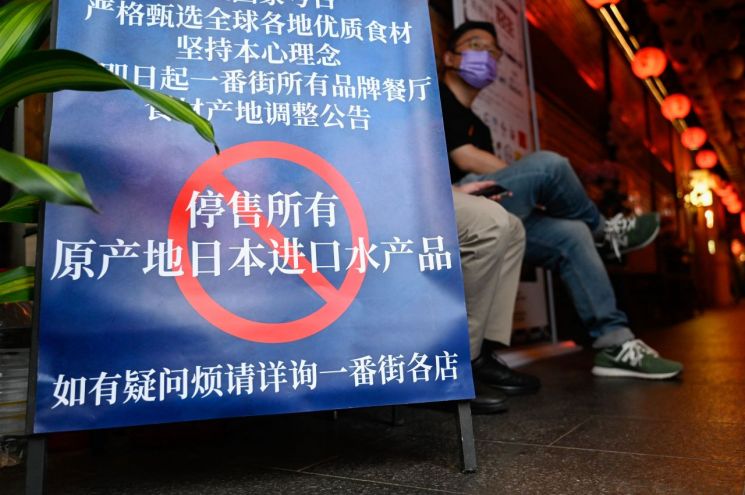 On the 27th, a sign announcing the suspension of sales of Japanese seafood was placed in a restaurant in Beijing, China. Japanese media reported on the 28th that anti-Japanese sentiments have emerged in China following the start of the discharge of contaminated water from the Fukushima Daiichi Nuclear Power Plant (referred to as "treated water" by the Japanese government) into the ocean. /
 [Image source=Yonhap News]
Professor Moon predicted that China might take additional measures against Japan. These additional measures can be summarized into four categories: public opinion warfare, international actions, economic sanctions, and military responses. Professor Moon particularly pointed out military responses as a notable aspect.
He said, "If the nuclear contaminated water discharged by Japan exceeds international standards, there is a claim that it should be considered a military attack using biochemical weapons, and thus China and Russia might jointly respond militarily based on biochemical standards," adding, "Chinese media also describe this situation as a last resort assuming the worst-case scenario, but all these phenomena are evidence showing the atmosphere within China."
Meanwhile, tensions between Chinese and Japanese diplomatic authorities are also intensifying.
At a press conference on the 28th of last month, Hirokazu Matsuno, Chief Cabinet Secretary and spokesperson for the Japanese government, expressed regret and concern over the spread of anti-Japanese sentiment in China and urged the protection of the safety of Japanese residents in China. On the same day, Mataga Okano, Vice Minister of Foreign Affairs of Japan, summoned Wu Jianghao, Chinese Ambassador to Japan, to the Japanese Ministry of Foreign Affairs in Tokyo to express regret over China's import restrictions on Japanese seafood and demanded their immediate removal.
The Chinese side maintains that the safety of foreigners will be protected according to Chinese law but holds Japan responsible for causing the current situation.
Wang Wenbin, spokesperson for the Chinese Ministry of Foreign Affairs, stated at a regular briefing, "What I want to emphasize is that China protects the safety and legitimate rights and interests of foreigners residing in China according to the law," but also added, "I want to emphasize that neighboring countries and the international community are criticizing Japan's behavior of starting the discharge of contaminated water despite international opposition."
© The Asia Business Daily(www.asiae.co.kr). All rights reserved.

















