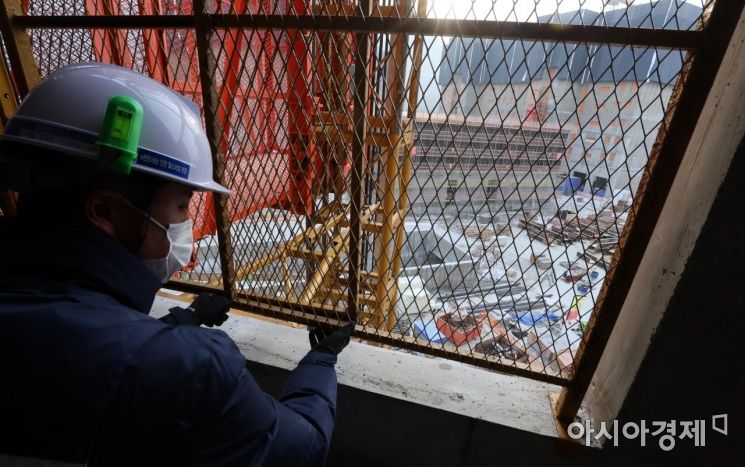
 On the first day of the Serious Accidents Punishment Act enforcement, which allows for the punishment of management officials when serious accidents such as worker fatalities occur, managers are conducting a safety inspection at an apartment construction site in Gyeonggi-do on the 27th. Photo by Hyunmin Kim kimhyun81@
Most small and medium-sized enterprises (SMEs) with fewer than 50 employees believe that the grace period for the Serious Accidents Punishment Act (SAP Act) should be extended.
The Korea Federation of SMEs announced on the 29th the results of a survey conducted from the 23rd to the 25th targeting 892 SMEs with 5 to 49 employees, titled "Status and Cases of SAP Act Response for SMEs with Fewer than 50 Employees." This survey was conducted to understand the preparation status and system improvement plans ahead of the application of the SAP Act to small workplaces with fewer than 50 employees, which is set to take effect on January 27, 2024, about five months away.
85.9% of SMEs with fewer than 50 employees responded that an extension of the SAP Act grace period is necessary, as preparations are still insufficient. 80% of SMEs with fewer than 50 employees said they were not prepared for the enforcement of the SAP Act. Among them, 29.7% said they had made "no preparations at all," and 50.3% said they had "not prepared significantly." Only 18.8% responded that they were "significantly prepared" for the enforcement of the SAP Act, and just 1.2% said they had "completed all preparations."
Regarding the reasons for the lack of preparation despite two years since the SAP Act was enacted, 35.4% cited a "lack of professional personnel." Responses such as "budget shortage" (27.4%) and "difficulty understanding obligations" (22.8%) also accounted for a large portion.
If the grace period for the SAP Act is not extended, more than half (57.8%) said they have "no appropriate measures." 18.7% said they would consider "reducing employment and automating facilities," and 16.5% said they would consider "downsizing or closing their business," indicating that SMEs feel a very high burden.
If the SAP Act is extended, many expressed intentions to expand safety management through measures such as "strengthening safety culture by conducting worker education" (38%), "expanding personal protective equipment such as protective clothing" (14.6%), "investing in facility improvements such as upgrading old facilities and automation" (18.9%), and "conducting safety consulting from specialized institutions" (13.7%).
Lee Myung-ro, Head of the Human Resources Policy Division at the Korea Federation of SMEs, said, "If the SAP Act is enforced without thorough preparation and support, and business owners are detained or sentenced to imprisonment, small workplaces where the role of the business owner is absolute will inevitably face the risk of closure. Since this is a matter concerning the survival of small workplaces and the livelihoods of the workers there, we ask that the ruling and opposition parties actively negotiate in the National Assembly to process the extension of the SAP Act grace period for workplaces with fewer than 50 employees by at least two years as a livelihood bill during the regular session in September."
© The Asia Business Daily(www.asiae.co.kr). All rights reserved.

















