The government will establish a special supply for newborns in public and private sales, providing about 70,000 housing units annually to families with newborns. Additionally, support will be provided for housing purchase and jeonse (long-term deposit lease) loans at the lowest interest rates to families with newborns, regardless of marital status. Income criteria for dual-income couples will be relaxed for public sales, and individual subscription by spouses will be allowed.
The government announced the "Housing Support Plan to Overcome Low Birthrate" on the 29th, which includes these measures. This plan is a follow-up to the housing policy measures presented at the Low Birthrate and Aging Society Committee meeting chaired by the president in March. Unlike previous birth encouragement housing policies that benefited married households, this plan focuses on benefits for families with newborns. To smoothly implement these policies, the government has allocated 36.7 trillion won in the 2024 budget proposal for national housing stability, an increase of 4.2 trillion won from the 2023 main budget (32.6 trillion won).
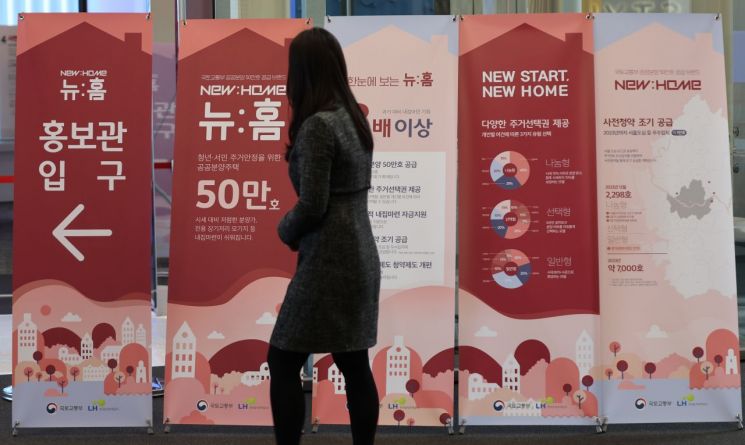
70,000 Public and Private Housing Units for Childbirth... Public Housing Provided Regardless of Marital Status
First, the government will specially supply about 70,000 units annually, including 30,000 public sales, 30,000 public rentals, and 10,000 private sales, for families with newborns. A special newborn supply will be newly established in public sales under the New:Home program, granting special supply eligibility if pregnancy or childbirth is proven within two years from the public announcement date, regardless of marital status. Income and asset criteria are set at 150% of the average monthly urban worker income and assets below 379 million won. The government plans to supply about 30,000 units annually through New:Home.
Additionally, a newborn priority supply will be introduced for private sales, prioritizing families with newborns during the first-time homebuyer and newlywed special supply. Similar to New:Home, if pregnancy or childbirth is proven within two years and the household income is below 160% of the average monthly urban worker income, subscription is possible, with priority given to lower-income households. The supply volume will be about 10,000 units annually, allocating 20% of the annual first-time homebuyer and newlywed special supply units.
A newborn priority supply will also be introduced for public rental housing, providing about 30,000 units annually to families with newborns. New public rentals will be prioritized for families with newborns, and existing public rental re-supply units will also prioritize these families. For example, a newlywed couple who becomes a three-person household due to childbirth can move to an appropriately sized unit. ▲For construction rentals, the criteria are below 100% of median income and assets below 361 million won ▲For purchase and jeonse rentals, the income criterion is below 100% of the average monthly urban worker income, with the same asset criteria.
Introduction of Newborn Special Purchase Funds... Preferential Interest Rate Benefits for Childbirth
Financial support for families with newborns will also be strengthened. To support homeownership for families with newborns, a low-interest purchase loan will be introduced, doubling the income eligibility compared to existing loans. The target is non-homeowning households that have given birth within two years from the loan application date, applicable from babies born this year. Households with income below 130 million won will be supported, with the housing price limit increased from 600 million to 900 million won and the loan limit raised from 400 million to 500 million won. Asset criteria remain the same as existing purchase loans, set at below 506 million won. Interest rates will be preferentially applied at 1.6% to 3.3% for five years, about 1 to 3 percentage points lower than market rates.
Furthermore, if an additional child is born after receiving the special loan, an additional interest rate reduction of 0.2 percentage points per newborn will be provided. The preferential interest rate can be extended for five years, allowing up to 15 years of application.
A special newborn jeonse loan will also be introduced. Low-interest jeonse loans will be newly established for tenant households giving birth, with income eligibility more than doubled compared to existing loans. The same income criteria as the special purchase loan apply to non-homeowning households that have given birth within two years, with increased deposit limits (4 billion to 5 billion won in the metropolitan area) and a loan limit of 300 million won. Upon loan execution, preferential interest rates of 1.1% to 3.0% will be applied for four years depending on income. Additional childbirth after the special loan will provide an extra 0.2 percentage point interest rate reduction per newborn. Extensions allow up to 12 years of interest benefits.
200% Income Criteria for Dual-Income Couples... Individual Subscription by Spouses Allowed
The subscription system will also be improved to favor marriage and childbirth. First, income criteria for dual-income couples will be relaxed. Specifically, a lottery system will be introduced for public housing special supply (newlyweds, first-time homebuyers, etc.), applying a 200% average monthly income criterion for dual-income households. Individual subscription by spouses will be allowed. Previously, if both spouses applied for the same subscription announced on the same day and both won, both were disqualified, effectively limiting subscription opportunities to one per couple; this rule will be abolished. Additionally, the multi-child criteria will be relaxed, lowering the private sale multi-child special supply standard from three children to two.
Moreover, to maximize subscription opportunities, the spouse's pre-marriage homeownership and subscription winning history will be excluded, and the subscription savings account period of both the applicant and spouse will be combined to favor newlywed households over singles. The marriage restriction for youth special supply will also be improved, allowing move-in and contract renewal even if marriage occurs after the move-in contract.
© The Asia Business Daily(www.asiae.co.kr). All rights reserved.

















