Meeting with Congressman Anderson during his visit to Korea
"Construction of 10 Reactors over 20 Years"
Lee In-seon, a member of the People Power Party (Daegu Suseong-gu B), held a meeting on the 28th at the National Assembly with Tobias Andersson, Chairman of the Swedish Industry and Trade Committee, who is visiting Korea. At this meeting, he requested active support at the National Assembly level to allow Korea Hydro & Nuclear Power to participate in Sweden's ongoing Small Modular Reactor (SMR) introduction project.
The meeting was held at the request of the Swedish Industry and Trade Committee delegation officially visiting Korea. Attendees included Lee In-seon of the National Assembly's Industry, Trade, Energy, Small and Medium Venture Business Committee, along with Chairman Lee Jae-jung, Secretary Kim Han-jung, and members Choi Hyung-doo and Noh Yong-ho.
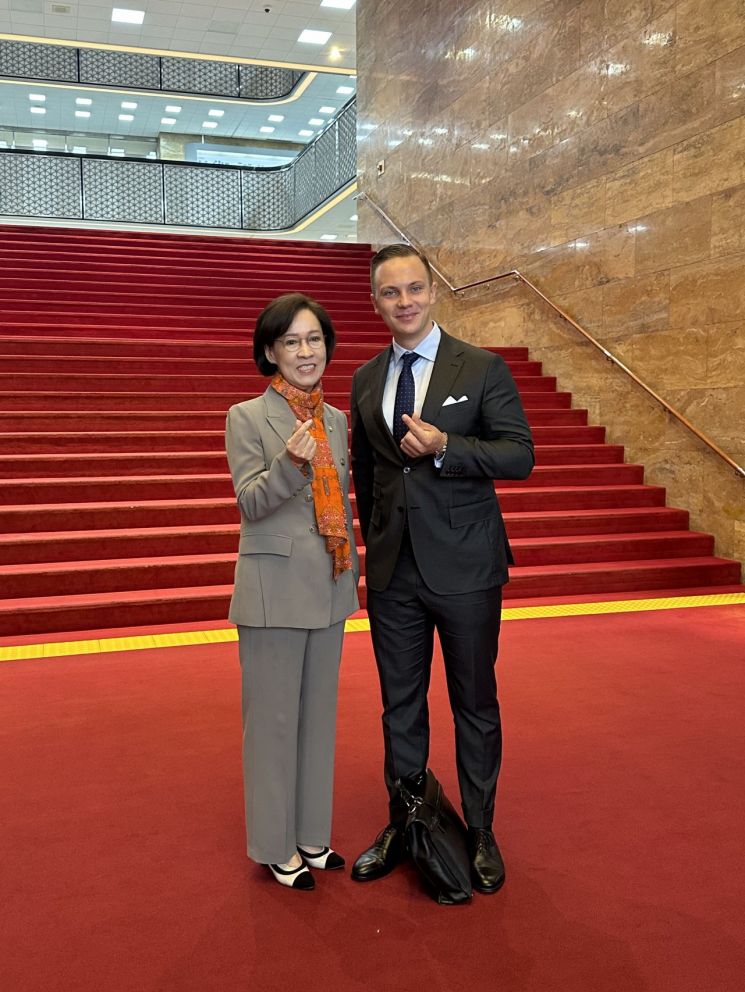 People Power Party lawmaker Lee In-seon is meeting with Swedish lawmaker Tobias Andersson at the National Assembly to discuss nuclear power plant exports and other matters, followed by a commemorative photo.
Lawmakers from both countries discussed energy, electric vehicles, batteries, and the defense industry, with the greatest interest focused on the energy mix in response to the climate crisis. Sweden is particularly recognized as a model country in addressing the climate crisis and has set a climate policy goal of ‘100% fossil-free energy’ to achieve net-zero by 2045.
A notable point in this goal is the plan to construct at least 10 nuclear reactors over the next 20 years, with active consideration of introducing Small Modular Reactors (SMRs). Korea Hydro & Nuclear Power is participating in this project and negotiations are underway.
Korea Hydro & Nuclear Power submitted a letter of intent to participate in the Swedish SMR construction project in January this year and submitted preliminary review materials in May. Vattenfall, the Swedish state-owned power company, informed Korea Hydro & Nuclear Power in June that it had passed the preliminary review, and the formal bidding evaluation is now in progress.
Sweden produces 30% of its total energy from nuclear power. In 1980, it pursued a policy of phased nuclear power phase-out through a national referendum. However, last year Sweden amended and repealed nuclear power regulations to meet realistic climate goals. This is because it is difficult to replace nuclear power in terms of generation costs and greenhouse gas emissions, and energy security has been challenged due to the Russia-Ukraine war.
At the meeting, Chairman Tobias Andersson said, “Sweden will expand nuclear power to overcome the climate crisis. There is no problem as facilities for radioactive waste disposal for nuclear power are also prepared. We hope to expand cooperation with Korea on nuclear power in the future.”
Lee In-seon of the People Power Party said, “Since the Swedish government has chosen to expand nuclear power in its new energy policy, we hope for active cooperation with Korea, a nuclear power stronghold. Korea has the capability to build the best nuclear power plants in the world in the shortest time and most economically,” adding, “Korea Hydro & Nuclear Power can be the most suitable and ideal partner for the SMR project underway in Sweden. We ask for active support and interest at the National Assembly level.”
Sweden is a major trading partner and maintains a friendly relationship with the Republic of Korea in Europe. During the Korean War, Sweden dispatched a medical support team and established diplomatic relations in 1959. Since then, cooperation has expanded in politics, economy, culture, and various fields on the international stage, including democracy, human rights, development, and non-proliferation.
© The Asia Business Daily(www.asiae.co.kr). All rights reserved.

















