World's First Discovery of Quantum State in Triangular Lattice Magnetic Material
Research Team of Prof. Je-Geun Park, Seoul National University and Prof. Sung-Jin Kim, Ewha Womans University
Researchers in South Korea have discovered a new quantum state in a triangular lattice structured magnetic van der Waals material for the first time in the world. This is seen as a step forward toward realizing error-free quantum computers.
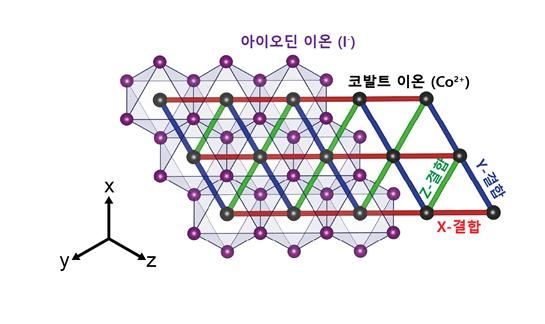
The Ministry of Science and ICT announced on the 29th that the research team led by Professor Park Je-geun of Seoul National University and Professor Kim Sung-jin of Ewha Womans University published a paper on the 28th (local time) in the international journal 'Nature Physics'. (Paper title: Bond-dependent anisotropy and magnon decay in cobalt-based Kitaev triangular antiferromagnet)
The Kitaev model is a quantum phenomenon that appears in materials with a honeycomb structure and has attracted worldwide attention because it possesses quantum states capable of realizing error-free quantum computers. Until now, many researchers both domestically and internationally have only succeeded in implementing the Kitaev model using honeycomb structured materials.
Although it has been theoretically known that materials with a triangular lattice structure, rather than a honeycomb structure, could exhibit various quantum phenomena if they possess quantum states, such implementation in actual materials had never been achieved.
While studying magnetic materials, the research team discovered that substituting the previously used material nickel (chemical symbol: Ni) with cobalt (chemical symbol: Co) satisfies several conditions necessary for implementing the Kitaev model. The cobalt iodide (CoI2) used by the team was found to have been synthesizable about 40 years ago but was very vulnerable to moisture, making it difficult to use.
Despite these difficulties, the research team was able to analyze this material in a more stable state due to their continued research on magnetic materials. To experimentally verify their theoretical findings, they conducted inelastic neutron scattering experiments and spin wave measurements using the neutron facility at the Japan Proton Accelerator Research Complex (J-PARC), and analyzed the experimental results through joint research with American researchers.
This is the world's first experimental realization of the Kitaev model in a two-dimensional triangular lattice and represents a global research achievement in quantum materials through Korea-US-Japan international collaboration. By implementing the Kitaev model, which can be utilized in quantum computers, in a two-dimensional magnetic van der Waals triangular lattice material, high applicability is expected in the fields of condensed matter physics and quantum information in the future.
Professor Park stated, “Discovering quantum states with quantum entanglement in two-dimensional materials is very important,” and explained, “Our research team pioneered and established the magnetic van der Waals materials field as a globally significant research area by discovering quantum states with important quantum entanglement, once again producing leading research results and leading this field.”
© The Asia Business Daily(www.asiae.co.kr). All rights reserved.

















