Color Changes According to the Amount of Light
Not Related to Contaminated Water Discharge
On the 24th, regarding the photos circulating on the internet showing color changes in the Fukushima sea area after Japan's discharge of contaminated water, the government drew a clear line, stating that "the color can change depending on the amount of light" and that "this is not an issue related to the discharge of contaminated water."
Park Gu-yeon, the First Deputy Director of the Office for Government Policy Coordination, announced on the 28th during a daily briefing on contaminated water that this was confirmed after inquiring with Tokyo Electric Power Company (TEPCO).
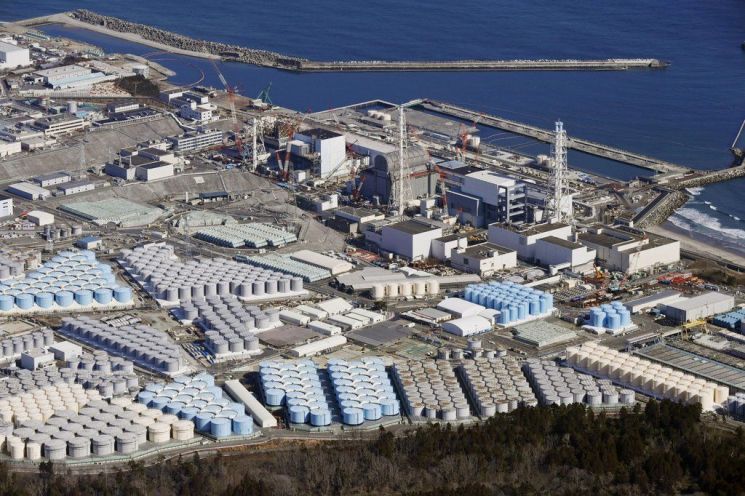 (View of Fukushima Daiichi Nuclear Power Plant with contaminated water tanks installed = Yonhap News)
Government: Natural Phenomenon Due to Changes in Light... Not Related to Contaminated Water Discharge
Deputy Director Park first conveyed TEPCO's position that "the photo was taken around 13:05, but the actual time when contaminated water started flowing into the sea was 13:13. The claim that the phenomenon in the photo occurred due to the discharge is not consistent with the timeline."
The part of the sea appearing black in the photo corresponds to the location of the reef zone, and the color can change depending on the amount of light. The yellowish appearance of the sea surface is due to strong tidal currents, which is a common phenomenon in the waters off Fukushima. Deputy Director Park stated, "The phenomenon in the photo is an extremely natural occurrence and is not related to the discharge of contaminated water."
Korean Experts Hold First Meeting with IAEA Office... Post-Activity Report Planned
The government announced that three experts from the Korea Institute of Nuclear Safety (KINS), who departed yesterday, held their first meeting with officials from the local International Atomic Energy Agency (IAEA) office. The duration of their stay and the mode of activities are under discussion with the IAEA. Deputy Director Park said, "To ensure the efficiency and safety of the experts' on-site inspection, it is difficult to provide real-time explanations. After their visit, we plan to report on the activities conducted by the Korean experts in a post-visit report format."
This dispatch is a measure following an agreement between the Korean government, the Japanese government, and the IAEA to allow Korean experts to be dispatched to the Fukushima IAEA office once every two weeks for safety inspections. The exact duration of their stay has not been determined. Previously, the IAEA promised to regularly share the latest information related to contaminated water discharge with the Korean government and to hold weekly video conferences with the Korean government.
Data Provided by Tokyo Electric Power Company... Meets Safety Standards
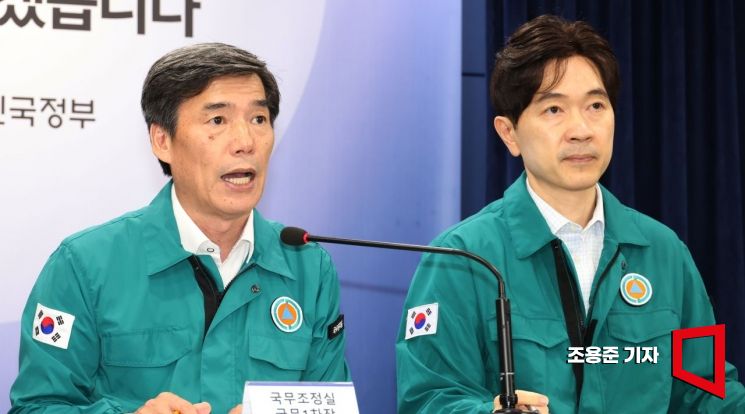 On the afternoon of the 22nd, when the Japanese government announced that it would start discharging contaminated water from the Fukushima nuclear power plant from the 24th, Park Gu-yeon, First Deputy Director of the Office for Government Policy Coordination, attended a daily briefing related to the nuclear power plant contaminated water discharge held at the Government Seoul Office in Jongno-gu, Seoul, and explained the government's position on Japan's contaminated water discharge. Photo by Jo Yong-jun jun21@
Deputy Director Park stated that the data provided by TEPCO after the discharge meets safety standards. He explained, "The 'total notified concentration ratio,' which sums the ratios of actual measured values against the emission standards for each radionuclide, must not exceed 1; if it does, the water must undergo ALPS (Advanced Liquid Processing System) purification again. The 'total notified concentration ratio' of the contaminated water currently being discharged, as of June 22, is 0.28, which meets the standards."
Deputy Director Park added, "The main focus of inspection is whether the tritium concentration in the seawater pipeline header is below the discharge target of 1,500 Bq (becquerels) per liter. Since the discharge began, measurements have ranged from a minimum of 142 Bq to a maximum of 200 Bq per liter, confirming that the levels are below the standard."
© The Asia Business Daily(www.asiae.co.kr). All rights reserved.

![A Woman with 50 Million Won Debt Clutches a Stolen Dior Bag and Jumps... A Monster Is Born [Slate]](https://cwcontent.asiae.co.kr/asiaresize/183/2026021902243444107_1771435474.jpg)
















