President Yoon Receives Related Reports and Discusses Response Over the Weekend
Government Expands Inspections by Private Agencies and Conducts Expert On-Site Investigations
Presidential Office and Government Prepare Measures to Increase Seafood Consumption
As public concerns over the 'safety of seafood' grow due to the discharge of contaminated water from Japan's Fukushima Daiichi Nuclear Power Plant into the ocean, the government has established and launched a comprehensive management system. The Presidential Office, government, and ruling party are focusing on blocking 'contaminated water rumors' while dispatching experts to Japan to establish an independent marine monitoring system. At the intergovernmental level, measures to promote seafood consumption are also being prepared.
According to the Presidential Office on the 28th, President Yoon received reports on domestic and international analyses of the contaminated water discharge even on the previous holiday and held discussions with aides on government responses. A senior official from the Presidential Office stated, "We will ensure that fishermen, seafood industry workers, and small business owners are not harmed by rumors," expressing a commitment to continue efforts to alleviate public anxiety.
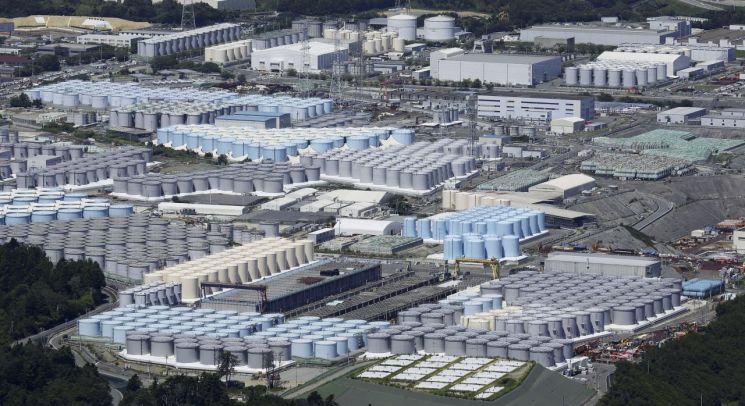
The day before, the Ministry of Oceans and Fisheries announced that in the first marine radioactivity survey conducted after Japan's contaminated water discharge, both cesium and tritium levels were confirmed to be significantly lower than the World Health Organization (WHO) standards for drinking water. The marine radioactivity survey was conducted on the 25th, one day after the discharge, at 15 points across three Korean sea areas, with results from five points in the southeastern sea area.
In particular, the government plans to strengthen radioactivity inspections before the shipment of farmed seafood and increase the volume of inspections by allowing private institutions to conduct tests as well. Starting as early as today until the end of the year, the government intends to expand pre-shipment inspections to over 4,000 cases using private institutions. A government official explained, "The goal is to divide all domestic fish farms into unit sea areas and conduct thorough inspections without blind spots," adding, "Effectively, radioactivity inspections before shipment will be conducted across all sea areas."
Three researchers from the Korea Institute of Nuclear Safety (KINS) also departed for Japan the day before to monitor the contaminated water discharge situation. This marks the dispatch of Korean experts to the site just three days after Japan began discharging contaminated water, an immediate measure aimed at reducing public anxiety through scientific investigation rather than rumors and preventing impacts on the domestic seafood market. The researchers dispatched to Japan will conduct comprehensive monitoring related to the discharge situation, including whether Japan is adhering to international safety standards while discharging the contaminated water.
Considering public sentiment, the term 'contaminated water' will continue to be used for the time being as a choice to build public trust. However, since countries like the United States, the United Kingdom, and Germany use the term 'treated water' after ALPS (Advanced Liquid Processing System) treatment, which is the accurate expression, there remains a possibility that the government may politically address terminology if domestic consumption changes due to the use of 'contaminated water' continue to be pointed out.
Government measures to promote domestic seafood consumption have already begun. The Presidential Office has taken the lead by providing domestic seafood in the cafeteria lunch menu for one week starting today. The Presidential Office believes that setting an example by consuming domestic seafood is essential to prevent excessive spread of anxiety.
Government-level measures to promote seafood consumption are expected to continue. The Ministry of Oceans and Fisheries reportedly requested the Ministry of Economy and Finance to allocate contingency funds for a 'seafood value and consumption promotion' project. Private sector participation is also ongoing. Minister Cho Seung-hwan of the Ministry of Oceans and Fisheries recently met with Koo Ja-yeol, Chairman of the Korea International Trade Association, and Roh Dong-jin, Chairman of the National Federation of Fisheries Cooperatives, to discuss cooperation plans for mutual growth in seafood consumption between domestic companies and the seafood industry. At this meeting, Minister Cho requested ▲expansion of domestic seafood supply to corporate group catering ▲encouragement of visits to domestic fishing villages during the autumn travel season ▲increased use of seafood for souvenirs and holidays.
© The Asia Business Daily(www.asiae.co.kr). All rights reserved.
![User Who Sold Erroneously Deposited Bitcoins to Repay Debt and Fund Entertainment... What Did the Supreme Court Decide in 2021? [Legal Issue Check]](https://cwcontent.asiae.co.kr/asiaresize/183/2026020910431234020_1770601391.png)















