Professor Kang Geon-wook of Seoul National University, YTN Radio Interview
"Vegetables, Fruits, and Meat Contain 10 Times More Tritium"
Professor Kang Geon-wook of the Department of Nuclear Medicine at Seoul National University said on the 28th regarding concerns about seafood safety due to the discharge of contaminated water from the Fukushima nuclear power plant in Japan, "Even if you consume seafood, tritium enters the body in the form of water and is expelled from the body."
When contaminated water is repeatedly treated with the Advanced Liquid Processing System (ALPS), the concentrations of 62 radioactive substances such as cesium and strontium in the contaminated water can be reduced below the standard levels. However, tritium is not removed through this process, which has raised concerns.
In an interview with YTN Radio's 'News King Park Ji-hoon' on the same day, Professor Kang said, "Tritium is unlikely to accumulate significantly in humans," adding, "Most of it is expelled within ten days, and about 2% is expelled after around 40 days."
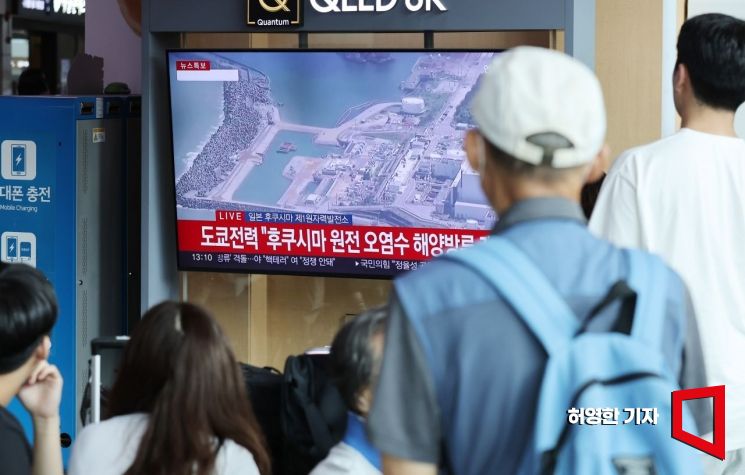 On the 24th at 1 PM, news that Japan has started discharging contaminated water from the Fukushima nuclear power plant is being reported on TV. Citizens and travelers at Seoul Station are watching the news broadcast. Photo by Heo Younghan younghan@
Professor Kang explained, "Compared to seafood and seaweed, vegetables, fruits, and meat grown on land have tritium concentrations that are 10 times higher. If you want to reduce tritium in your body, you should eat more fish or seaweed."
He continued, "Anyway, it will be diluted in the Pacific Ocean and carried by ocean currents all the way to the United States, so it will not reach Korea immediately," emphasizing, "By the time it reaches Korea in about 4 to 5 years, it will be diluted to one ten-quadrillionth, making it too small to measure."
He added, "Tritium is constantly produced in nature, and in fact, more than half of it remaining today comes from nuclear tests conducted in the 1960s," saying, "Because of this, we have already consumed a significant amount of tritium."
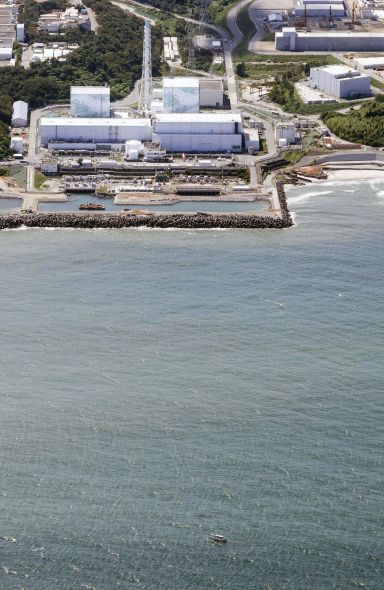 The Fukushima Daiichi Nuclear Power Plant, where the discharge of contaminated water (referred to as "treated water" by the Japanese government) into the ocean began on the afternoon of the 24th. [Image source=Yonhap News]
Professor Kang said, "During the 2011 Great East Japan Earthquake (which caused the Fukushima Daiichi Nuclear Power Plant accident), radiation levels released were more than 1,000 times higher than now, so this (discharge of contaminated water) cannot be considered unprecedented."
He stated, "We have experienced an enormous amount of radiation being released over the past 12 years," adding, "At that time, the sea in front of Japan was contaminated, and there were reports of contamination in various seaweeds and fish, but Korea was not affected at all."
Regarding the opposition's claim that if the discharge of contaminated water is safe, it should be used for agricultural and industrial water within Japan, he explained, "Generally, evaporating it into the air or leaving it on land would expose people, so it is not ethical," adding, "Discharging it into the sea is the safest option. Leaving it on land is not good even from Korea's perspective."
© The Asia Business Daily(www.asiae.co.kr). All rights reserved.


















