Cold Damage and Hail in Spring, Monsoon and Typhoon in Summer
One Month Left Until Chuseok Holiday... Fruit Prices Soar
10kg Apples 64,730 KRW → 107,764 KRW
Government to Announce Chuseok Livelihood Stabilization Measures Early Next Month
With Chuseok just a month away, fruit prices continue to soar. This is due to reduced production caused by abnormal weather conditions such as the monsoon, typhoons, and El Ni?o. The government has taken measures to stabilize prices by increasing shipments of items with significant price hikes and holding sales events.
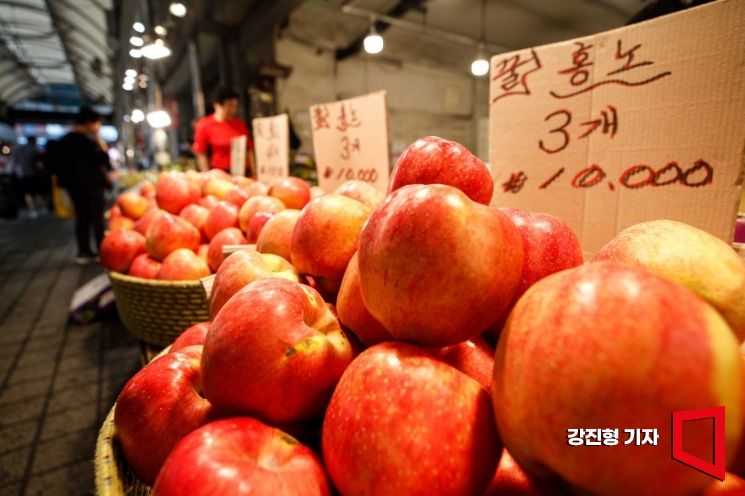 As fruit and vegetable prices, including apples, have risen sharply due to the monsoon and typhoons, Hongno apples are displayed at Cheongnyangni Fruit and Vegetable Market in Dongdaemun-gu, Seoul, on the 28th. Photo by Kang Jin-hyung aymsdream@
According to agricultural product distribution information from the Korea Agro-Fisheries & Food Trade Corporation on the 28th, a 10kg box of premium-grade Hongro apples, commonly used as gifts, was sold for 107,764 won at the Garak Market in Songpa-gu, Seoul, early that morning. Compared to the same product being auctioned at 64,730 won at the end of August last year, this is a sharp increase of 43,034 won (66.4%). The 15kg box of Wonhwang pears, harvested around Chuseok, recorded 54,325 won, up 10,835 won (24.9%) over the same period.
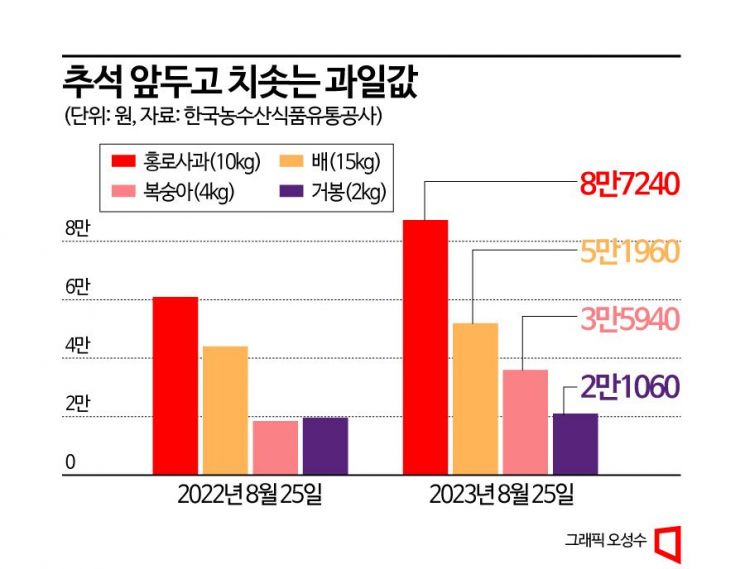
Average wholesale prices are also on the rise. As of the 25th of this month, the wholesale price of a 10kg box of Hongro apples was 87,240 won, up 26,312 won (43.1%) from 60,928 won at the same time last year. For pears (15kg), the price increased by 7,912 won (17.9%) from 44,048 won to 51,960 won, and for 2kg of Kyoho grapes, it rose by 1,428 won (7.2%) from 19,632 won to 21,060 won. The price of 4kg of peaches jumped 17,455 won (94.4%) from 18,485 won to 35,940 won.
Some vegetable prices have also increased. The wholesale price of 30kg of dried chili peppers rose from 616,167 won to 694,571 won, and 20kg of carrots increased from 54,916 won to 74,660 won. While the price of napa cabbage remains stable at 16,220 won, cabbage prices rose by 3,235 won (39.2%) from 8,245 won to 11,480 won.
The rise in fruit and vegetable prices is due to abnormal weather. For apple cultivation to proceed smoothly, fruit blossoms need to bloom in spring, but this year, cold damage and hail harmed growth. Moreover, heavy rains last month and Typhoon Khanun caused significant damage to farms. Flood damage from late June to mid-July affected 5,530 hectares, and damage from Typhoon Khanun was tentatively estimated at 1,200 hectares. Because of this, anthracnose, a disease that causes fruit rot, started 10 days earlier than last year, on July 27. Pears also suffered from pests and diseases and insufficient sunlight, hindering growth.
"Strong El Ni?o Expected This Year... Concerns Over Food Prices Due to Weather Anomalies"
Overall food prices are expected to remain unstable. The Bank of Korea released a report titled ‘Assessment of Domestic and International Food Price Trends and Risk Factors’ on the same day, stating, “Due to worsening weather conditions such as heavy rains, heatwaves, and typhoons in Korea, prices of agricultural products like vegetables and fruits have rapidly increased compared to the previous month.” It further analyzed, “Concerns over food prices are growing due to overlapping factors such as weather anomalies, suspension of the Black Sea grain agreement, and export restrictions by some countries.”
There are also concerns that the expected strong El Ni?o this year will disrupt international grain prices and overseas agricultural imports. El Ni?o refers to the phenomenon where the Pacific Ocean sea surface temperature remains at least 0.5°C higher than the average for several months. Typically, when sea surface temperatures rise by 1°C compared to the previous year, international food prices increase by 5-7% with a time lag.
The government has begun establishing measures to stabilize prices. It is implementing supply-demand stabilization plans by item and conducting price events to reduce consumer price burdens. Items with high prices are selected weekly, and discounts of 20% (30% at traditional markets) are supported up to a limit of 10,000 won per person. For apples and pears, which have seen significant price increases, contract shipment volumes will be expanded compared to last year to meet increased demand during the holiday season.
Kim Jong-gu, Director of Distribution and Consumer Policy at the Ministry of Agriculture, Food and Rural Affairs, stated, “We will monitor supply and demand trends daily to respond to worsening weather conditions and expand supply through stockpiling, contract farming, and import measures. We will also continue to support discounts to ease consumer burdens and do our best to stabilize grocery prices.”
Meanwhile, the government plans to announce a Chuseok livelihood stabilization plan early next month, including a joint sale event and holiday fund support.
© The Asia Business Daily(www.asiae.co.kr). All rights reserved.
![From Bar Hostess to Organ Seller to High Society... The Grotesque Con of a "Human Counterfeit" [Slate]](https://cwcontent.asiae.co.kr/asiaresize/183/2026021902243444107_1771435474.jpg)

















