Some Experts Express Concerns, "More Research Needed"
BBC in the UK pointed out that while the majority of experts consider the Japanese government's discharge of contaminated water from the Fukushima Daiichi Nuclear Power Plant to be "safe," not everyone agrees. Some experts believe that further research is needed on the impact of the contaminated water discharge on ecosystems and humans.
On the 26th (local time), BBC published an article titled "The science behind the Fukushima waste water release," stating, "Experts believe that if the levels of the radioactive substance tritium are low, the impact is minimal," but also reported that "there are expert opinions that more research is needed on how tritium might affect seabed and marine life as well as humans."
"It may have negative effects on flora and fauna"
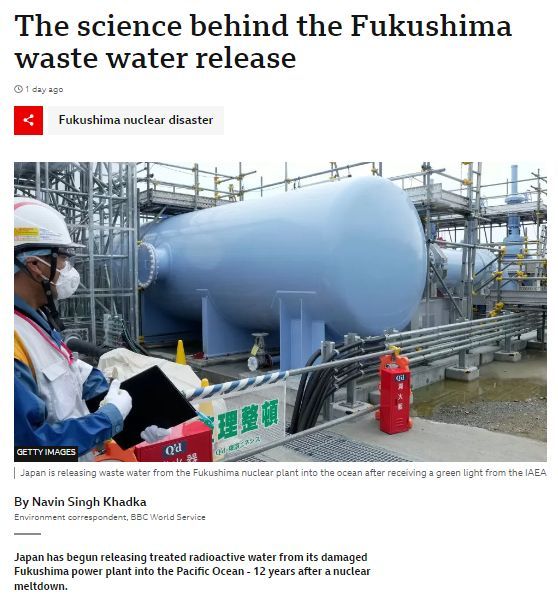
However, some scholars expressed the opinion that since the effects of the discharged contaminated water cannot be predicted at present, extensive research is necessary.
Professor Emily Hammond of George Washington University in the United States said, "The problem with radioactive nuclides like tritium presents questions that science cannot fully answer," and added, "it raises the question of what can be considered 'safe' at very low levels of exposure."
She also said, "While I trust the International Atomic Energy Agency (IAEA), compliance with standards does not mean that the environmental or human impact is 'zero.'"
Earlier, the U.S. National Oceanic and Atmospheric Research Association issued a statement in December last year expressing that the data related to Japan's discharge of contaminated water into the ocean was not convincing.
Regarding this, Robert Richmond, a marine biologist at the University of Hawaii, said, "We have seen inadequate assessments of radioactive substances and ecological impacts," adding, "This raises serious concerns that Japan does not know what is entering the water, sediment, and organisms, and if it does, there is no way to remove it."
Sean Burnie, senior nuclear expert at Greenpeace East Asia, said, "Ingesting tritium can have direct negative effects on flora and fauna, such as reduced reproductive ability and damage to cellular structures like DNA."
"Japanese contaminated water is theoretically drinkable"
 On the 27th, a rally condemning the discharge of contaminated water was held in Iwaki City, Fukushima Prefecture, Japan. [Image source=Yonhap News]
Professor James Smith, an environmental geologist at the University of Portsmouth in the UK, claimed, "Theoretically, this water can be drunk." He noted that the contaminated water has already been treated and diluted.
David Bailey, a physicist running a radiation measurement research institute in France, agreed, saying, "The important thing is how much tritium is present," and added, "For example, as long as fish populations do not decline severely, there is no problem for marine species."
Contaminated water discharged 12 and a half years after the Great East Japan Earthquake
Tokyo Electric Power Company (TEPCO) began discharging contaminated water stored at the Fukushima Daiichi Nuclear Power Plant at 1 p.m. on the 24th. This is about 12 and a half years after the Fukushima nuclear accident caused by the Great East Japan Earthquake in March 2011.
TEPCO plans to carry out the operation of diluting about 460 tons of contaminated water daily with seawater and discharging it over 17 days, initially releasing 7,800 tons of contaminated water into the sea. The amount of contaminated water expected to be discharged by March next year is 31,200 tons, which is about 2.3% of the currently stored contaminated water.
© The Asia Business Daily(www.asiae.co.kr). All rights reserved.
![Clutching a Stolen Dior Bag, Saying "I Hate Being Poor but Real"... The Grotesque Con of a "Human Knockoff" [Slate]](https://cwcontent.asiae.co.kr/asiaresize/183/2026021902243444107_1771435474.jpg)











