Korea Atomic Energy Research Institute, Successful Development and Commercialization of Analytical Method
"Helps Strengthen Marine Radiation Monitoring Against Fukushima Contaminated Water"
As Japan's Fukushima nuclear power plant began releasing contaminated water, a South Korean research team has developed and commercialized a technology that can detect strontium-90, a major radioactive nuclide in seawater, much faster than before.
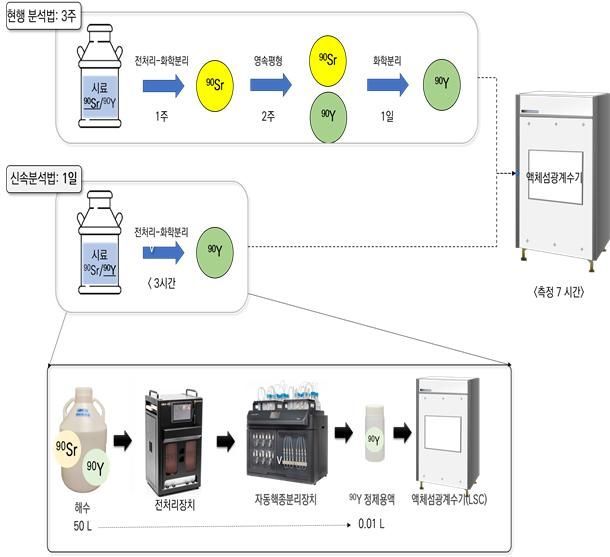
On the 27th, the Ministry of Science and ICT announced that Dr. Kim Hyun-chul's team at the Nuclear Environment Division of the Korea Atomic Energy Research Institute has advanced the analysis technology for strontium-90 in seawater to be faster and more accurate than existing methods and commercialized the related analytical equipment.
This research achievement was published this month in the internationally renowned marine science journal, Marine Pollution Bulletin. Seawater contains many substances with chemical behaviors similar to strontium-90, such as calcium and magnesium. Moreover, it is extremely difficult to accurately separate and measure only the trace amounts of strontium-90. The conventional analysis method, which relies heavily on highly skilled analysts, takes at least three weeks just for analysis.
The research team drew inspiration from the fact that strontium-90 emits beta rays over time and produces yttrium-90. After 14 days, the radioactivity of strontium-90 and yttrium-90 becomes equal. In 2021, the team developed an analytical method that indirectly confirms the radioactivity of strontium-90 by analyzing yttrium-90 using a resin that adsorbs yttrium-90 and a self-developed automatic nuclide separation device (KXT-H, Kaeri eXtraction Technology-Hybrid). This reduced the analysis time from three weeks to two days, or one-tenth of the previous duration.
This research achievement is a further advancement compared to 2021, doubling the sample processing capacity of the self-developed large-volume seawater pretreatment equipment and shortening the pretreatment time from six hours to three hours. Therefore, the total analysis time can now be completed within one day. The recovery rate of yttrium-90, the target of analysis, was also improved from 60-70% to about 90%. Since increasing the seawater sample volume allows for more accurate and precise evaluation, this research achievement represents an improvement over existing methods in terms of speed, accuracy, and precision.
Using the advanced technology and equipment, the research team investigated the southeastern waters of Jeju Island from November 2021 to March 2023 and found that the amount of strontium-90 ranged from 0.5 to 1.23 mBq/L, similar to average years, with no observed concentration changes by depth or season.
The newly developed testing method is expected to aid in marine radioactivity monitoring following the release of contaminated water from Japan's Fukushima nuclear power plant. Dr. Kim Hyun-chul stated, “Separating strontium-90 from seawater is challenging, but by simply and rapidly analyzing its daughter nuclide, yttrium-90, from a new perspective, we have brought a change to marine radioactivity analysis.” He added, “We are currently in discussions with the industry that received technology transfer for the commercialized equipment to export it overseas.”
© The Asia Business Daily(www.asiae.co.kr). All rights reserved.

















