There are concerns that loan delinquencies at domestic commercial banks may increase in the second half of the year due to the end of some financial support measures implemented during the COVID-19 response, highlighting the growing importance of managing non-performing loans (NPLs).
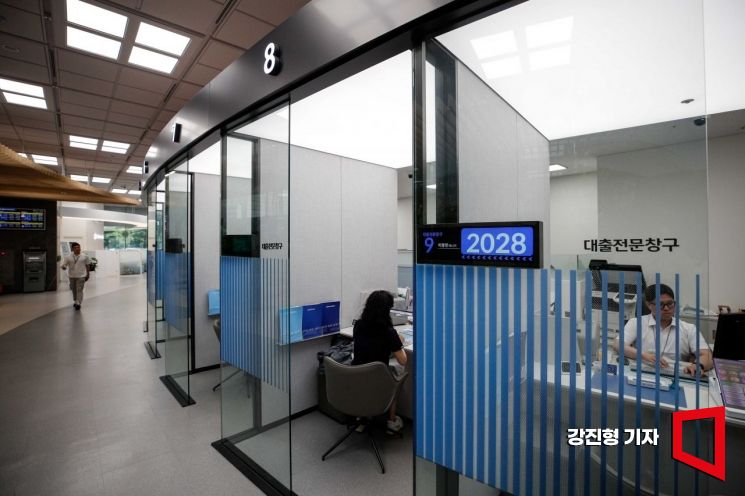 A customer is receiving consultation at a bank loan counseling desk. Photo by Jinhyung Kang aymsdream@
According to Francis Chan, an analyst at Bloomberg Intelligence (BI), a research arm of Bloomberg, managing NPLs has become crucial for the future performance of South Korean commercial banks.
Chan and other analysts pointed out that real estate project financing (PF), often considered a breeding ground for bad debt, accounts for about 31 trillion won, or 2% of total loans, in real estate PF exposure among the four major domestic commercial banks: KB Kookmin, Shinhan, Hana, and Woori. By bank, the exposure amounts are KB Kookmin (11 trillion won), Shinhan (8.9 trillion won), Hana (7.7 trillion won), and Woori (3.3 trillion won), respectively.
Additionally, the phased termination of COVID-19-related financial support starting at the end of next month is a concern for banks. In early 2020, following government directives amid the COVID-19 outbreak, banks extended the principal maturity of loans for small and medium-sized enterprises (SMEs) and small business owners and also deferred interest payments. Although the support began with a deadline set for September 2020, extensions continued due to the prolonged pandemic. It is now known that financial support will effectively end starting with borrowers eligible for repayment deferral at the end of September.
As market interest rates rise and the housing market remains unstable, household loan delinquencies are increasing. The four major commercial banks are actively managing NPLs, focusing on improving asset quality by writing off and selling off large amounts of bad loans. Lena Kwok, an analyst at BI, and economist Kwon Hyo-sung also forecasted in a separate report earlier this month that the four major banks could face an increase in loan delinquencies in the second half of the year for similar reasons.
Kwok and others believe that with high market interest rates and growing macroeconomic risks, the end of repayment deferrals at the end of September could lead to a continued rise in loan delinquency rates in the second half of the year, especially among relatively vulnerable groups such as self-employed individuals and SMEs. They also assessed that even if pressure for additional interest rate hikes eases in the second half, loan delinquencies will persist due to delayed increases in housing prices in the outskirts of Seoul.
However, Chan believes that commercial banks can withstand the deterioration in asset quality. Kwok also expects that the banks’ expected loan loss provisions this year will remain manageable, citing a gradual increase in NPL ratios and strengthened risk controls implemented over several years.
Earlier, financial authorities denied concerns that the simultaneous end of maturity extensions and repayment deferrals at the end of September would trigger a sudden surge in bad loans. In June, the Financial Services Commission stated, "Maturity extensions, which account for 92% of the support amount, can be used until September next year, and since interest payments are being made normally, there is no problem." They added, "Principal repayment deferrals, which make up 6%, are also accompanied by normal interest payments and allow for up to 60 months of installment repayment," and "Interest repayment deferrals, which account for 2%, pose relatively higher risks but represent only 0.09% of the total 1,498 trillion won in business loans across the financial sector."
© The Asia Business Daily(www.asiae.co.kr). All rights reserved.
![From Bar Hostess to Organ Seller to High Society... The Grotesque Con of a "Human Counterfeit" [Slate]](https://cwcontent.asiae.co.kr/asiaresize/183/2026021902243444107_1771435474.jpg)
















