Hanwha Ocean, SK Innovation, and Others Increase Capital by Over 1 Trillion Won
Funds Raised to Ease Debt Burden and Secure Future Growth Resources
The paid-in capital increase market has been heating up in the second half of this year. As the cost of borrowing has risen to a burdensome level, more companies have chosen to issue new shares (capital increase), accepting dilution of equity and stock price decline rather than increasing debt. Companies aiming to improve their financial structure by reducing the burden of principal and interest repayment on borrowings are also opting for paid-in capital increases.
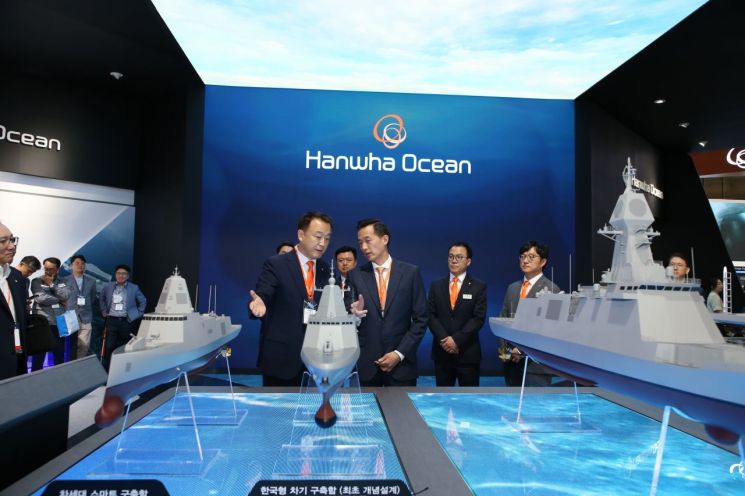
Surge in Paid-in Capital Increases... Big Deals Follow One After Another Including Hanwha Ocean and SK Innovation
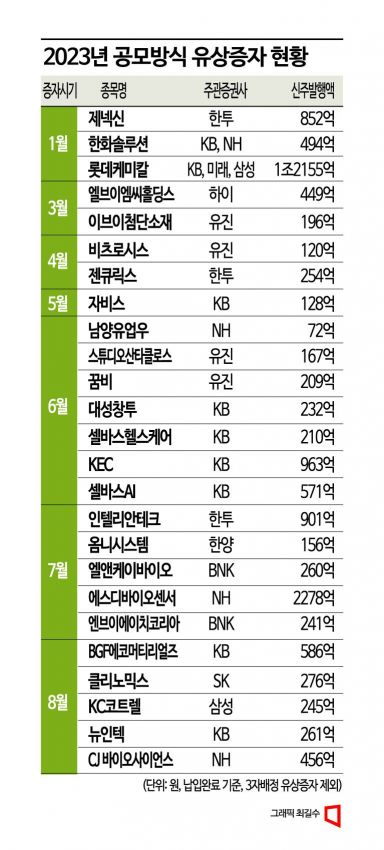
According to the investment banking (IB) industry on the 24th, 25 listed companies have completed paid-in capital increases through public offerings (general public offering, rights offering followed by public offering of unsubscribed shares) this year. Paid-in capital increases through third-party allotment (private placement) targeting specific shareholders were excluded. The listed companies that chose public paid-in capital increases raised a total of 2.2732 trillion KRW through new share issuance this year.
Due to increased market volatility in interest rates and stock prices at the beginning of the year, the paid-in capital increase market also experienced a downturn in the first half. Only eight companies conducted capital increases through public offerings from January to May. Among them, Lotte Chemical played a vital role by conducting a large-scale capital increase worth 1.2155 trillion KRW in January, acting as a much-needed boost to the market.
The quiet market began to see a significant rise in the number and scale of paid-in capital increases starting in the second half. The number of capital increases, which had been only one or two per month, increased to five to seven per month from June. Small and mid-sized listed companies such as SD Biosensor (227.8 billion KRW), KEC (96.3 billion KRW), Intellian Technologies (90.1 billion KRW), and BGF Eco Materials (58.6 billion KRW) raised funds through paid-in capital increases.
Starting with SK Innovation, big deals exceeding 1 trillion KRW began to emerge. SK Innovation is pushing forward a paid-in capital increase worth 1.3 trillion KRW, with Korea Investment & Securities and NH Investment & Securities as lead managers. Following this, CJ CGV (440 billion KRW), Cosmo Chemical (120 billion KRW), and Cosmo Advanced Materials (220 billion KRW) also joined the ranks with capital increases worth several hundred billion KRW.
Recently, Hanwha Ocean (formerly Daewoo Shipbuilding & Marine Engineering) announced plans for a paid-in capital increase in the 2 trillion KRW range. Hanwha Ocean reportedly selected several major domestic securities firms as lead managers for fundraising. The process will proceed through a rights offering followed by a public offering of unsubscribed shares, with new share allotment and subscription procedures, aiming to complete fundraising around the end of this year.
Leading bio companies have also chosen paid-in capital increases as a liquidity securing measure. CJ Bioscience, Vaxcell Bio, Ewha Diagnostics, Kangstem Bio, Genewin Life Sciences, Vaxcell Bio, Kkumbee, PCL, Voronoi, People Bio, SCM Life Sciences, and Noeul are among those pursuing paid-in capital increases.
Significant Impact of Rising Borrowing Costs
The surge in paid-in capital increases is largely attributed to the rise in borrowing costs. With market interest rates continuously increasing, companies face interest expenses two to three times higher than before when taking out new loans or refinancing existing debt.
An IB industry insider said, "Companies that postponed borrowing in the first half expecting interest rates to peak and then decline are now shifting to paid-in capital increases as the outlook for prolonged high interest rates grows."
As a result, many capital increases are aimed at repaying borrowings. SK Innovation plans to use about 350 billion KRW of the funds raised through the capital increase to repay debt. CJ CGV will also use a significant portion of the funds raised through new share issuance to repay existing borrowings and improve its financial structure.
Many companies are conducting paid-in capital increases to secure resources for future growth engines. Hanwha Ocean stated that out of the 2 trillion KRW raised, about 1.5 trillion KRW will be used to secure production bases for entry into the U.S. and European marine defense markets and to develop eco-friendly ships and technologies.
SK Innovation will use a substantial portion of the raised funds for facility investments and equity investments in eco-friendly companies. Cosmo Chemical plans to use the capital increase funds for its own facility investments and to acquire new shares of its subsidiary Cosmo Advanced Materials, while Cosmo Advanced Materials will use the funds to expand production facilities for cathode active materials (NCM). Previously, Lotte Chemical used capital increase funds to purchase raw materials such as naphtha and to acquire Iljin Materials.
An industry insider said, "Paid-in capital increases were not a preferred financing method for companies in low-interest-rate environments due to the burden on existing major shareholders, dilution of holdings, and stock price declines. Recently, however, they have emerged as a means for investment in future growth, operating funds, and alternative financing to borrowings, and capital increase transactions are expected to continue rising for some time."
© The Asia Business Daily(www.asiae.co.kr). All rights reserved.


















