Discussion at the 4th Regulatory Innovation Strategy Meeting
Year-End Revision of the Toxic Chemicals Control Act and Chemical Management Act That Hindered Businesses
Relaxation of New Chemical Substance Registration 'Annual 1t or More'
Proactive Support for Industrial Complexes Including Yongin Cluster
Going forward, the registration criteria for new chemical substances will be relaxed from '0.1 tons or more per year' to '1 ton or more per year.' Chemical substance regulations, which have been uniformly applied, will be applied differentially according to risk levels. Related regulations will also be rationally improved to proactively support the creation of advanced industrial complexes such as the Yongin Semiconductor Cluster.
On the 24th, the Ministry of Environment reported these details in the "Plan to Reform Environmental Killer Regulations including Chemical Substance Management" at the 4th Regulatory Innovation Strategy Meeting presided over by President Yoon Seok-yeol. It announced that through improvements in chemical substance regulations, an economic effect of 300 billion KRW, and through improvements in regulations for advanced industries such as semiconductors, an economic effect of 8.5 trillion KRW, totaling 8.8 trillion KRW by 2030, will be induced.
First, the government plans to complete revisions to the "Act on Registration and Evaluation of Chemicals (AREC)" and the "Chemical Substances Control Act (CSCA)" within this year. Until now, the AREC and CSCA have been pointed out as major factors increasing companies' time and cost burdens due to their strict management standards. The AREC is a law concerning the registration, reporting, examination, and evaluation of chemical substances, requiring annual reporting and registration to authorities for use, while the CSCA stipulates handling and management standards for hazardous chemical substances designated under the AREC.
Specifically, the government will adjust the registration criteria for new chemical substances, which had been stricter than international standards, from 0.1 tons or more per year to 1 ton or more per year, aligning with advanced countries such as the European Union (EU). The economic effect of this adjustment is expected to be 200 billion KRW by 2030, benefiting about 700 companies in advanced industries such as semiconductors and electronics by reducing registration costs. Chemical substance regulations (covering about 330 handling facilities), which have been uniformly applied even to workplaces with low accident risk, will be converted to "risk-proportional regulations" that apply regulations differentially according to risk levels. If 16,000 companies simplify the submission requirements for test data necessary for the registration of existing chemical substances by 2030, it is estimated that cost savings of about 100 billion KRW will be possible.
The efficiency of environmental impact assessments will also be enhanced. A simplified assessment will be introduced to exempt evaluation consultations when environmental impact is not significant, and small-scale environmental impact assessments will have their evaluation authority delegated to local governments through local ordinances. Emergency disaster response projects will be exempt from environmental impact assessments, and river maintenance projects included in the basic river plan will also be exempted from environmental impact assessments.
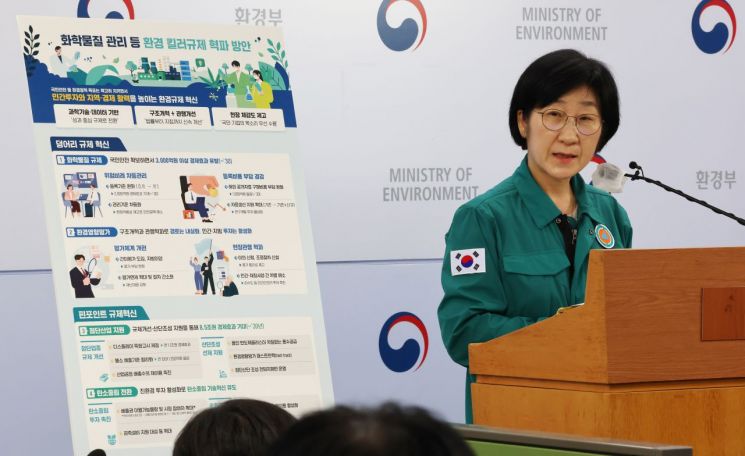 Minister Han Hwa-jin Announcing Plans to Reform Environmental Killer Regulations
(Sejong=Yonhap News) Reporter Kim Joo-hyung = On the 22nd, Minister Han Hwa-jin of the Ministry of Environment announced plans to reform environmental killer regulations, including chemical substance management, at the Government Complex Sejong in Sejong City. 2023.8.24
kjhpress@yna.co.kr
(End)
<Copyright(c) Yonhap News Agency, Unauthorized reproduction and redistribution prohibited>
Environmental regulations for advanced industries such as semiconductors and displays will be promptly improved, and proactive support will be provided for the creation of industrial complexes such as the Yongin Semiconductor Cluster. First, specialized facility standards for displays will be established to create an economic effect of 1.1 trillion KRW annually. Fluorine emission standards will also be rationalized to induce operational cost savings of up to 125 billion KRW per year.
While allowing the reuse of industrial wastewater between companies, regulatory relaxation will also be pursued to promote carbon neutrality and circular economy investments. The regulation limiting the carryover of greenhouse gas emission allowances will be eased to expand participation in the emission trading market, and battery waste storage standards will be improved to increase utilization rates. To secure domestic supply chains of core resources such as rare or useful metals, a circular resource designation notification system will be implemented to relax waste regulations.
The Ministry of Environment estimates the economic effect of these environmental regulation improvements to be 8.8 trillion KRW by 2030. Including the effects of last December’s establishment of semiconductor specialized facility standards (16.8 trillion KRW), the total is expected to reach about 25 trillion KRW. Han Hwa-jin, Minister of Environment, said, "We will strengthen the momentum of regulatory innovation going forward to create tangible regulatory innovation outcomes that enhance private investment as well as regional and economic vitality."
© The Asia Business Daily(www.asiae.co.kr). All rights reserved.

















