Nike, struggling with sluggish consumer recovery in China, is experiencing its longest-ever streak of stock price declines.
On the 22nd (local time), Nike's stock closed at $101.46, down 1.4% from the previous session. Nike's stock price fell for nine consecutive trading days, setting the longest decline record since its listing in December 1980. The stock price has dropped 13% since the beginning of the year. During the same period, the S&P 500 Consumer Discretionary Index, to which Nike belongs, rose by 29%.
With nine consecutive trading days of stock price decline, Nike's market capitalization evaporated by $13 billion (17.4 trillion KRW). As a result, Nike's market cap shrank to $155.2 billion (approximately 207.72 trillion KRW) based on the closing price that day.
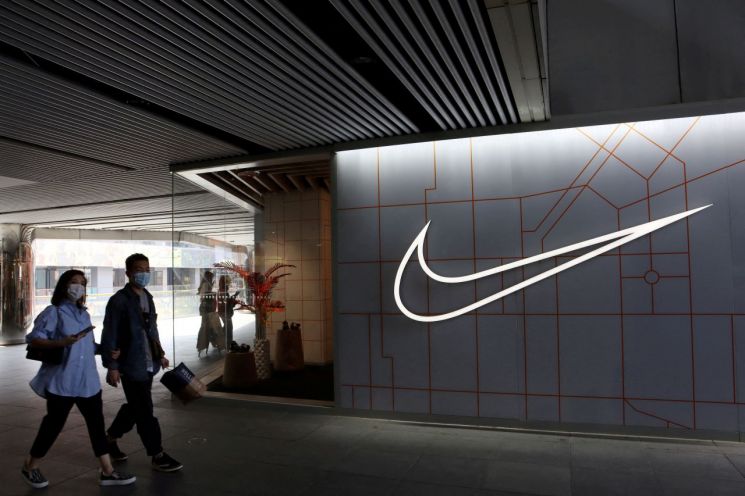
The decline in Nike's stock price is largely influenced by concerns over the stagnation of China, Nike's single largest market. Matt Maley, chief market strategist at U.S. securities firm Miller Tabak, pointed out, "Investors are realizing that China's growth has started to slow down," adding, "Especially as the Chinese government is no longer implementing strong economic stimulus measures as in the past, concerns about prolonged stagnation and the resulting impact on global companies' earnings are increasing."
As China enters a low-growth trajectory, it is expected that Nike's performance, heavily dependent on Chinese sales, will also show a sluggish trend. The Chinese economy showed a brief recovery due to the reopening effect after lifting lockdown measures but has recently been deteriorating. Both consumption and production have fallen into a slump due to the worsening economy. According to the National Bureau of Statistics of China, the growth rates of retail sales and industrial production in July were only 2.5% and 3.7%, respectively, significantly below market expectations.
These concerns are already materializing in the results. Nike announced in its June earnings report that its net profit for the fourth quarter of fiscal year 2023 decreased by 28% year-over-year to $1 billion. Bloomberg reported, "The sharp drop in net profit suggests that Nike is still struggling to manage excess inventory."
Tom Nikic, an analyst at Wedbush Securities, evaluated, "Concerns that profit margins will further decline due to high inventory levels and increased price discount promotions to clear inventory are dampening investor sentiment."
© The Asia Business Daily(www.asiae.co.kr). All rights reserved.

















