OECD "Need to Ensure Collection Systems to Promote Economies of Scale"
"It is more advantageous for business to concentrate investment in Korea and establish base factories to bring used batteries from abroad to Korea rather than investing dispersedly around the world." - Executive A of a used battery recycling company
"It's not that importing used batteries is impossible, but it's complicated. There are many restrictions." - Another official B of a used battery recycling company
Used electric vehicles accumulate in each country, and used batteries inside these vehicles cross borders to recycling plants. Processing facilities for used battery recycling are dispersed worldwide. With the rapid growth of the electric vehicle market, cross-border trade of used batteries continues to increase, but regulations on used batteries vary by country, and transportation regulations differ as well. Some countries view used batteries as recyclable resources, while others classify them as hazardous waste. There are calls to clarify related regulations to ensure stable supply of used batteries, a prerequisite for the growth of the used battery recycling market.
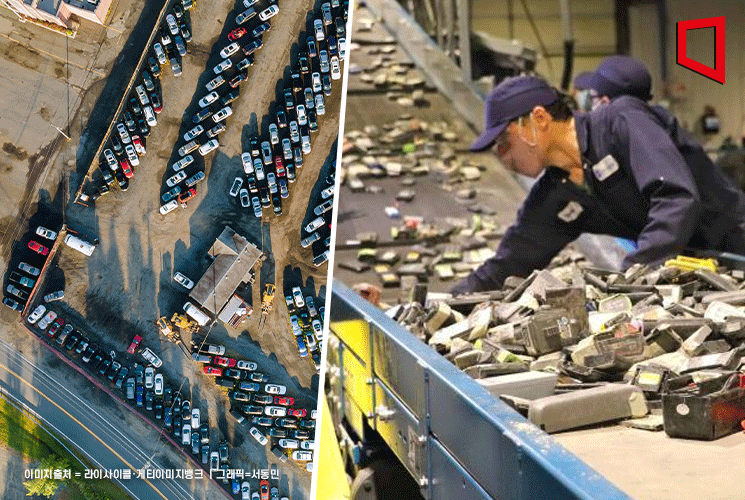
On the 21st, the Permanent Delegation of the Republic of Korea to the OECD (Organization for Economic Cooperation and Development) released the OECD's report published in January this year titled "Trade Policies to Promote Circular Economy: A Case Study of Lithium-ion Batteries." The OECD stated in this report, "Currently, used battery recycling contributes to reducing dependence on raw materials and mitigating risks of price fluctuations and supply instability, but economic viability is insufficient due to product design complexity, chemical diversity within batteries, and shortage of used battery stock." It added, "Current battery regulations generally do not consider reuse or various recovery flows," and emphasized, "Efficient collection systems must be ensured to promote economies of scale."
It was suggested that the definition of used batteries should be clarified first. If used batteries are classified as 'hazardous waste,' strict regulations apply during transportation and storage, increasing cost burdens. According to the Basel Convention procedures to prevent illegal cross-border waste trade, exporting countries must obtain prior written consent from importing countries, and importing countries must notify the exporting side of the receipt or treatment results of the waste.
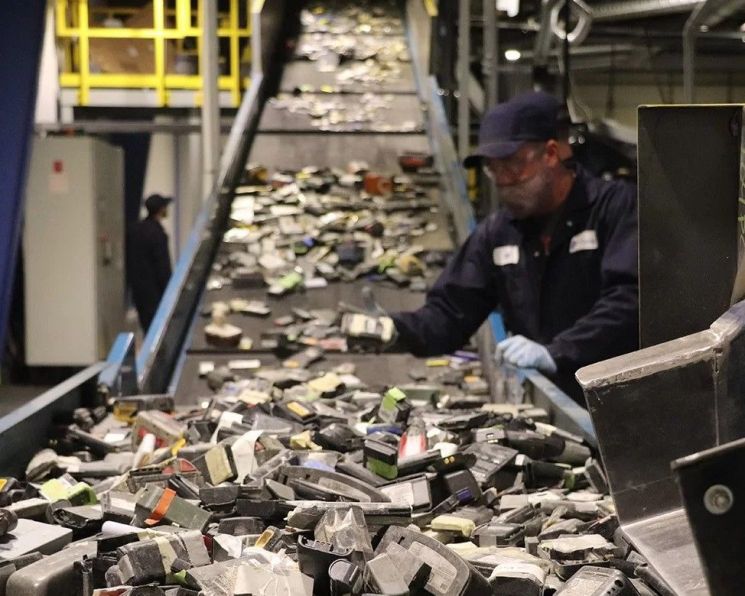 An employee of Li-Cycle, North America's largest battery recycling company, working on site
 [Photo by Li-Cycle]
For example, Australia and Brazil consider end-of-life products as waste regardless of reuse. In contrast, Canada distinguishes between waste and recyclable materials. The European Union (EU) does not define batteries as waste if they are used for specific purposes without affecting human health or the environment. Korea classifies used batteries as waste.
If used batteries intended for material recovery and recycling are considered waste, cross-border administrative procedures follow the Basel Convention or OECD decisions. The OECD stated, "Used batteries recycled through parts recovery or material extraction are classified as waste under Article 2 of the Basel Convention, but definitions may differ if reused or repurposed," and added, "To promote resource circulation of used batteries, it is necessary to clarify the legal status of batteries globally."
Even if not classified as waste, used batteries are subject to regulations in management and transportation due to hazards such as explosion risks. The OECD noted, "Because there is no international agreement on transportation for cross-border movement, transportation costs increase," and "Compliance with safety regulations in each country and qualification requirements for transporters complicate battery transportation and burden international supply chains."
The OECD estimated the global capacity of used battery recycling facilities at approximately 843,000 tons, exceeding the current volume of recycled batteries. Domestic companies are also striving to secure used batteries. Young Poong recently signed a memorandum of understanding (MOU) with comprehensive logistics company Lotte Global Logistics to import used batteries generated in North America and Europe to Korea. Saevitchem currently imports scrap (defective products from battery manufacturing processes) from Japan and plans to secure used batteries from Europe and the United States for import to Korea. An official from a used battery recycling company said, "The United States classifies used batteries as hazardous materials and imposes related regulations during transportation," adding, "There will be many additional considerations when bringing used batteries into Korea."
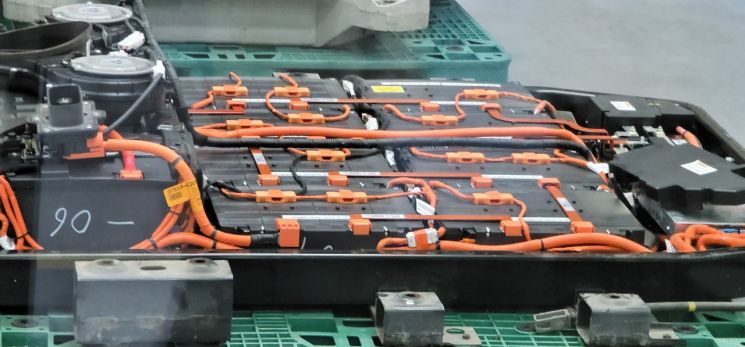 Used batteries awaiting inspection at Jeju Electric Vehicle Battery Industrialization Center, Korea's first used battery performance evaluation institution. A battery with the pack cover removed.
 [Photo by Choi Seoyoon]
Our government announced plans to exempt waste regulations on used batteries to revitalize the circular economy, reflecting industry opinions. Deputy Prime Minister and Minister of Economy and Finance Choo Kyung-ho stated at the emergency economic ministers' meeting in June, "Economically viable waste resources such as steel scrap and used batteries will be collectively designated as circular resources exempt from waste regulations without individual company applications." Detailed standards will be prepared by this month and finalized by December.
The OECD said, "In the absence of sufficient regulations, electric vehicle and battery manufacturers, used battery recycling companies, and potential buyers face uncertainties, which affect disparities between countries and international trade of used batteries," and emphasized, "Attention should be paid to policies that increase used battery collection rates."
Energy market research firm SNE Research predicted that the number of used electric vehicles will surge from 170,000 units this year to 42.27 million units by 2040. Correspondingly, used battery capacity is expected to increase from 18 GWh this year to 3,339 GWh by 2040.
© The Asia Business Daily(www.asiae.co.kr). All rights reserved.
!["The Woman Who Threw Herself into the Water Clutching a Stolen Dior Bag"...A Grotesque Success Story That Shakes the Korean Psyche [Slate]](https://cwcontent.asiae.co.kr/asiaresize/183/2026021902243444107_1771435474.jpg)


















