At 5 PM on the 22nd, Disaster and Safety Countermeasures Headquarters
About 40 attendees including Administrative Deputy Mayor An Byeong-yun
As the discharge of contaminated water from the Fukushima nuclear power plant in Japan is scheduled for the 24th, Busan City has activated a 'response task force.'
On the 22nd at 5 p.m., an emergency task force meeting was held at the City Hall Disaster and Safety Countermeasures Headquarters. This was the sixth meeting since the task force was formed on February 28, led by the Deputy Mayor and consisting of 4 teams and 13 departments.
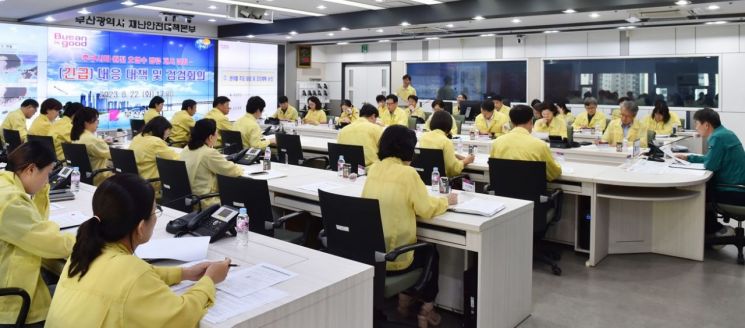 As the discharge of contaminated water from the Fukushima nuclear power plant in Japan is scheduled for the 24th, Busan City has activated a 'response task force' and held an emergency countermeasure meeting at 5 p.m. on the 22nd at the City Hall Disaster and Safety Countermeasures Headquarters.
This meeting was convened to reassess the response status at the Busan City level and discuss future countermeasures following Japan's announcement at the Cabinet meeting that morning, setting the start date for the Fukushima contaminated water discharge as the 24th.
About 40 people attended the meeting, including Deputy Mayor Ahn Byung-yoon, the head of the task force, as well as directors of affiliated offices, bureaus, headquarters, and departments.
Deputy Mayor Ahn Byung-yoon received reports from related department heads on measures such as ▲strengthening seawater radiation monitoring and management ▲enhancing seafood safety and promoting consumption ▲analyzing the impact on the local economy and countermeasures, and discussed future response plans with the attendees.
Through this meeting, Busan City decided to continuously secure seawater analysis equipment, including plans to install two additional unmanned seawater monitoring networks in the second half of this year and add two mobile rapid radiation analysis devices for quick radiation testing of seawater in imported live fish trucks.
Additionally, the city plans to conduct cross-analysis of seawater safety by comparing seawater from the eastern, western, and southern coasts outside the city waters, and establish an information-sharing system with university research institutes and other organizations to broadly promote seawater radiation investigations in cooperation with these institutions.
As a preemptive measure to verify seawater radiation safety, Busan City is conducting detailed analyses of representative radioactive nuclides such as cesium and iodine at 10 radiation investigation points, and has been conducting weekly investigations at seven city beaches since their opening in July.
Moreover, six unmanned seawater monitoring networks capable of rapidly detecting seawater radiation every 15 minutes are in operation, and the city has requested the government to expand marine environmental radiation investigation points, increasing the city's investigation points from three to seven since July.
So far, radiation levels at these points have been found to be within normal ranges and at safe levels.
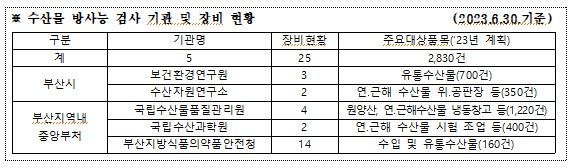
To strengthen seafood safety and promote consumption, Busan City plans to add two more radiation analysis devices for food and seafood by the second half of this year, and develop various seafood consumption promotion projects linked to local festivals and events, such as seafood safety campaigns and seafood mutual discount support programs for scientifically and objectively verified safe seafood.
Busan City already conducts radiation inspections at the import, production, and distribution stages, applying inspection standards more than ten times stricter than international standards.
At the import stage, seafood produced in eight prefectures including Fukushima Prefecture in Japan is completely banned from import, and seafood from other regions in Japan undergoes radiation testing upon each import; if any radioactive substances are detected, additional stringent certification is required, effectively blocking imports.
At the production stage, radiation is inspected before auction at production sites and before shipment from aquaculture farms, prior to distribution to consumers. As of the third week of August this year, all 285 radiation test results were found to be compliant.
At the distribution stage, radiation inspections are conducted during the consumer purchase process at markets and supermarkets, with all 602 radiation test results up to the third week of August this year also deemed compliant.
In addition, Busan City stated that it manages the safety of seafood and other food products more meticulously through the import seafood origin labeling system and distribution tracking system.
The city has expanded the items and personnel for enforcement of origin labeling regulations, including changes in seafood labeling at restaurants and unauthorized use, and is increasing the number of items subject to distribution tracking to prevent the mislabeling of imported seafood as domestic products.
Regarding the analysis of the impact on the local economy and countermeasures, the city is closely monitoring whether there is any impact on the local economy and will implement appropriate preemptive measures such as support plans for fishermen to ensure they can continue their livelihoods with peace of mind if any crisis signs are detected.
To this end, the city already operates a 'continuous monitoring system for local economic crisis diagnosis' through analysis of key economic indicators for proactive management of local economic crises.
Deputy Mayor Ahn Byung-yoon of Busan City said, “We will fully mobilize city administration capabilities to thoroughly respond to ensure that the discharge of contaminated water does not cause any problems to citizens' health safety or the local economy, and actively cooperate with the government, city council, and specialized institutions.”
© The Asia Business Daily(www.asiae.co.kr). All rights reserved.


















