"Japanese Government's Irresponsibility, South Korean Government's Complicity Joint Work"
As the Japanese government announced plans to discharge contaminated water from the Fukushima Daiichi Nuclear Power Plant into the ocean as early as the 24th, environmental groups have protested, calling it a "collaborative product of the Japanese government's irresponsibility and the South Korean government's complicity."
Environmental group Greenpeace issued a statement on the 22nd, strongly criticizing "the Japanese government's irresponsible announcement that could cause an irreversible disaster," and warned sternly against "the South Korean government's complicity in neglecting the potential transboundary risks of radioactive pollutant discharge and failing to exercise the rights of neighboring countries guaranteed under international law to prevent the discharge."
Earlier that day, the Japanese government decided to begin discharging contaminated water as early as the 24th. Japanese Prime Minister Fumio Kishida said, "If there are no weather or other disruptions, we expect it to be on the 24th," adding, "Based on the scientific grounds of the International Atomic Energy Agency (IAEA), we have received expressions of understanding and support from a wide range of regions and countries, and I believe that the accurate understanding of the international community is certainly spreading."
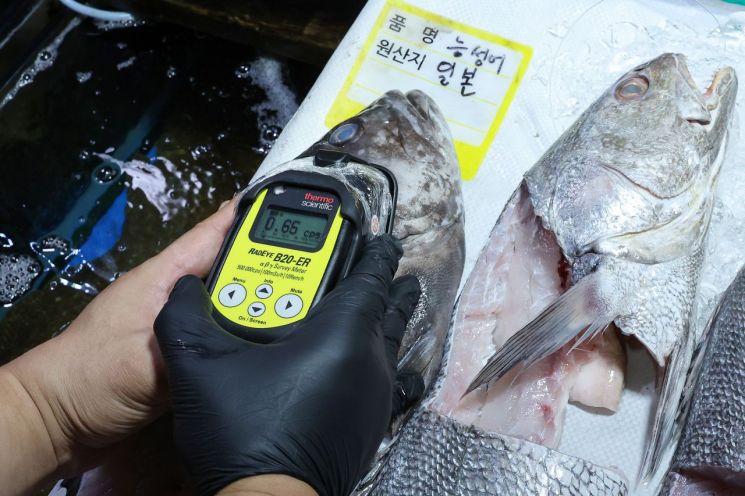 On the afternoon of the 22nd, a market management department employee is conducting a radiation inspection on Japanese seafood at Noryangjin Fisheries Wholesale Market in Dongjak-gu, Seoul. Photo by Yonhap News
The group pointed out, "The ocean discharge of radioactive waste generated by the nuclear power plant accident is unprecedented on Earth and could pose serious risks to the marine ecosystem and human safety," adding, "It is an act that threatens the right to survival of not only Japanese fishermen but also residents of Pacific coastal countries, and it also violates international maritime law."
Greenpeace stated, "The Japanese government and Tokyo Electric Power Company claim that discharging contaminated water is essential for decommissioning the Fukushima nuclear plant and that there are no suitable alternatives, but this is tantamount to admitting that the decommissioning plan is effectively failing," and added, "Even if the contaminated water stored in tanks is discharged, cooling water injection cannot be stopped to cool the hot nuclear fuel debris remaining inside the reactor."
They continued, "The increase in contaminated water due to groundwater inflow will also continue," and argued, "They claim that the contaminated water problem will be resolved by discharge, but even after discharge, hundreds of thousands of tons of contaminated water will inevitably be generated. The discharge of contaminated water is not for decommissioning but a desperate choice to save costs arising from the long-term storage of existing contaminated water."
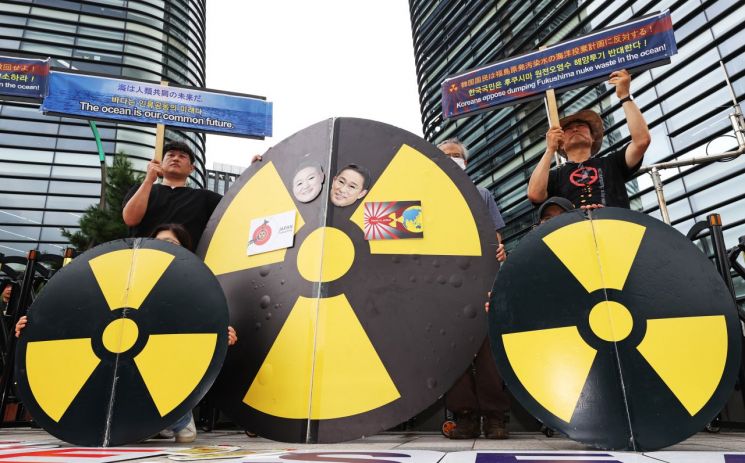 On the afternoon of the 22nd, participants hold placards at a press conference condemning the Japanese government's decision to discharge contaminated water from the Fukushima nuclear power plant, held by the Citizens' Center for Environmental Health and the Korea Federation for Environmental Movements in front of the Japanese Embassy in Jongno-gu, Seoul. Photo by Yonhap News
In Jeju, a region expected to be affected by the contaminated water discharge, protests continued. The 'Jeju Pan-Citizen Movement Headquarters to Stop Japan's Nuclear Contaminated Water Ocean Dumping and CPTPP (Comprehensive and Progressive Agreement for Trans-Pacific Partnership)'?composed of agricultural, fisheries, and civil society groups in Jeju?issued a statement that day urging, "The Japanese government must halt its decision to dump nuclear contaminated water into the ocean, which is a global disaster, and the Yoon Suk-yeol administration must strongly protest to Japan."
The Anti-Nuclear and Climate Crisis Jeju Action also released an emergency statement, calling the Japanese government's decision "an unacceptable declaration of terrorism for any reason," and pointed out, "The ocean dumping of nuclear contaminated water is neither scientifically safe nor compliant with international law, directly contradicts environmental justice, and undermines the sustainability of the human community."
© The Asia Business Daily(www.asiae.co.kr). All rights reserved.


















