"Annual meetings of the Three Countries are institutionalization and sustainability"
"Not excluding specific countries... Will also cooperate with China"
Oh Young-joo, the Second Vice Foreign Minister, addressed concerns about the sustainability of trilateral cooperation among South Korea, the United States, and Japan, stating that even if the government of one of the three countries changes, "it is considered irreversible."
In an interview on the 22nd with SBS Radio's 'Kim Tae-hyun's Political Show,' Vice Minister Oh said, "Although it is not an agreement signed as a treaty, if the three countries hold tightly knit various consultative bodies and meet annually, this is institutionalization and sustainability," emphasizing this point.
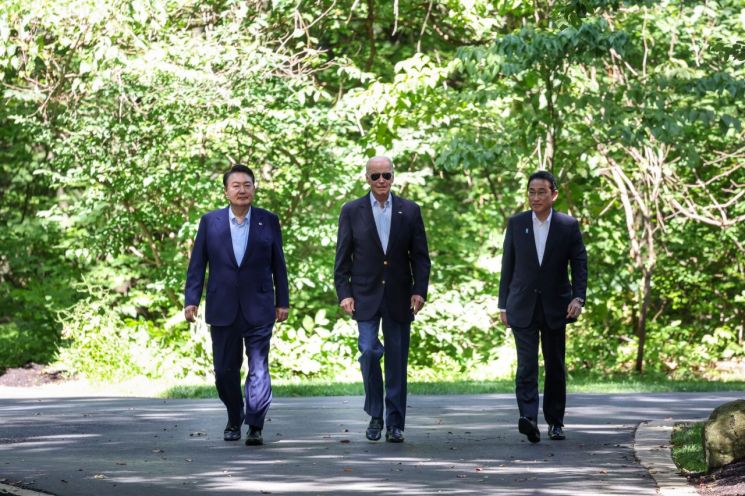 President Yoon Suk-yeol, U.S. President Joe Biden, and Japanese Prime Minister Fumio Kishida are walking together along a trail on the 18th (local time) at Camp David, the U.S. presidential retreat near Washington DC, for a trilateral joint press conference.
 [Image source=Yonhap News]
Vice Minister Oh described the greatest achievement of this South Korea-U.S.-Japan summit as "(the trilateral cooperation) being formed as a very independent and long-term cooperative body that cannot be found anywhere else," adding, "through this cooperative body, a kind of foundation has been established not only for peace and stability on the Korean Peninsula but also for peace and stability in the Indo-Pacific region."
Regarding concerns about relations with China, he responded, "This is not a consultative body that excludes or alienates any specific country," and added, "We will pursue diplomatic approaches to strengthen cooperation with China as well." However, he noted, "Our position on the Taiwan issue remains unchanged, as stated in the joint statement," and added, "Not only on the South China Sea issue but also regarding unilateral attempts to change the international order, all countries recognize that such actions are inappropriate."
On the issue of the 'East Sea' naming dispute and other sources of conflict in South Korea-Japan relations, he said, "The East Sea naming issue is one we have been directly addressing to the international community since 1991, inducing many changes," and added, "the Ministry of National Defense and the Ministry of Foreign Affairs continue to raise the position that this issue should be resolved in a way that reflects Korea's stance. The government is working hard to achieve more results in the future."
© The Asia Business Daily(www.asiae.co.kr). All rights reserved.

















