Significant Increase in Fruit Prices Compared to Average Year
Production Declines Due to Cold Damage During Blooming and Rainy Season
Distribution Industry Strives for Supply and Demand Management
Fruit prices are soaring day by day. The poor harvest caused by adverse weather conditions such as heavy rain and typhoons this summer has reduced production, driving prices up. With the Chuseok holiday, when demand for ritual fruits is expected to increase significantly, just a month away, consumers' concerns are expected to deepen further.
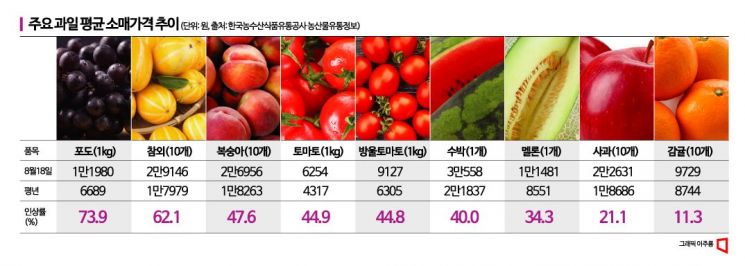
According to the agricultural product distribution information from the Korea Agro-Fisheries & Food Trade Corporation (aT) on the 21st, the average retail price of 10 chamoe melons at large supermarkets and traditional markets as of the 18th was 29,146 won, a 77.7% increase from one month ago (16,401 won). Compared to the same period last year (23,649 won), the price is also more than 20% higher.
Besides chamoe, prices of most fruits have risen significantly compared to the average year. The price of grapes per 1kg rose to 11,980 won, up 73.9% from the average year (6,689 won), and peaches, which usually cost 18,263 won for 10 pieces, increased by 47.6% to 26,956 won as of the 18th. Other fruits such as tomatoes (44.9%), cherry tomatoes (44.8%), watermelons (40.0%), melons (34.3%), and apples (21.1%) also recorded double-digit percentage increases compared to the average year.
The recent rise in fruit prices is due to difficulties in fruit harvests caused by abnormal weather conditions, including heatwaves, heavy rain during the monsoon season, and typhoons this summer. In particular, the impact of Typhoon Khanun (the 6th typhoon) caused significant fruit drop damage in the major fruit-producing Gyeongsang-do region. Additionally, low temperatures during the flowering period reduced fruit set, and frost and hail damage during the growing season have led to an overall poor harvest, exacerbating supply issues.
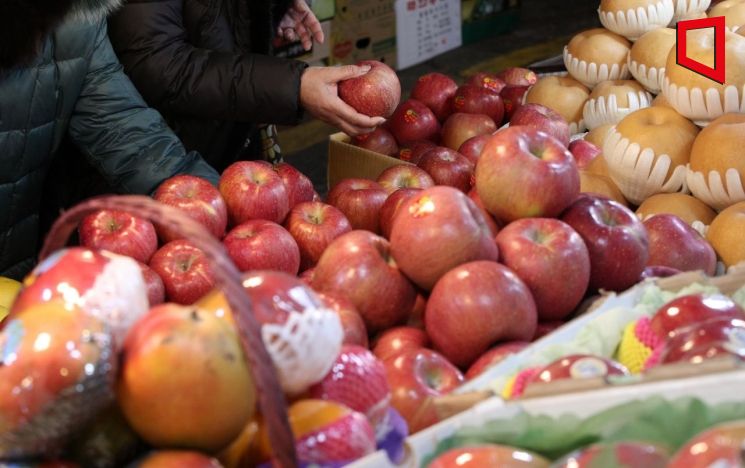
With supply decreasing and Chuseok just a month away, fruit demand is expected to increase, so the upward trend in fruit prices is likely to continue for the time being. Especially, price increases for representative ritual fruits such as apples and pears are inevitable. The Korea Rural Economic Institute forecasts that this year’s production of apples and pears will decrease by 19% and 22%, respectively, compared to the previous year. Kim Hyeong-jin, a researcher at the Korea Rural Economic Institute, said, "The low temperatures during the flowering period in April reduced fruit set and increased the occurrence of malformed fruits. In this situation, the heavy rain during the monsoon season and lack of sunlight during the growing period further worsened the weather conditions, leading to a decrease in production and an expected price increase due to Chuseok."
With the production of apples and pears expected to decline compared to last year ahead of Chuseok, the distribution industry plans to maintain stable supply and demand by expanding alternative production areas beyond the existing main producing regions and by composing practical mixed gift sets. In addition to products with increased prices such as apples and pears, items like Shine Muscat, whose supply has increased and prices have fallen, will be offered separately or in mixed sets to adjust price ranges. Gift sets composed solely of Shine Muscat can be purchased at prices up to 20% cheaper than last year, and apples and pears can also be bought at more affordable prices of 40,000 to 60,000 won if practical sets are chosen.
Emart has quickly secured apple supplies from Jeolla-do, where typhoon damage was relatively minimal. Furthermore, they are expanding unique fruit gift sets that can substitute apples and pears, and the quantity of mixed sets including Shine Muscat has increased by about 26% compared to last year. Lotte Mart, considering the poor harvest of apples and pears, has expanded low-cost, cost-effective gift sets by 30%, reducing auxiliary material costs or using smaller-sized raw fruits than before.
The government has also been managing fruit supply and demand since last month by forming and operating a ‘Fruit Supply and Demand Management Response Team’ involving large supermarkets and the Nonghyup (National Agricultural Cooperative Federation). The Ministry of Agriculture, Food and Rural Affairs plans to secure as much supply as possible during peak seasons centered on Nonghyup and is considering expanding discount rates by linking government agricultural and livestock product discount support with events held by distribution companies.
© The Asia Business Daily(www.asiae.co.kr). All rights reserved.


















