At Least One Separate Multilateral Summit Annually
Real-Time Sharing System for North Korea Missile Warning Information Activated
Annualization of Trilateral Exercises and Establishment of Trilateral Finance Ministers Meeting
South Korea, the United States, and Japan have adopted the 'Commitment to Consult,' which outlines cooperation measures against common threats. In particular, they agreed to strengthen 'trilateral military exercises' to effectively respond to North Korea's nuclear and missile threats, embarking on comprehensive security cooperation.
On the 18th (local time), the Presidential Office announced that the three leaders agreed on these matters at Camp David, the U.S. President's retreat. During the meeting, the three leaders adopted three documents formalizing the agreement: 'The Spirit of Camp David' (hereinafter Spirit), 'Camp David Principles' (Principles), and 'Commitment to Consult' (Commitment).
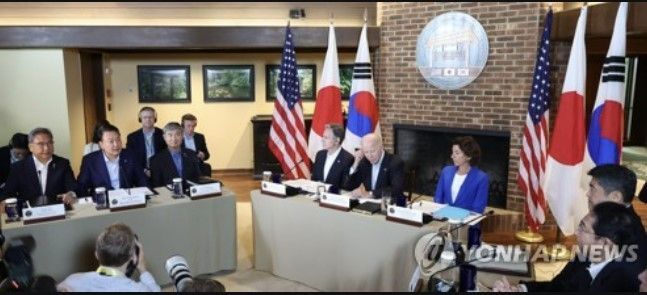 President Yoon Suk-yeol, U.S. President Joe Biden, and Japanese Prime Minister Fumio Kishida are holding a South Korea-U.S.-Japan summit on the 18th (local time) at Camp David, the U.S. presidential retreat near Washington, D.C. Photo by Yonhap News.
Agreement on Comprehensive Cooperation Plan... Strengthening Security through Annual or More Frequent Summits
The 'Spirit,' which also serves as a joint statement, includes comprehensive cooperation measures among South Korea, the U.S., and Japan. The 'Principles' document outlines the principles to be upheld in pursuing trilateral cooperation going forward.
First, it was agreed to hold the South Korea-U.S.-Japan summit at least once a year. Until now, the three leaders met mainly on the sidelines of multilateral meetings, but starting with the first separate summit at Camp David, they plan to regularize these meetings. Additionally, consultations among foreign ministers, defense ministers, commerce and industry ministers, and national security advisors will also be held at least once a year, and a new meeting of finance ministers will be established.
In the field of security cooperation, a real-time sharing system for North Korean missile warning information will be operational by the end of this year. Enhanced ballistic missile defense cooperation was also added to respond to North Korea's nuclear and missile threats.
There are also notable contents directly targeting China. In the 'Spirit,' the three leaders stated their strong opposition to "dangerous and provocative actions supporting illegal maritime territorial claims by the People's Republic of China in the South China Sea, as well as any unilateral attempts to change the status quo in the Indo-Pacific region."
Efforts will also be made to address the increasing threats from overseas information manipulation and misuse of surveillance technologies. This includes support for North Korea's complete denuclearization and a free and peaceful reunification of the Korean Peninsula, expressing concerns over North Korea's illicit cyber activities used to finance illegal weapons of mass destruction and ballistic missile programs, and reaffirming the will to promptly resolve issues related to abductees, detainees, and prisoners of war.
In the fields of economic security and advanced technology, the plan includes launching a pilot early warning system to expand information sharing and enhance policy coordination against potential global supply chain disruptions, as well as continuing trilateral cooperation among South Korea, the U.S., and Japan for the successful conclusion of the Indo-Pacific Economic Framework (IPEF) negotiations.
They also agreed to expand joint research and development and personnel exchanges among national research institutions of the three countries, strengthen cooperation by engaging with the U.S. 'Innovation Technology Strike Force' to prevent the leakage of innovative technologies, collaborate on technology security and standards, enhance trilateral artificial intelligence (AI) governance, promote financial cooperation among South Korea, the U.S., and Japan, and solidify cooperation on critical minerals.
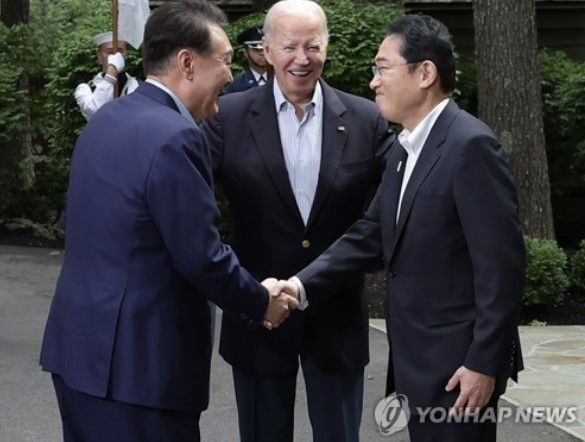 President Yoon Suk-yeol, U.S. President Joe Biden, and Japanese Prime Minister Fumio Kishida are greeting each other in front of Laurel Lodge ahead of the South Korea-U.S.-Japan summit held at Camp David, the U.S. presidential retreat near Washington DC, on the 18th (local time).
 [Photo by Yonhap News]
Strengthening Response to North Korean Nuclear and Missile Threats... Establishing a Stable Cooperation Base through Trilateral Exercises
One of the biggest achievements of this summit is the strengthening of 'trilateral military exercises' to effectively respond to North Korea's nuclear and missile threats. The plan includes not only exercises conducted immediately after provocations such as missile launches by North Korea but also regular trilateral exercises according to an annual schedule. Through this, they aim to send coordinated messages regarding North Korea's nuclear and missile threats and establish a stable foundation for trilateral cooperation.
The three countries plan to conduct working-level consultations to establish exercise plans and pursue the resumption of suspended maritime interdiction and anti-piracy exercises, regularization of maritime missile defense and anti-submarine warfare exercises, and disaster response and humanitarian assistance exercises that contribute to regional peace and stability.
They also reaffirmed plans to activate a real-time sharing system for North Korean missile warning information within this year. Currently, South Korea and the U.S. share warning information in real time through the Korean Theater Missile Operations Cell (KTMO-CELL) and the U.S. Forces Korea Theater Missile Operations Cell (TMO-CELL), and the U.S. Forces Japan and Japan Self-Defense Forces also operate a real-time information sharing system. However, real-time sharing among the three countries has not yet been established.
However, the Hawaii Integrated Control Center under the U.S. Indo-Pacific Command is expected to serve as a hub for the real-time missile warning information sharing system, connecting the TMO-CELL of U.S. Forces Korea and the C4I (Command, Control, Communications, Computers, and Intelligence) system of U.S. Forces Japan to build a real-time information sharing network among South Korea, the U.S., and Japan.
In addition, they agreed to actively respond to 'fake news' that threatens security. They will establish a cooperative system to effectively and proactively counter overseas disinformation and jointly respond to threats arising from information manipulation and misuse of surveillance technologies.
© The Asia Business Daily(www.asiae.co.kr). All rights reserved.


















