The second trial upheld the first trial's ruling that the Cultural Heritage Administration's order to stop construction against a construction company that built apartments near Gimpo Jangneung, a UNESCO World Cultural Heritage site, without permission from the head of the Cultural Heritage Administration, was unjust.
The Seoul High Court Administrative Division 8-1 (Presiding Judges Jeong Chong-ryeong, Jo Jin-gu, Shin Yong-ho) ruled on the 18th in favor of Daebang Construction in the appeal against the order to stop construction issued by the head of the Cultural Heritage Administration's Royal Tombs and Historic Sites Headquarters, maintaining the first trial's decision.
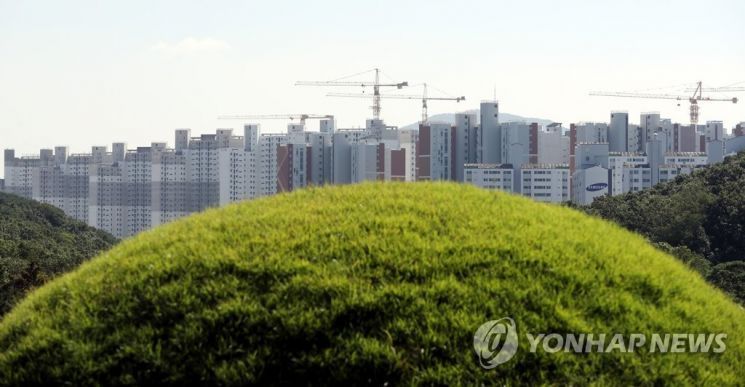
Previously, Daebang Construction, JS Global, and Daekwang ENC purchased residential land created through the Incheon Geomdan New Town Development Project, obtained project plan approval, and built apartments.
However, the Cultural Heritage Administration determined that the residential land where the apartments were being built fell within 500 meters of the outer boundary of the nationally designated cultural heritage site Historic Site No. 202, 'Gimpo Jangneung,' and thus qualified as a historical and cultural environment preservation area.
According to Article 35 of the Cultural Heritage Protection Act, buildings exceeding 20 meters in height require permission from the head of the Cultural Heritage Administration. Since these construction companies did not obtain such permission, the Administration issued an order to stop construction on land within 500 meters of the outer boundary of Gimpo Jangneung and on buildings exceeding 20 meters in height above ground. Nineteen out of 44 apartment buildings, totaling about 3,400 households, were subject to this order.
In response, the construction companies filed a lawsuit seeking cancellation of the Cultural Heritage Administration's order, arguing that the land where the apartments were being built did not qualify as a historical and cultural environment preservation area, and thus Article 35 of the Cultural Heritage Protection Act did not apply. Along with the cancellation lawsuit, their request for suspension of execution was accepted by the court, allowing construction to continue, and the apartments have now been completed and occupied.
The trial focused on several issues: whether the residential land in question qualifies as a historical and cultural environment preservation area of Gimpo Jangneung; whether the construction requires permission under Article 35 of the Cultural Heritage Protection Act according to the 'Gyeonggi-do Cultural Heritage Protection Ordinance' and the 'Notice on Changes to Permission Standards for Construction Activities within Historical and Cultural Environment Preservation Areas of 12 Nationally Designated Cultural Heritage Sites including Gimpo Jangneung'; whether the construction constitutes an act of installing or expanding buildings or facilities that may impair the landscape of the designated national cultural heritage under Article 21-2, Paragraph 2, Subparagraph 1(a) of the Enforcement Decree of the Cultural Heritage Protection Act; and whether the Cultural Heritage Administration's disposition violated the principle of trust protection or abused its discretion.
In July last year, the Seoul Administrative Court Administrative Division 6 (Presiding Judge Lee Ju-young) ruled in favor of Daekwang ENC and JS Global in their lawsuits against the head of the Royal Tombs and Historic Sites Headquarters of the Cultural Heritage Administration, canceling the order to stop construction.
Regarding the first issue, the court stated, "Article 13, Paragraph 1 of the Cultural Heritage Protection Act stipulates that the scope of historical and cultural environment preservation areas shall be determined by ordinance within 500 meters from the outer boundary of the cultural heritage. Accordingly, Article 5, Paragraph 1, Subparagraph 1 of the 'Gyeonggi-do Cultural Heritage Protection Ordinance' defines the 'historical and cultural environment preservation area' as within 200 meters from the outer boundary of the cultural heritage for residential, commercial, and industrial areas under the National Land Planning and Utilization Act, and within 500 meters for green areas, management areas, and agricultural and forestry areas."
The court continued, "However, the land in question corresponds to a Type 3 general residential area and is located more than 200 meters outside the outer boundary of Gimpo Jangneung, so it is generally considered not to fall within the historical and cultural environment preservation area according to the ordinance."
The court also noted, "Article 5, Paragraph 2 of the 'Gyeonggi-do Cultural Heritage Protection Ordinance' requires that even in areas between 200 and 500 meters from the outer boundary, if buildings over 10 meters are constructed, the impact on cultural heritage must be reviewed. However, the subject of this review appears to be the administrative agency responsible for construction permits, and this provision does not expand the scope of the historical and cultural environment preservation area nor impose an obligation to obtain permission from the head of the Cultural Heritage Administration under Article 35 of the Cultural Heritage Protection Act."
The court further ruled, "It cannot be definitively concluded that the construction in question constitutes an act of installing buildings that may impair the landscape of the designated national cultural heritage under Article 21-2, Paragraph 2, Subparagraph 1(a) of the Enforcement Decree of the Cultural Heritage Protection Act."
As grounds, the court cited: ▲ Currently, from the pavilion (Jeongjagak), which is the viewpoint of visitors, there is virtually no obstruction of the view, and from the viewpoint of the burial subject at the front of the burial mound's mixed stone (Honyuseok), the view of Gyeyang Mountain, which is a distant mountain, is blocked by the building in question; ▲ According to the Cultural Heritage Administration's directive, 'Guidelines for Preparing Permission Standards for Construction Activities within Historical and Cultural Environment Preservation Areas,' when reviewing obstruction of views of tombs, royal tombs, and graves, the focus is on whether the Ansan (a mountain opposite the site in Pungsu-jiri) can be seen from key internal viewpoints, and distant mountains behind the Ansan are not significantly considered; ▲ In fact, not only Gimpo Jangneung but also Donggureung, Jeongneung, Uireung, Seolleung, and Jeongneung, which are royal tombs located in urban areas, have their views of distant mountains blocked by high-rise buildings, and Gimpo Jangneung's Ansan has already been damaged by existing apartments; ▲ These facts were reported during the application for UNESCO World Heritage registration of the Joseon royal tombs, so the obstruction of views toward distant mountains and the damage to the Ansan at Gimpo Jangneung were already considered; ▲ Even if the upper floors of the building in question were partially demolished as proposed by the defendant (Cultural Heritage Administration), the view of Gyeyang Mountain would still be mostly blocked by other newly constructed apartments located outside the 500-meter boundary, so it is difficult to conclude that the construction alone severely damages the cultural heritage's landscape or that stopping construction or demolition would restore the view.
Finally, the court pointed out, "At the time of the disposition, the building's framework was already completed, and the financial damage to the plaintiffs and some buyers from stopping construction would be enormous, whereas the benefits gained from the disposition or partial demolition of the building are relatively small or negligible. Therefore, the private interests infringed by the disposition are not insignificant compared to the public interests sought, and considering the principle of proportionality, the disposition shows signs of abuse or deviation of discretion."
In August last year, the Seoul Administrative Court Administrative Division 4 (Presiding Judge Kim Jeong-jung) ruled in favor of Daebang Construction in the first trial of the lawsuit against the head of the Royal Tombs and Historic Sites Headquarters of the Cultural Heritage Administration seeking cancellation of the order to stop construction.
The appeal trial results for the lawsuits filed by JS Global and Daekwang ENC will be announced next month.
Gimpo Jangneung is the tomb of Wonjong (1580?1619), the fifth son of King Seonjo of Joseon and father of King Injo, and his wife Queen Inheon (1578?1626). It is designated as Historic Site No. 202 and is included among the 40 Joseon royal tombs registered as UNESCO World Cultural Heritage.
© The Asia Business Daily(www.asiae.co.kr). All rights reserved.

















