'Camp David' Historic Site of Dialogue
Expectations for Strengthened Korea-US-Japan Cooperation
Concerns Over Intensified Korea-US-Japan vs. North China Russia Rivalry
As President Yoon Suk-yeol attends the South Korea-U.S.-Japan summit, expectations and concerns are mixed within the political circles regarding the meeting.
The ruling party evaluated that the South Korea-U.S.-Japan summit could develop into a security consultative body like the Quad, which includes the U.S., India, Japan, and Australia, through regularization and institutionalization. Meanwhile, the opposition party pointed out that the tangible benefits for South Korea from the summit are unclear and that it could escalate tensions on the Korean Peninsula by reinforcing the confrontation between South Korea-U.S.-Japan and North Korea-China-Russia.
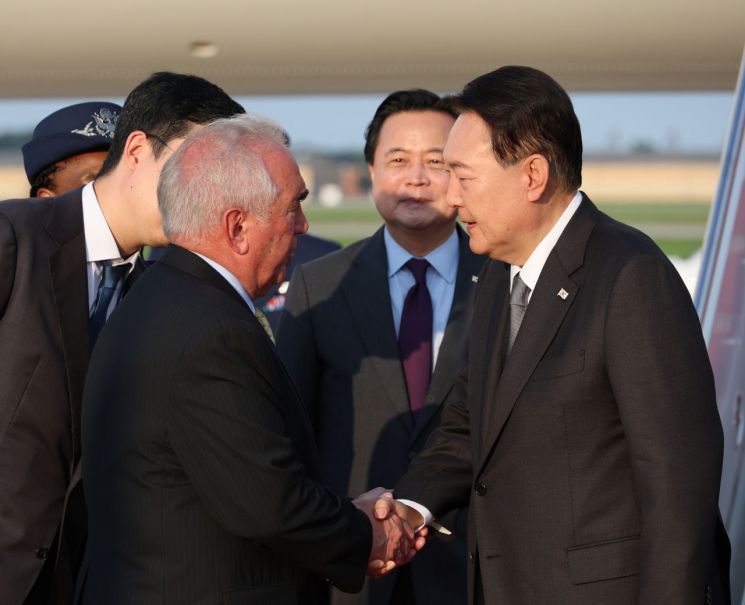 President Yoon Suk-yeol arrived at Andrews Air Force Base near Washington D.C., USA, on the 17th (local time) and greeted the welcoming crowd. Photo by Yonhap News Agency
On the 17th (local time), President Yoon arrived in the United States. Prior to this, he departed to attend the South Korea-U.S.-Japan summit held at Camp David. It is the first time in eight years since a foreign head of state visited Camp David, and the first time in 15 years for a South Korean president since former President Lee Myung-bak in 2008.
The three leaders are expected to adopt two documents: the "Camp David Principles," which contain guidelines for trilateral cooperation, and the "Spirit of Camp David," a joint statement outlining the vision and implementation plans for cooperation.
Camp David, located in Maryland, USA, is the presidential retreat. It covers approximately 5,000 square meters and includes offices and meeting rooms as well as recreational facilities such as a golf course, swimming pool, tennis courts, shooting range, and equestrian facilities. It is classified as a military facility managed by the U.S. Navy, which is why it is called a "camp."
Camp David is recognized as a historic diplomatic site where significant dialogues and agreements have taken place in modern history. In 1943, U.S. President Franklin D. Roosevelt and British Prime Minister Winston Churchill discussed World War II-related matters there. In 1978, U.S. President Jimmy Carter invited Egyptian President Anwar Sadat and Israeli Prime Minister Menachem Begin to mediate peace negotiations, which later resulted in the peace agreement known as the "Camp David Accords."
 On June 26, 2008, the presidential guard is standing in front of Camp David, the presidential retreat facility, where former U.S. President Barack Obama invited world leaders. Photo by AP·Yonhap News
The ruling party anticipates that the South Korea-U.S.-Japan summit will achieve regularization. On the 18th, Yoon Sang-hyun, a member of the People Power Party, said on SBS Radio's "Kim Tae-hyun's Political Show" that this summit "creates an institutional framework for cooperation among the three countries on security cooperation, traditional security, new economic security, advanced technology, climate change, nuclear non-proliferation, and various global issues." He added, "By establishing this institutional cooperation framework, the trilateral cooperation will be institutionalized, regularized, formalized, and stabilized."
He continued, "It is highly likely to follow the Quad model," explaining, "A consultative body among South Korea, the U.S., and Japan will be formed to regularize military exercises for extended deterrence against North Korea's nuclear threat, including information sharing on this, as well as creating consultative bodies on AI issues, cyber, and economic sectors."
However, the opposition expresses concerns that strengthening military cooperation among South Korea, the U.S., and Japan could intensify the confrontation with North Korea, China, and Russia, thereby increasing tensions on the Korean Peninsula. Chinese state media has already criticized the meeting as a "destructive 'mini NATO,'" and North Korea is reportedly preparing various provocations, including ICBM (intercontinental ballistic missile) launches, targeting the South Korea-U.S.-Japan summit or South Korea-U.S. joint military exercises.
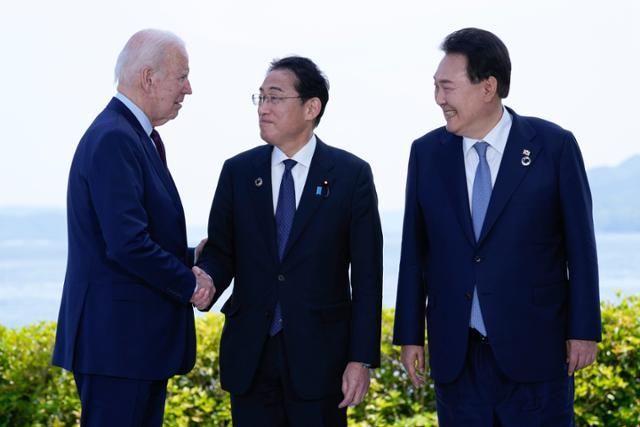 President Yoon Suk-yeol, visiting Japan as a guest country at the G7 Summit, is with U.S. President Joe Biden and Japanese Prime Minister Fumio Kishida ahead of the May South Korea-U.S.-Japan summit. Photo by Yonhap News
There are also criticisms that the tangible benefits for South Korea from the summit are unclear. The U.S. can establish a China containment network centered on Japan within East Asia, secure supply chains, and gain economic and security benefits through arms deals with Taiwan, Japan, and South Korea. Japan, in turn, can pursue its long-standing goal of becoming a military power by securing leadership in the East Asian region in coordination with the U.S.
Kim Kyung-hyup, a member of the Democratic Party of Korea, said on YTN Radio's "News King with Park Ji-hoon" on the 18th, "While cooperating with the U.S. and Japan, we are effectively giving up on forced labor compensation and almost agreeing to the discharge of Fukushima contaminated water." He added, "We are practically losing markets like China and Russia, and instead, strengthening the South Korea-U.S.-Japan framework is reinforcing the North Korea-China-Russia axis, which is actually escalating tensions and insecurity on the Korean Peninsula."
He continued, "We are continuously losing national interests," and said, "We need to clearly recognize this situation and respond accordingly, but it is worrisome that this summit is expected to result mostly in one-sided concessions."
© The Asia Business Daily(www.asiae.co.kr). All rights reserved.



















