Announcement of 3rd Briefing Materials on the Morning of the 18th
Domestic academia has partially produced LK-99 samples and conducted experiments, but has not yet confirmed superconductivity.
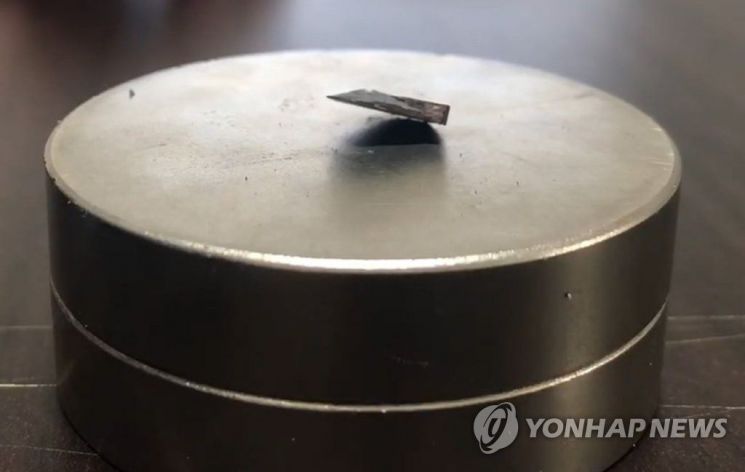
The Korean Society of Superconductivity and Cryogenics announced this on the morning of the 18th through a written briefing by the LK-99 Verification Committee. The society stated, "We have produced some samples containing impurities as well as single crystal samples with minimized impurities according to the LK-99 manufacturing process," but explained, "We are measuring the characteristics of the reproduced samples obtained, and so far, there are no measurement results indicating superconductivity."
After forming the verification committee on the 2nd, the society has been reproducing LK-99 samples according to the manufacturing method disclosed by the Quantum Energy Research Institute on the 22nd of last month to verify whether it is a room-temperature and ambient-pressure superconductor. Although sample production was delayed due to the inability to procure the main material, lead sulfate, on the 11th, Hanyang University High Pressure Research Institute secured it from overseas and provided it to various laboratories, enabling full-scale sample reproduction and experiments. In addition to Hanyang University, a total of seven laboratories including Pusan National University, Sungkyunkwan University, and Kyung Hee University are participating.
Regarding recent media reports stating, "researchers worldwide have attempted to replicate LK-99 but none have succeeded," the society expressed a critical stance. Even if replication of LK-99 is successful, according to the data presented in the paper, it cannot be considered a superconductor. The society said, "Producing samples with the same composition and structure as LK-99 (identical to the Quantum Energy Research Institute samples) does not prove it is a room-temperature superconductor," and added, "Even if domestic researchers produce samples identical to Quantum Energy Research Institute's LK-99 and measure characteristic values matching the experimental results in the paper, the existing position that it is difficult to regard it as a room-temperature superconductor remains unchanged."
The society also commented on the recent LK-99 reproduction results announced by China's Huazhong University of Science and Technology and Germany's Max Planck Institute. The society stated, "Huazhong University of Science and Technology's samples showed abrupt changes in resistance and magnetization similar to the characteristics in the LK-99 paper, but the authors judged the material to be predominantly semiconductor," and "The Max Planck Institute reproduced LK-99 in a nearly impurity-free single crystal form and measured its characteristics but did not find superconducting properties." Regarding the partial revision of the paper by the Quantum Energy Research Institute on the 11th, the society pointed out, "Only theory was added, no new measurement results were included. These measurement results do not prove superconductivity."
© The Asia Business Daily(www.asiae.co.kr). All rights reserved.

















