Analyzing Optical Cable Movement at Micrometer Scale
Helps Early Detection of Earthquake Tsunamis
Research is underway in Japan to measure earthquakes using submarine optical cables, drawing attention both inside and outside the country. It is possible to measure earthquakes by utilizing already installed optical cable facilities in underwater areas where installing seismometers is difficult, and it is expected to greatly aid future earthquake research as it allows for more precise earthquake measurements than land-based seismometers.
On the 18th, Nihon Keizai Shimbun (Nikkei) introduced the "optical fiber sensing" research being conducted at the University of Tokyo. The method measures the reflection of laser light in optical cables buried under the sea, detecting the minute movements of the vibrating cables when an earthquake occurs to measure the earthquake. According to the research team, they can detect the cable’s subtle movements caused by earthquakes down to the micrometer (㎛) scale.
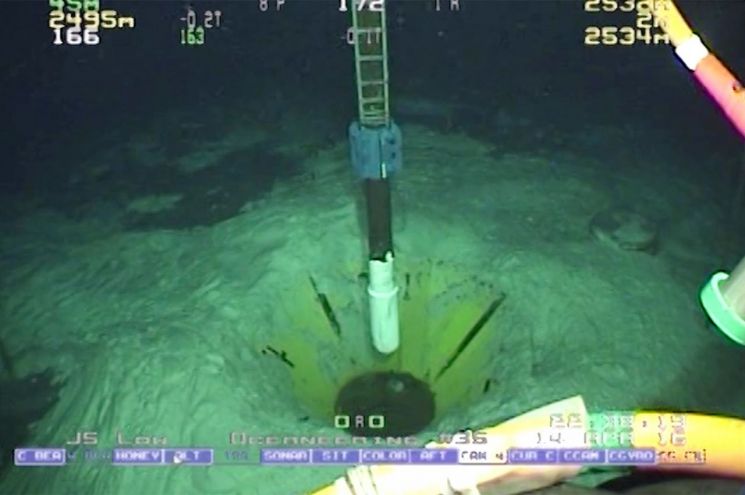 Earthquake observation cable installed in the sea off Tohoku by the Japan Agency for Marine-Earth Science and Technology. (Photo by Japan Agency for Marine-Earth Science and Technology)
By applying this technology, all optical fiber cables laid in the waters near Japan can be used like seismometers. In Japan, although there are already thousands of seismometers on land, installing seismometers underwater is difficult, and observation points are limited depending on the terrain, making research challenging.
Another advantage is that there is no need to install new observation cables since existing optical fibers are used. Considering the cables already laid, Nikkei reported that the places where underwater earthquake data can be collected will increase by thousands of times compared to now.
Professor Masanao Shinohara of the University of Tokyo, who has been researching this method since 2019 off the coast of Iwate Prefecture, stated, "This method helps in the early detection of earthquakes and tsunamis." However, how to process the vast amount of data received daily through optical cables remains a challenge, as the daily data volume reaches several terabytes (TB). Professor Shinohara added, "We plan to further analyze the data using artificial intelligence (AI) and other technologies."
Earthquake prediction technology in Japan is steadily evolving. Hisahiko Kubo, a senior researcher at the Disaster Prevention Science Institute, developed a method using AI to predict shaking and aftershocks when a major earthquake occurs. This is because even earthquakes of the same magnitude cause shaking that varies greatly depending on the location, such as side-to-side or up-and-down movements.
The Disaster Prevention Science Institute trained AI with all past records of each earthquake observation point to enable it to predict shaking when an earthquake occurs. They are also developing techniques to calculate the probability of aftershocks using this method.
Currently, complete earthquake prediction is impossible with existing technology. Nikkei analyzed, "Earthquakes have complex mechanisms, making it difficult to predict them in advance with current technology. Increasing observation points through optical fiber sensing and interpreting large amounts of data with AI will make it easier to clarify earthquake structures and precursor phenomena." They added, "Improving accuracy can help in disaster prevention."
© The Asia Business Daily(www.asiae.co.kr). All rights reserved.

















