Foreign Investors Sell Chinese Stocks and Bonds
Yuan Value Hits 16-Year Low
As concerns over a Chinese economic downturn rise due to the default crisis of Chinese real estate developer Country Garden (Biguoyuan), foreign investors are selling off Chinese stocks and bonds. The value of the yuan against the dollar has fallen to its lowest level in 16 years.
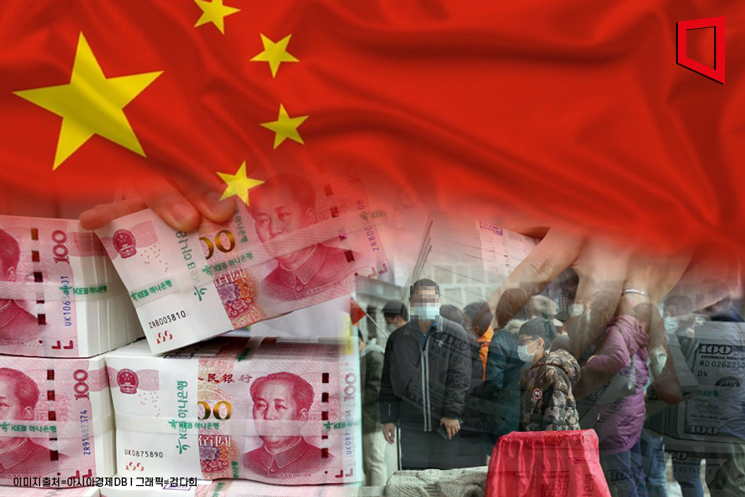
On the 16th (local time), major foreign media outlets, citing the Hong Kong Stock Exchange, reported that overseas investors who had net purchased about 54 billion yuan (approximately 9.88 trillion won) worth of Chinese stocks since the Chinese Communist Party Central Politburo meeting on the 24th of last month have sold almost all of them. After the Communist Party expressed its intention to stimulate the economy at last month’s meeting, foreign investors significantly increased their investments in China, but this month they have turned to selling.
Foreign investors are reducing their investments not only in stocks but also in Chinese bonds. According to Chinese foreign exchange authorities, bonds held by foreign institutional investors decreased by 37 billion yuan (approximately 6.77 trillion won) in July, totaling 3.24 trillion yuan (approximately 592.92 trillion won).
Foreign investors are withdrawing from the Chinese market because the possibility of an economic downturn in China is becoming increasingly apparent. China is facing a comprehensive crisis including a real estate market slump, shrinking domestic demand, declining exports, and a sharp rise in youth unemployment. The consumer price index in July fell by 0.3% year-on-year, raising concerns that China is effectively entering a deflationary phase. Moreover, early this month, Country Garden, one of China’s three major private real estate developers, failed to pay interest on its corporate bonds, spreading fears that the real estate market could collapse.
The Chinese Communist Party has also failed to present clear economic stimulus measures. While there are growing calls in the market for a 'big bang' approach such as large-scale liquidity supply and fiscal spending, the Chinese government has only introduced predictable and limited policies such as interest rate cuts and easing real estate regulations. Above all, the fact that Country Garden is effectively in default raises concerns that the Chinese government’s willingness to rescue real estate developers is weak.
Mohamed Afafhai, head of Asia trading strategy at Citigroup, diagnosed, "The measures taken by the Chinese government so far seem to have disappointed the market," adding, "The lack of decisive policy actions is increasing investors’ dissatisfaction and concerns."
Market pessimism toward Chinese stocks is spreading further. According to a survey conducted earlier this month by Bank of America (BofA) targeting fund managers in the Asia region, 84% of respondents believed that Chinese stocks are in a structural 'de-rating' phase (a decline in price-to-earnings ratios).
The foreign investors’ 'China exodus' is also leading to yuan depreciation. Currently, the yuan is trading around 7.3 yuan per dollar, the lowest level since January 18, 2008 (7.3015 yuan). The market expects the yuan’s value to continue declining.
Nomura Securities in Japan stated in an investor memo the previous day, "Capital outflows from Chinese stock and bond markets will exert additional downward pressure on the yuan," reaffirming that now is the time to bet against the Chinese yuan.
© The Asia Business Daily(www.asiae.co.kr). All rights reserved.

















