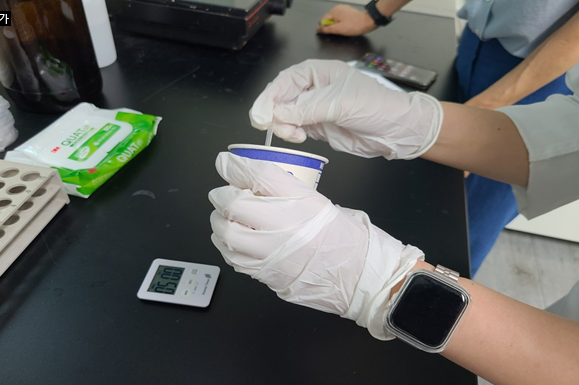
 Some district offices in Seoul have started 'anonymous drug testing' from this month. The photo shows the anonymous drug testing being conducted at the Dongjak-gu Public Health Center. (Photo by Dongjak-gu)
“Have you been exposed to suspected narcotic substances?”
“Has it been more than two weeks since the relevant period?”
“Do you wish to take legal action based on the results of a test conducted at a public health center due to suspicion of drug-related crimes such as date rape drugs or drugged drinks?”
(From the 'Seoul Public Health Center Narcotics Anonymous Test Preliminary Questions')
The ‘Narcotics Anonymous Test’ is being launched one after another at public health centers in 25 autonomous districts across Seoul. This test is a measure introduced by the Seoul Metropolitan Government to alleviate the growing anxiety following the ‘drugged drink’ incident in the academy district and to prevent harm from narcotics exposure. If desired, individuals can receive a free anonymous drug test at public health centers in Seoul.
Dobong-gu, Dongjak-gu, and Dongdaemun-gu public health centers already started the narcotics anonymous test on the 10th of this month, and Gangbuk-gu will begin testing at the Gangbuk-gu Public Health Center from the 21st. Citizens residing in other districts will have to wait a little longer to get tested. The number of testers is not large yet, possibly due to the limited number of districts conducting the test and insufficient promotion. Although the start times vary by each district’s public health center, the Seoul Metropolitan Government explains that they encourage implementation by early next month at the latest.
The narcotics anonymous test screens eligibility through an online preliminary questionnaire (QR code), then confirms exposure to narcotics through a urine test at the public health center. Testers answer about eight preliminary questions and five items excluding personal identification information, such as gender and age group. They then show the final screen and unique number to the public health center staff, receive a urine container, fill it, and submit it to complete the test.
Afterward, the public health center uses a narcotics test kit to test for six types of drugs: marijuana, cocaine, methamphetamine, morphine (opioids), amphetamines, and ecstasy. It takes less than 20 minutes to get the results. Test results are kept confidential in accordance with the Regional Health Act and the Personal Information Protection Act.
If the test result is positive, a more accurate secondary test and treatment cost support are available at Eunpyeong Hospital in Seoul, where specialists provide medical care. If treatment is desired, medical welfare services are also linked. For victims of narcotics crimes who wish to take legal action, connections to investigative agencies or the Sunflower Center are provided upon request.

There are restrictions on who can be tested. Eligible individuals are Seoul citizens who unknowingly ingested narcotics given by others or those who wish to take the anonymous test. Those who wish to take legal action due to narcotics crimes, drug addicts or those undergoing rehabilitation treatment, patients with substance disorders, healthcare workers seeking diagnosis certificates related to their duties, and others are excluded from testing.
A Seoul city official stated, “The purpose of this system is to ensure that victims of narcotics crimes receive prompt treatment and rehabilitation,” adding, “We plan to continue the program while carefully monitoring related projects.”
© The Asia Business Daily(www.asiae.co.kr). All rights reserved.


















