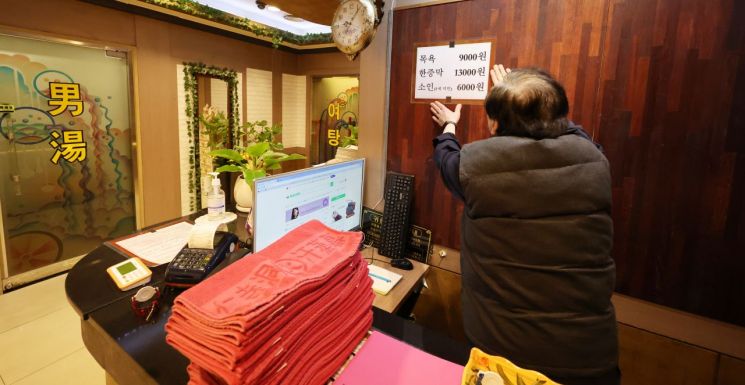
Public bath fees in Seoul are approaching 10,000 won, indicating that the perceived price increase of major services remains high.
According to the Korea Consumer Agency on the 17th, the average bath fee in Seoul last month (adult general public bath, one-time fee) was 9,769 won, a 16.5% increase compared to 8,385 won a year ago. Bath fees in Seoul surpassed the 8,000 won mark in February last year and entered the 9,000 won range in February this year, continuing the upward trend.
The sharp rise in bath fees is largely due to the continuous increase in energy costs such as electricity and gas. According to Statistics Korea, electricity, gas, and water prices rose by 21.1% year-on-year last month, with a price increase contribution (0.71) second only to dining out expenses. During the same period, laundry fees in Seoul averaged 8,846 won, and beauty fees were 21,846 won, rising 9.5% and 7.1% respectively compared to a year ago.
Dining out prices, a key indicator of perceived inflation, are also still soaring. Last month, the cost of eight popular dining items in Seoul increased by 7.2% compared to a year ago. The item with the highest increase over the year was Jajangmyeon (black bean noodles) at 6,915 won, rising 9.7%. This was followed by Samgyetang (ginseng chicken soup) at 16,692 won, up 8.4%, Naengmyeon (cold noodles) at 11,231 won, and Gimbap (Korean rice rolls) at 3,200 won, both up 7.7%. Other items such as Bibimbap (10,385 won) rose 7.5%, 200g of Samgyeopsal (pork belly) (19,150 won) increased 6.0%, Kalguksu (handmade noodle soup) (8,885 won) rose 5.9%, and Kimchi Jjigae set meal (7,846 won) went up 5.6%, all showing upward price trends.
The dining out price index compiled by Statistics Korea was 5.9% last month, showing a slowdown in the rise since April but still exceeding the overall consumer price index (2.3%). The concern is that the trend of rising perceived prices is expected to continue for the time being. This is due to recent increases in international oil and grain prices. Brent crude oil from the North Sea was priced at $83.45 as of the previous day, up 6.3% compared to a month ago, and grain prices have also fluctuated due to Russia’s cancellation of the Black Sea grain agreement.
The upcoming Chuseok holiday, just a month away, is also raising concerns about price increases. Prices of agricultural products mainly consumed during this period have surged recently due to heavy rains and other factors. The Korea Rural Economic Institute forecasted that prices of major fruits such as apples and pears will rise further in conjunction with the Chuseok holiday due to reduced shipment and production volumes.
© The Asia Business Daily(www.asiae.co.kr). All rights reserved.

















