New York University: "Longest Duration Among Pig Kidney Transplant Cases"
A brain-dead patient in his 50s who received a genetically modified pig kidney transplant has been confirmed to have maintained life for over a month.
On the 16th (local time), The New York Times (NYT) and others reported that a research team from New York University Langone Medical Center successfully achieved positive results in an experiment transplanting genetically modified pig kidneys.
According to the report, the pig kidney transplanted into a 57-year-old brain-dead male patient on a ventilator has been functioning normally for 32 days as of this day. This is the longest duration recorded in experiments using pig kidneys.
Previously, in an experiment by medical staff at the University of Alabama who first succeeded in transplanting a pig kidney into a brain-dead patient last year, the pig kidney functioned normally for only one week.
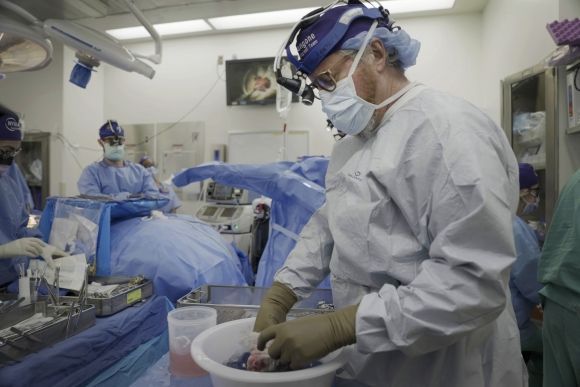 On the 14th of last month, Dr. Robert Montgomery of NYU School of Medicine was preparing for a pig kidney transplant surgery. [Image source=AP Yonhap News]
The research team also added that no rejection caused by the human immune system was observed after the transplant surgery. The New York team is expected to prepare experiments transplanting pig kidneys into general patients rather than brain-dead patients in the future.
Both the University of Alabama and New York University research teams used genetically modified pig kidneys produced by Revivicor, a subsidiary of United Therapeutics. However, unlike the University of Alabama, which modified 10 types of pig genes, New York University differentiated itself by modifying only one gene related to immune system learning.
The world's first 'pig heart' transplant patient dies after 2 months
 In January last year, patient David Bennett (right) is seen taking a commemorative photo with attending physician Bartley Griffith (left) before undergoing a pig heart transplant surgery at the University of Maryland Hospital in Baltimore, Maryland, USA.
 [Image source=AP Yonhap News]
Meanwhile, there was also a case of a genetically modified pig heart transplant. The University of Maryland Medical Center in the United States performed the world's first pig heart transplant on a terminally ill patient in January last year, but he died after rapid health deterioration two months later. An autopsy revealed that the patient had a virus that causes pneumonia in pigs.
It is unclear whether the virus was the direct cause of death. However, since the virus itself could pose a risk not only to the patient but also to the patient's family and medical staff, it has been pointed out that such an incident must not recur.
Meanwhile, advances in transplant research using pig organs are expected to be good news for the many patients waiting for organ donations. In 2021, about 41,000 organ transplant surgeries were performed in the United States. However, with more than 100,000 people on the organ transplant waiting list, this number is far from sufficient. It is reported that thousands of these patients die each year while waiting for organ transplants.
© The Asia Business Daily(www.asiae.co.kr). All rights reserved.


















