China's central bank, the People's Bank of China, took steps to improve fragile financial market sentiment by injecting liquidity into the market on the 16th.
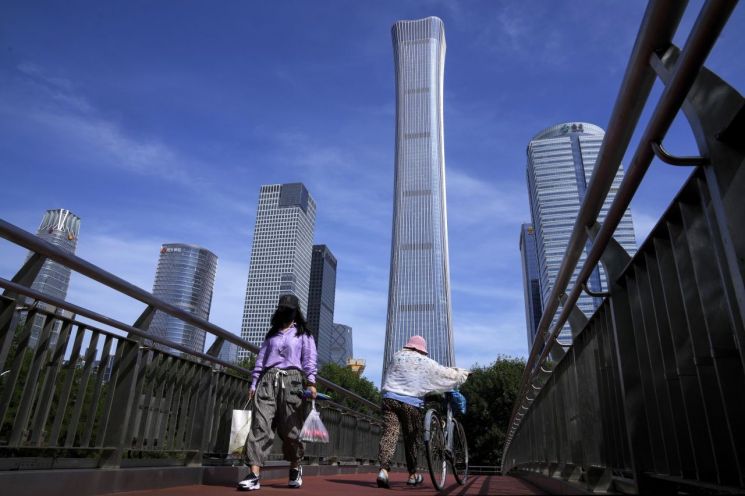 Pedestrians are walking on a pedestrian overpass near office buildings in the central business district of Beijing, China. / Photo by Yonhap News
According to Bloomberg News, the People's Bank of China injected 297 billion yuan (51 trillion won) into the market through a 7-day reverse repurchase agreement (reverse repo) contract on the same day. This followed a 0.1 percentage point cut in the 7-day reverse repo rate the previous day, marking the largest short-term fund supply since February, the news agency reported.
Before supplying liquidity, the People's Bank of China set the dollar-yuan reference exchange rate 783 pips (1 pip = 0.0001) higher than the market average estimate. The news agency described this as the most decisive guidance for yuan traders since October last year.
This move by the People's Bank of China came amid worsening economic conditions in China. Recently, many economic data points, from retail sales to fixed asset investment, have been sluggish, leading to a decline in financial market confidence.
The onshore yuan's value recently fell to its lowest level in 16 years against the dollar, and the Morgan Stanley Capital International (MSCI) China Index has been declining due to the absence of additional stimulus measures expected by the market.
China's major real estate developer Country Garden (Biguoyuan, 碧桂園) is facing default risk. In particular, a subsidiary of Zhongzhi (Zhongzhi) Group, a large financial conglomerate managing a total of 1 trillion yuan (184 trillion won), postponed repayment of maturing products, spreading crisis sentiment about the Chinese economy.
The news agency assessed that the People's Bank of China's unexpected rate cut the previous day failed to restore optimism about the Chinese economy, and investors in the market are waiting for more aggressive support measures. It also added that experts expect additional monetary easing, such as a cut in bank reserve requirements, along with fiscal stimulus from Chinese authorities.
Meanwhile, unlike China, which has eased monetary policy, other countries including the United States are entering a tightening cycle while fighting high inflation. The yuan has depreciated about 5.5% against the dollar since the beginning of the year, falling to the lowest value among Asian currencies.
© The Asia Business Daily(www.asiae.co.kr). All rights reserved.
![From Bar Hostess to Organ Seller to High Society... The Grotesque Con of a "Human Counterfeit" [Slate]](https://cwcontent.asiae.co.kr/asiaresize/183/2026021902243444107_1771435474.jpg)
















