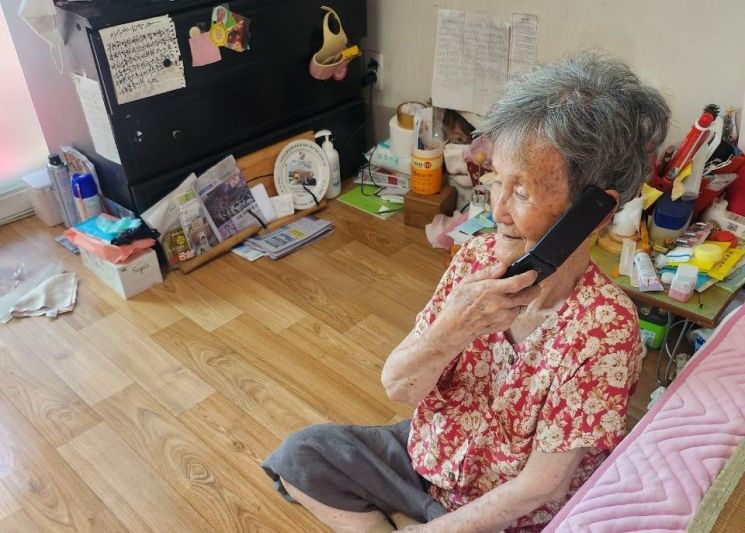
 AI check-in services for middle-aged and elderly single-person households are spreading. (Photo by Yangcheon-gu)
Choi, a man in his 70s living in Sinwol-dong, Yangcheon-gu, Seoul, recently overcame a dangerous crisis. Living alone in a semi-basement room, Choi faced a critical situation in May when his usual cerebrovascular disease reoccurred. What saved him was none other than the district office’s ‘Artificial Intelligence (AI) Check-in Service.’ Yangcheon-gu makes automated calls once a week to AI check-in service recipients to inquire about their exercise, health, meals and medication, and current condition. When they contacted Choi, he responded, “I want to have surgery,” and the officials who received the data from the AI system responded meticulously.
The call content was automatically analyzed through the Check-in System (AI Control Center) and delivered to the Yangcheon-gu office staff and the local community center officials. A visiting nurse from the community center personally visited Choi and supported all procedures including surgery and treatment. Since Choi had no family, his surgery and hospital expenses were covered by the Seoul-type Emergency Welfare Support Service, and hospital accompaniment was provided through the Care SOS Center’s accompaniment support service.
AI Check-in Service to Prevent Solitary Deaths
With the increase in single-person households and aging population, the use of artificial intelligence (AI) in expanding public welfare services is growing. The expansion is rapid, from simple services like responding to civil complaints to customized services for specific groups.
Choi’s case, where a precious life was saved by the AI Check-in Service, is one of the success stories of the ‘Seoul AI Check-in Service’ project introduced by the Seoul Metropolitan Government last year. The AI Check-in Service calls single-person households once a week to check on their well-being via AI phone calls, and when necessary, the local administrative district directly checks and manages the household. SK Telecom was selected as the service provider for most Seoul districts and built the system under the name ‘NUGU Biz Call.’ It was introduced to prevent solitary deaths among vulnerable single-person households, and each district office has a set target number of recipients.
Yangcheon-gu, which started this service in October last year, is actively expanding it by increasing the number of service target households from 200 to 400 by the end of this month, and to 600 by the end of the year. The end of this month is designated as the intensive discovery period for at-risk households. The target group is ‘socially isolated at-risk households,’ with the first priority being single middle-aged and older adults aged 50 and above living in vulnerable housing environments such as semi-basement rooms, rooftop rooms, and goshiwon (small, cheap rooms). Elderly people living alone or households recommended by the community center are also included.
A Yangcheon-gu official explained, “If the recipients do not answer or respond, we call two more times at 10-minute intervals, and if there is still no response, staff immediately rush to the site. If there is no sign of life at the site, there is a manual to coordinate with 119 (emergency services) to break in.” Yangcheon-gu Mayor Lee Gijae said, “We aim to fill blind spots through the intensive discovery period for at-risk households to prevent social isolation and solitary deaths,” and added, “If you know of neighbors in difficulty, please do not hesitate to inform the nearest community center or district office.”
Pilot Project for Behavioral Analysis of People with Developmental Disabilities Using AI
The origin of the check-in service is Gwangjin-gu. Since 1994, Gwangjin-gu has partnered with Korea Yakult to deliver beverages and check on the elderly to prevent solitary deaths. As times have changed, technological advancements and innovations have been made using the Internet of Things (IoT) and AI. Seongdong-gu was recognized for introducing the latest technology in projects such as the AI Check-in Service ‘Good Morning Call’ and was selected in April by the Ministry of the Interior and Safety as one of 17 institutions with the ‘first and best government innovation cases.’
Care services using AI robots have already started several years ago and are becoming widespread. Since 2021, Gwanak-gu has been supporting robots for elderly and disabled people living alone, and Jongno-gu and Seocho-gu have also distributed robots with positive responses. Gangdong-gu selects households with depression among single-person households and supports them with AI robots. These AI robots serve as simple companions, provide medication guidance, and have emergency reporting functions when detecting danger signals.
Some districts are also introducing an ‘AI-based Behavioral Analysis System’ to support families with people with developmental disabilities. Dobong-gu plans to install a developmental disability video system (CCTV) at the Dobong Lifelong Learning Center for Developmental Disabilities by the end of this year and equip it with an AI engine for video database (DB) analysis.
Developmental disabilities, manifested as autism and intellectual disabilities, sometimes involve aggressive tendencies that can lead to self-harm or pose risks to those around them. Seoul Metropolitan Government and Dobong-gu plan to use this system to analyze the behavior of people with developmental disabilities and develop psychological and behavioral treatment plans to alleviate these behaviors. Recently, through a public contest, Seoul selected Dobong-gu and Jongno-gu as pilot districts for introducing this system.
© The Asia Business Daily(www.asiae.co.kr). All rights reserved.

















