Rapid Increase Expected to Reach 700 by Year-End
Consult a Specialist if Malaria Symptoms Appear
Although August has not yet passed, the number of domestic malaria patients, the world's leading cause of death from infectious diseases, has exceeded 500 so far this year. Due to the rapid increase, the number of patients is expected to reach 700 by the end of the year.
According to the Disease Control and Prevention Agency's infectious disease portal on the 15th, the number of domestic malaria patients since January 1st reached a total of 509. This figure far surpasses the 420 cases reported throughout last year. At the current pace, the number is expected to be around 700 by the end of the year.

On an annual basis, the number of domestic malaria patients has not exceeded 700 since 2011 (826 cases). There were only three years when the number surpassed 600: 2014 (638 cases), 2015 (699 cases), and 2016 (673 cases).
After the spread of the novel coronavirus disease (COVID-19) in 2020, the numbers decreased to 385 in 2020, 294 in 2021, and 420 in 2022. However, this year, with most social distancing measures lifted and outdoor activities increasing, malaria cases are surging.
Disease Control and Prevention Agency Issues Nationwide Malaria Alert
 According to the Disease Control and Prevention Agency's infectious disease portal on the 15th, the number of domestic malaria patients since January 1st has reached a total of 509. This figure far exceeds the 420 cases reported throughout last year. At the current trend, the number is expected to be around 700 by the end of the year.
 [Photo by Yonhap News]
On the 3rd, the Disease Control and Prevention Agency issued a nationwide malaria alert after detecting malaria parasite genes in vector mosquitoes collected in the Paju area.
Malaria occurs mainly in tropical regions, with 2 billion people, or 40% of the world's population, living in malaria-endemic areas. Annually, 150 million cases occur, and in Africa alone, over 1 million children under the age of five die each year. Therefore, it is essential to inform your healthcare provider about your travel history when returning from or living in tropical regions to prevent tropical malaria.
Malaria is primarily transmitted by mosquitoes. In South Korea, benign tertian malaria was present until the mid-1970s but disappeared and reemerged from 1993 onward.
Malaria Early Symptoms Include Headache and Loss of Appetite... Followed by Chills and High Fever Within Days
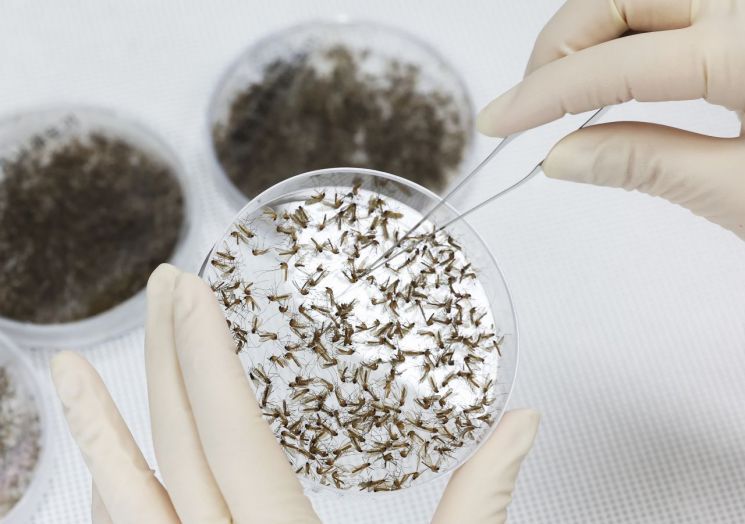
 On the afternoon of May 18, a researcher is demonstrating mosquito classification work at the Gyeonggi-do Institute of Health and Environment in Gwonseon-gu, Suwon-si, Gyeonggi-do. [Image source=Yonhap News]
The malaria occurring domestically is tertian malaria, which presents symptoms similar to a cold every three days. Unlike tropical malaria, which has a higher fatality rate, it has a lower mortality rate but still requires caution.
The typical symptoms of malaria begin with headache and loss of appetite, followed by chills and high fever within a few days. Body temperature rises to 39?41℃, often accompanied by severe chills and shivering. Generally, the tertian malaria prevalent in South Korea shows a pattern of fever one day, no fever the next, and fever again the following day. Tropical malaria often involves continuous or daily fever.
If malaria symptoms appear, it is necessary to consult a specialist and receive treatment. This is because the type of parasite and the region visited affect drug resistance and the medication required. Especially for tropical malaria, using the wrong prophylactic medication based on travel region may result in ineffective prevention. Delayed treatment can also lead to death. Although symptoms can aid diagnosis, it is crucial to obtain an accurate diagnosis through testing.
Meanwhile, domestically occurring malaria cases are geographically concentrated in the northwestern Gyeonggi region around the Seoul metropolitan area and temporally concentrated between June and September.
© The Asia Business Daily(www.asiae.co.kr). All rights reserved.
![Clutching a Stolen Dior Bag, Saying "I Hate Being Poor but Real"... The Grotesque Con of a "Human Knockoff" [Slate]](https://cwcontent.asiae.co.kr/asiaresize/183/2026021902243444107_1771435474.jpg)


















