Usage More Than Twice That of Typical 4-Person Households in Korea
Progressive Rates Applied to Those Exceeding Threshold
Fees Expected to Exceed 290,000 Won as of August This Year
Households that use more than '1000kWh' of electricity in a month are commonly referred to as 'super users.' They consume about twice the amount of electricity compared to the average four-person household in Korea. The domestic electricity tariff system applies a progressive rate, and super users are charged a much higher rate than the existing progressive rates.
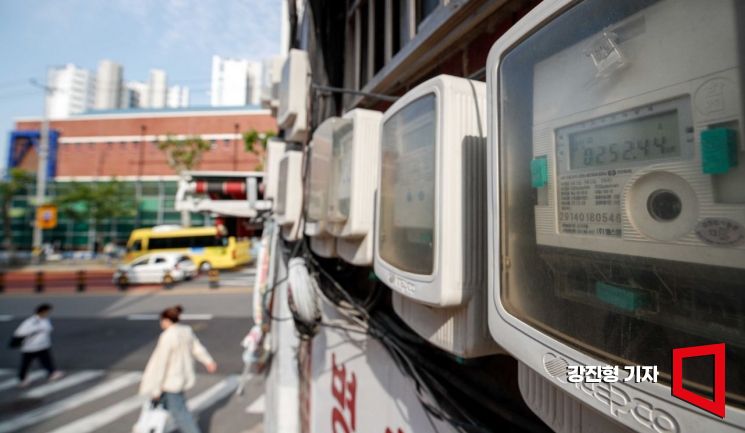 On the 15th, the government announced an adjustment plan to raise the electricity rate by 8 won per kWh starting tomorrow. An electricity meter is installed in a commercial building in Seoul. Photo by Jinhyung Kang aymsdream@
According to the Korea Meteorological Administration and others, this summer has been marked by intense heat. Tropical nights were already observed from June, before the rainy season began, and heatwaves with apparent temperatures around 35 degrees Celsius continued through last month and this month.
Although Typhoon 'Khanun' recently crossed the Korean Peninsula causing a temporary drop in temperature, from this week onward, heatwaves with daytime highs around 31 to 32 degrees Celsius are expected to persist for some time.
Accordingly, electricity demand from households and businesses has also reached record highs. On the afternoon of the 7th, the average power consumption for one hour exceeded 100GW, marking the first time in domestic history that the average hourly total power demand surpassed 100GW.
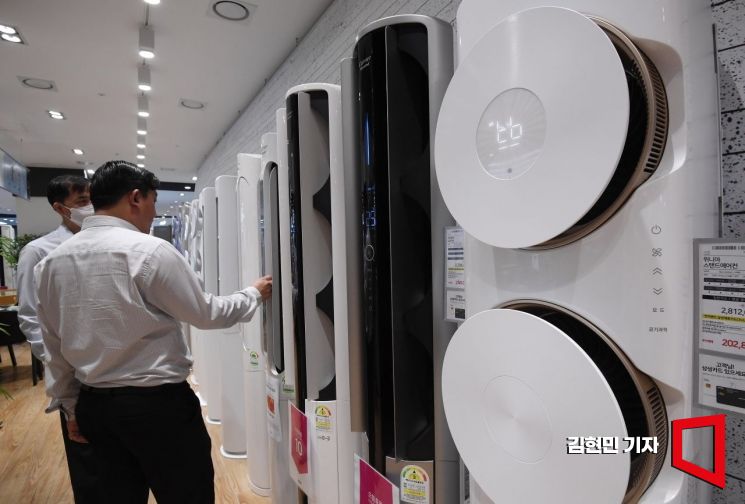 Due to the heatwave, electricity demand surged. The photo shows visitors at an electronics store looking at air conditioners and other cooling appliances.
As a result, concerns about electricity bills among households are deepening. Currently, Korea Electric Power Corporation (KEPCO) applies a progressive rate system to household electricity bills. The current residential electricity rates are divided into three tiers: △ up to 300kWh (120 KRW per kWh, based on residential low voltage), △ 301?450kWh (214.6 KRW), and △ over 450kWh (307.3 KRW).
However, 'super users' who consume more than 1000kWh in a month are generally not subject to the progressive rate system. Instead, they are charged the highest rate of 736.2 KRW per kWh. As of August this year, the electricity bill for a household consuming 1000kWh reaches 293,910 KRW, approaching 300,000 KRW.
Super users consume significantly more electricity than typical domestic households. According to the 2020 'Energy Census' by the Korea Energy Economics Institute, one-person households typically used 316kWh in July and August, two-person households 402kWh, three-person households 412kWh, and four-person households 427kWh. Super users consume more than twice the electricity of a typical four-person household.
The number of super users in Korea varies somewhat depending on the weather but is generally maintained between 10,000 and 40,000 households.
Looking at data from August over the past six years, the number of super user households was 11,975 in 2017, 49,206 in 2018, 17,074 in 2019, 11,502 in 2020, 54,415 in 2021, and 34,834 in 2022.
© The Asia Business Daily(www.asiae.co.kr). All rights reserved.


















