Expansion of V2H and V2G Features Following V2L
EV Companies in the US and Japan Expanding V2X Business
Electric Vehicle Batteries as Cloud Power Grid Resources
Kim Min-seok (pseudonym), who enjoys camping, is seriously considering purchasing an electric vehicle (EV). Every time he sees a fellow camper at the campsite using the EV's V2L (Vehicle to Load) function to power a heater and air conditioner, he can't help but feel envious. Recently, some have even started connecting air fryers to their EVs to enjoy various camping dishes.
Electric vehicles are effectively serving as wheeled energy storage systems (ESS). Recently, more EVs equipped with V2H (Vehicle to Home) functionality, which can supply power to homes during emergencies as well as outdoors, have been introduced. In the long term, it is expected that V2G (Vehicle to Grid), which connects to the power grid, will also develop. EVs will act as a kind of cloud power grid.
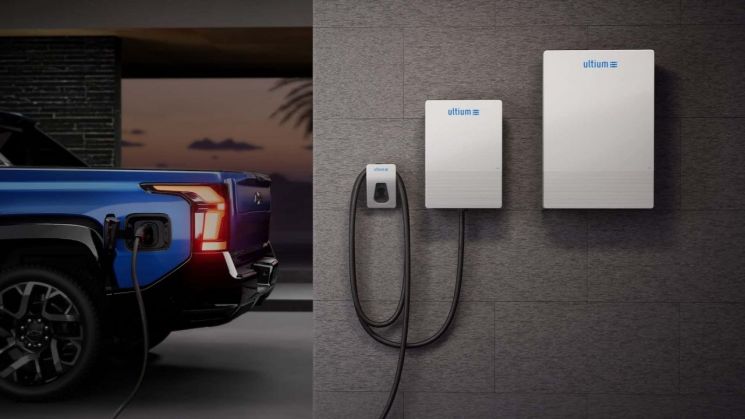
On the 9th of this month (local time), U.S. automaker GM announced that all EVs based on the Ultium platform, starting from 2026 models, will be equipped with V2H functionality. 'Ultium' refers to GM's EV platform, and in South Korea, LG Energy Solution supplies the batteries.
Initially, the company announced that the V2H function would only be applied to the 2024 Chevrolet Silverado EV RST pickup truck, which was recently unveiled. However, now the 2024 GMC Sierra EV Denali Edition 1, 2024 Chevrolet Blazer EV, 2024 Chevrolet Equinox EV, 2024 Cadillac Lyriq, and 2024 Cadillac Escalade IQ will also feature V2H functionality.
Expansion of V2H Adoption by GM, Tesla, and Others
V2H refers to the function of connecting an EV's battery to a home to power lighting and household appliances. It is a step beyond the existing V2L. When an EV is connected to a building, it is called V2B (Vehicle to Building), and when connected to the power grid, it is called V2G (Vehicle to Grid). Collectively, technologies that utilize an EV's battery by connecting it externally are referred to as V2X (Vehicle to Everything).
To use V2H, a separate device capable of bidirectional charging is required. GM Energy Division released a bundled product last month that enables the use of V2H functionality. GM Energy Division was established by GM last year to compete with Tesla and develops and launches energy-related products such as battery packs, solar panels, and EV chargers.
GM views EVs not only as transportation means but also as energy management solutions and is actively targeting this market. Wade Sheffer, Vice President of GM Energy Division, emphasized, "By integrating V2H into all Ultium-based products, consumers will be able to enjoy value beyond the vehicle itself."
Tesla also hinted at the possibility of applying V2H functionality starting in 2025 during its Investor Day event held in March. Drew Baglino, Tesla's Vice President, stated during the Q&A session, "Tesla EVs will be capable of bidirectional charging within the next two years." Bidirectional charging is fundamentally required to support V2X.
Following this, Elon Musk expressed a different opinion, saying, "If you unplug the car from the plug, the house will go dark and people will be inconvenienced," and added, "I don't think many people will want bidirectional charging." However, attendees paid more attention to Baglino's remarks than Musk's.
Competing models have already equipped or plan to equip V2L or V2H functions. Hyundai Motor and Kia support V2L functionality on the E-GMP platform. Rivian has applied V2L functionality compatible with V2H in the future. Ford's F-150 Lightning supports V2L and V2H functions when connected to the 'Ford Charge Station Pro' launched in March.
Japan's Nissan Leaf introduced the V2G service last July, allowing the sale of surplus EV power to the grid, the first of its kind. Although the Nissan Leaf has had V2G functionality since 2013, it was only last year that this function became practically usable.
Lucid also announced plans to equip its vehicles with V2X functionality. Volkswagen plans to apply bidirectional charging functionality to its EVs as well.
Japan Even Provides Subsidies
Japan is the country where V2H in electric vehicles is spreading the fastest.
Japan's EV adoption rate was 0.8% as of 2021, which is low compared to Europe (16.7%), China (15.9%), and North America (5%). To reduce carbon emissions in the transportation sector, Japan provides subsidies for EV-related facilities, including V2H.
According to a report published by the Korea Trade-Investment Promotion Agency (KOTRA) in May, the Japanese government is allocating a budget of 10 billion yen this year to subsidize V2H charging and discharging equipment, external chargers, EV (hybrid vehicle) charging equipment purchase costs, hydrogen station maintenance, and operation costs.
Japanese electronics companies such as Nichicon and Panasonic are actively responding to the V2H market. Nichicon's 'TRIBRID' is a system that stores energy in residential solar power generation, home storage batteries, and EV batteries, and controls the use of power where needed. Nichicon reported 5,000 orders for the TRIBRID storage system last year and expects the number to more than double this year.
KOTRA explained, "With the increase in V2H-compatible EV models and easier subsidy applications, most Japanese EVs in 2023 are designed to support V2H."
Panasonic also launched 'eneplat' in February, combining V2H and storage systems. It connects existing solar power generation systems and home storage batteries to EVs.
A service that allows electricity charged at the workplace to be used at home has also emerged. Sumitomo Corporation established 'Hakobune' in April, providing corporate EV leasing and integrated V2B and V2H services. This method charges EVs during the day using surplus power from solar power systems installed at workplaces and then uses that power at home.
Electricity in One EV Can Power a Home for 10 Days
The reason for overseas interest in V2H is that EVs can be a useful power source during emergencies. When linked with renewable energy sources such as solar power, EV batteries could become a cloud power grid.
In particular, after the Texas cold wave in February 2021 caused power outages for millions of households, the U.S. began to focus on the potential of EVs as ESS. The high-capacity batteries installed in EVs contain enough electricity to power a home for about 10 days.
The Hyundai Ioniq 5 is equipped with a 77.4-kilowatt-hour (kWh) battery. Considering that the average daily electricity consumption per household in Seoul was 7.9 kWh as of January this year, a simple calculation shows that the battery contains enough electricity for 9.7 days of use.
There are obstacles to the spread of V2H. To use V2H functionality at home, a bidirectional charging device is required, which costs several million won. Ford's home integration system launched in March is priced at $3,895 (about 5.13 million won).
Unlike the U.S., where single-family homes are common, South Korea has many apartments and poor parking environments, which may reduce the utility of V2H. Lee Ho, head of the Industry Analysis Office at the Korea Automotive Technology Institute, said, "The automotive usage environment in Korea differs from overseas, so the effectiveness of V2H may be limited domestically," adding, "In the long term, it may be possible to activate V2G functionality in cooperation with power companies."
In May, Korea Electric Power Corporation's Power Research Institute and SK Rent-a-Car signed a V2G demonstration project agreement to utilize EVs as energy storage devices to help balance power demand and supply.
© The Asia Business Daily(www.asiae.co.kr). All rights reserved.

















