U.S. President Joe Biden announced an executive order restricting domestic investment in Chinese advanced technology companies in three sectors: semiconductors, quantum computing, and artificial intelligence (AI). However, there are forecasts that the effect of blocking the inflow of American capital into China will be minimal.
On the 9th (local time), The Wall Street Journal (WSJ) reported that even before the new regulations were announced, some American venture capital (VC) and private equity (PE) firms had already begun slowing down or halting investments in China. According to financial information provider S&P Global, the total amount of U.S. PE and VC investments in China last year was $7.02 billion, a sharp 76% drop compared to the previous year (approximately 38 trillion won). The number of investment deals also shrank by about 40%, from 346 to 208.
WSJ cited the U.S. VC ecosystem as already rapidly decoupling from China, using Sequoia Capital?the American VC that made the most investments in Chinese startups?as an example. Sequoia Capital, a major shareholder of ByteDance, the Chinese company operating the world’s largest video platform TikTok, withdrew from its China business in June shortly after undergoing a national security-related investigation by the U.S. government. WSJ explained that Sequoia Capital’s exit, after investing in about 300 Chinese startups, marked a significant decline in direct U.S. investment in China.
The New York Times (NYT) also noted, "U.S. investment flows into China have dramatically retreated over the past two years," adding, "It is unclear how much funding will be affected by this new measure." According to PitchBook, U.S. VC investments in China fell from a peak of $43.8 billion in Q4 2021 to $10.5 billion in Q2 this year, a reduction to about one-quarter, NYT reported.
The Washington Post (WP) highlighted that the scope of the new measure was significantly narrowed compared to the originally proposed draft. WP reported, "There were months of intense debate over the scope of restrictions on China’s advanced industries," and "The U.S. Treasury and Department of Defense had differing views on whether to narrow or broaden the scope." The debate ultimately led to narrowing the regulatory scope, excluding sectors such as electric vehicle batteries and biotechnology (bio) by the end of last year.
Gabriel Weildow, Managing Director at global consulting firm Teneo, predicted, "Because the scope of the executive order is limited, the direct impact will not be significant." The U.S. think tank Center for a New American Security (CNAS) forecasted that Chinese companies will continue behind-the-scenes lobbying efforts to circumvent the new measures, suggesting the effectiveness of the order will be limited.
However, there are also evaluations that the measure is valuable for tracking capital flows toward China and blocking the transfer of management know-how and technology that accompany investments. WP commented, "Another goal of this executive order is to gain insight into investment flows into advanced technology within China."
It added, "Another key objective, according to officials, is to prevent management-related advice from being provided to Chinese startups," noting that the regulation could effectively block China’s access to U.S. technology and expertise through investment attraction. CNN also cited U.S. government officials emphasizing, "One of the main purposes of the new executive order is to restrict China’s access to intangible assets associated with PE or VC investments."
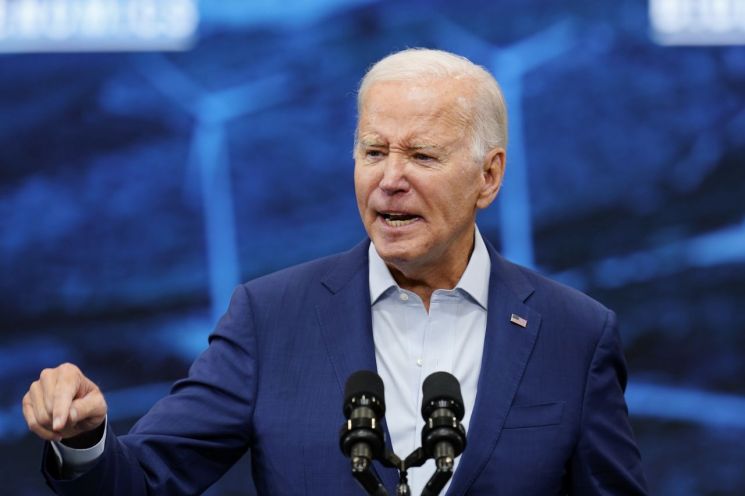
On the same day, President Biden signed an executive order regulating investments by American capital such as private equity and VC in China’s advanced technology sectors as part of a ‘derisking’ effort to protect national security. The order designates China, along with Hong Kong and the Macau Special Administrative Regions, as so-called countries of concern and prohibits direct investment in Chinese companies whose revenue, net profit, investment, or operating expenses in the three sectors?advanced semiconductors, quantum computing, and AI?account for 50% or more of their overall business.
© The Asia Business Daily(www.asiae.co.kr). All rights reserved.

















