Semiconductor Industry Responds to Power Supply Issues, Telecom 3 Companies Take Full Measures to Prevent Communication Disruptions
Flight Routes Canceled Along Typhoon Path
POSCO, Hyundai Steel Also Operating in Emergency Mode
As Typhoon Khanun, the 6th typhoon, passes through the Korean Peninsula on the 10th, the industrial sector is responding by establishing an emergency response system, including controlling production lines and evacuating employees to minimize damage to workplaces.
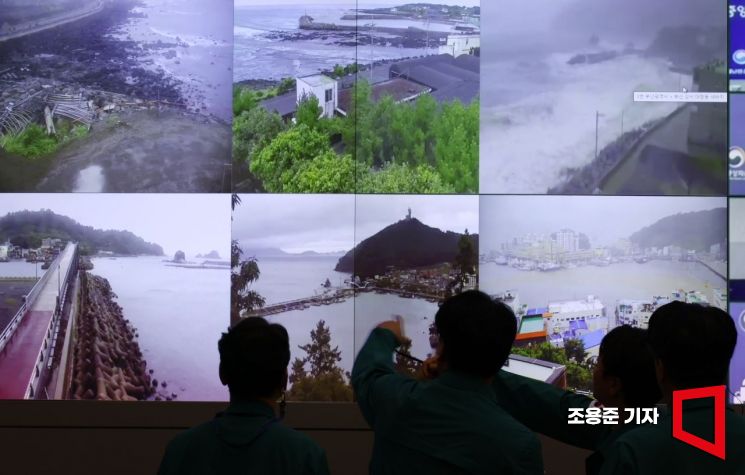 On the morning of the 10th, an official from the Central Disaster and Safety Countermeasures Headquarters is checking the typhoon's path in the situation room inside the Government Seoul Office in Jongno-gu, Seoul. Photo by Jo Yongjun jun21@
Samsung Electronics has halted external and peripheral construction at its semiconductor campus in Pyeongtaek, where expansion work is underway. To prevent wind damage, windbreak forests have also been planted around the factory. SK Hynix has stopped outdoor work and instructed immediate reporting if damage is expected. The company has also announced internally to actively utilize flexible working hours if commuting becomes difficult due to the typhoon. Additionally, ‘vibration isolation pads’ were installed to protect semiconductor equipment sensitive to strong winds.
Given the 24-hour operation nature of semiconductor factories, special attention is being paid to power supply. Samsung Electronics conducted inspections of its Uninterruptible Power Supply (UPS) battery systems, which store power during normal times and supply electricity during emergencies to ensure stable fab (factory) operations. SK Hynix activated a customized power supply system to ensure that if a specific substation supplying electricity encounters problems, power can be supplied from other substations without difficulty.
LG Electronics controlled access to the production line at its LG Smart Park in Changwon, Gyeongnam, from midnight to noon on the same day. Office workers at the Changwon plant also switched to remote work. Commuter buses were not operated. Fortunately, this week coincides with the summer vacation period at the Changwon plant, so there is expected to be little disruption to production volumes. LG Future Park in Gumi and LG Digital Park in Pyeongtaek also implemented recommended leave and remote work at the discretion of organizational leaders. An LG Electronics official said, "We have completed measures to prepare for strong winds through securing, reinforcing, and removing structures within the workplace," adding, "We are fully prepared with inspections of rain gutters and drainage channels, as well as locking various entrances and windows."
Hyundai Motor Company is preparing for the typhoon mainly at its Ulsan plant. To prepare for flooding, 5,000 vehicles were moved to safe zones within the company. Windows inside the factory were secured, and manholes in internal drainage channels were inspected. Debris on building rooftops was cleared to prevent typhoon damage. Drainage conditions were checked, and the operation status of underground drainage pumps within the factory was confirmed. Vulnerable leakage points were identified, and foreign materials around the factory and office buildings were managed.
Airlines have established 24-hour emergency response systems and canceled flights along the typhoon’s path. Korean Air canceled a total of seven international flights, including Busan-Narita and Taipei routes. For domestic flights, 71 flights were canceled, including Gimpo-Jeju, Incheon-Busan, and Busan-Jeju routes. Additional cancellations will be decided based on the typhoon’s movement path beyond the preemptive cancellations.
Telecom 3 Companies Activate Emergency Systems to Prevent Communication Failures; POSCO Completes Pre-Inspection to Prevent Flooding After Hinamnor Damage
The three major telecom companies have entered emergency response mode by operating control rooms to prevent communication failures. SK Telecom decided to operate its response control room until the typhoon’s impact subsides. Not only SKT but also its affiliates SK Broadband and Home & Service are jointly operating an emergency response workforce of about 1,800 people daily. Additional personnel will be organized depending on the typhoon situation.
KT has set up special control rooms at the Gwacheon control center and regional headquarters and is operating an emergency response system. To minimize damage to communication facilities caused by the typhoon and heavy rain, preventive measures against flooding in low-lying areas, capacity expansion of batteries in island regions, and inspections of antennas and other facilities at risk of toppling have been completed. Depending on damage situations, mobile base stations, power generators, and water pumps are ready to be deployed for emergency recovery. Network experts will be assigned to intensive monitoring and quality management of communication facilities.
LG Uplus has established an emergency contact system nationwide and conducted generator inspections. A ‘Comprehensive Disaster Situation Room’ was opened at the Magok headquarters, initiating an emergency work system. Regional disaster situation rooms are also operated in seven areas nationwide to respond to emergencies. Emergency levels will be raised and responses adjusted according to the typhoon’s path.
POSCO, which suffered flooding damage from Typhoon Hinamnor last year, conducted full inspections of waterways and drains, dredging and cleaning, inspection and installation of sewage pumps, replenishment of sandbags to prevent rainwater inflow, and installation of curbs and water-blocking hoses. Additionally, potential risk areas for flooding, collapse, falls, drowning, ground erosion, leakage, and electrical faults were inspected in advance. Hyundai Steel has also established an emergency response system for each workplace across the company and is operating an emergency situation room in preparation for the typhoon.
GS Caltex Yeosu Refinery has entered an emergency work system to prepare for the typhoon. A task force (TF) team composed of environmental and safety personnel was formed to ensure that key plant facilities operate normally and that immediate action can be taken if damage occurs. Inspections and cleaning of drainage channels to remove debris in preparation for heavy rain and strong winds, securing of major equipment, and ship sheltering measures at the pier were carried out.
SK Innovation Ulsan Complex (hereafter Ulsan CLX) secured more steam than usual as a reserve capacity to maintain the temperature required for process operation in response to temperature drops caused by heavy rain and the typhoon. The control room and coordination office are monitoring the site situation 24 hours a day. Roads and drainage channels were inspected, and workers were pre-informed to evacuate to designated locations according to the Ulsan CLX emergency response procedures.
At gas stations nationwide, pre-typhoon inspections were conducted on vulnerable facilities such as aging infrastructure, and movable facilities (such as signboards) were secured to minimize damage. An SK Innovation official stated, "SKIET Jeungpyeong Plant and SK Incheon Petrochemicals are preparing similar safety measures," adding, "We have strongly recommended remote work on the 10th and 11th at all Ulsan business sites, including headquarters."
© The Asia Business Daily(www.asiae.co.kr). All rights reserved.
![Clutching a Stolen Dior Bag, Saying "I Hate Being Poor but Real"... The Grotesque Con of a "Human Knockoff" [Slate]](https://cwcontent.asiae.co.kr/asiaresize/183/2026021902243444107_1771435474.jpg)
















